Updated At: Mar 01, 2026
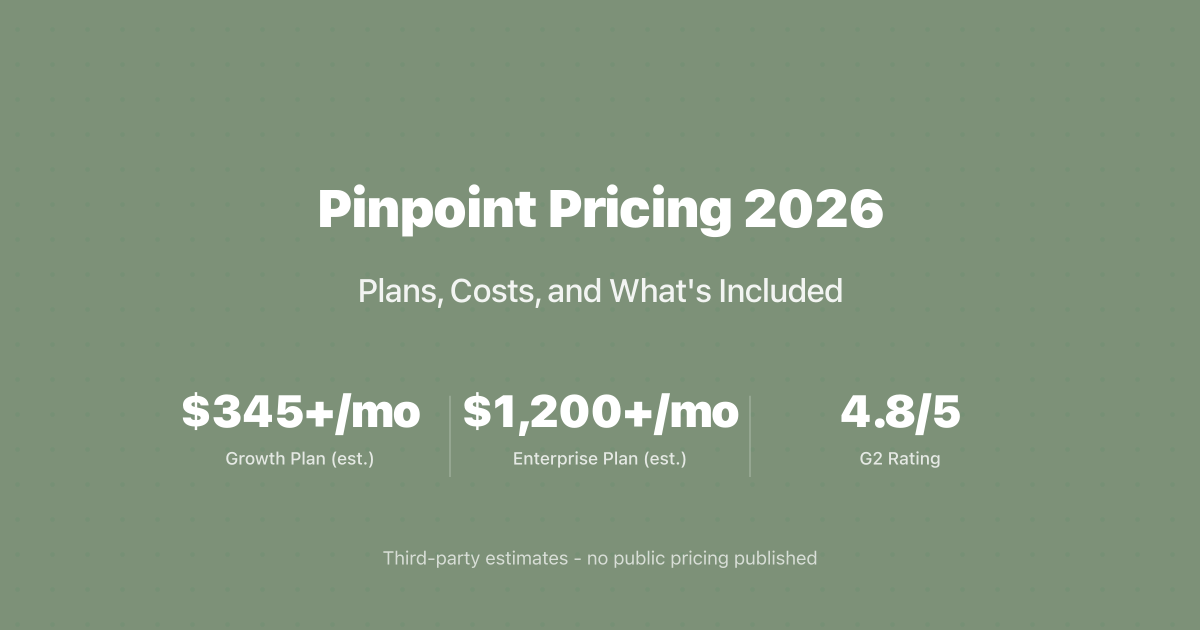
Pinpoint pricing starts at roughly $345/month for its Growth plan (billed annually) and climbs to $1,200/month or more for Enterprise, based on buyer-reported data from SelectSoftware Reviews (2026). There's no public rate card on Pinpoint's website - every quote is custom, based on your company size and hiring volume.
That $345/month starting point puts the platform below Greenhouse and Ashby on the ATS pricing spectrum, but well above budget options like Workable. And because it doesn't charge per seat, teams with large recruiting departments can save significantly versus platforms that bill per recruiter license.
This guide maps out what you'll actually pay in 2026, what each tier includes, where the hidden costs sit, and how the platform stacks up against five alternatives. If you're requesting quotes this quarter, you'll know exactly which questions to ask.
TL;DR: Pinpoint costs $345-$1,200+/mo depending on company size, with annual contracts only and no public pricing (SelectSoftware Reviews, 2026). Implementation is included, but onboarding costs extra. Pin starts at $100/mo with 850M+ profiles and outreach built in.
What Does Pinpoint Actually Cost in 2026?
The company doesn't publish pricing on its website. Instead, pinpointhq.com/pricing routes you to a demo request form. All the numbers below come from third-party sources that aggregate buyer-reported data.
According to SelectSoftware Reviews (2026), Pinpoint's Standard (Growth) plan starts at approximately $345/month on annual billing. Enterprise starts at around $1,200/month. PeopleOpsClub (2026) places the Growth range at $600-$800/month for companies with 100-250 employees, and Enterprise at $900-$1,200/month for 250-1,000+ employees. SelectHub (2026) cites a $7,200/year baseline.
The wide range across sources reflects the custom-quote model. Your actual cost depends on company size, hiring volume, and how well you negotiate. Here's what the third-party data points to:

A few things to know about how Pinpoint charges:
- No per-seat pricing. The platform scales by company size and hiring volume, not by the number of recruiters. You get unlimited team members on every plan.
- Annual contracts only. There's no month-to-month option. You're committing to at least 12 months upfront.
- No free tier or trial. You can't test the platform before buying. The only way in is through a sales demo and contract.
- Implementation is included. Career site setup, data migration, integrations, and team training are bundled into the subscription - no separate implementation fee.
That unlimited-seats model is the platform's strongest pricing advantage. A company with 8 recruiters would pay the same as one with 3, assuming the same company size tier. On a per-seat platform like Greenhouse, adding 5 more recruiter licenses can add $5,000-$10,000+ to your annual bill. If you're scaling your TA team, run the per-seat math on competing platforms before comparing to the flat rate.
What Do Pinpoint's Growth and Enterprise Plans Include?
The platform doesn't publish a detailed feature-by-tier breakdown. Based on Pinpoint's features page and buyer reviews on G2 (4.8/5 rating, 2026) and Capterra (4.7/5, 69 reviews), here's what each tier covers:
| Feature | Growth (Standard) | Enterprise |
|---|---|---|
| Branded Career Site | ✅ | ✅ |
| Unlimited Jobs | ✅ | ✅ |
| Unlimited Team Members | ✅ | ✅ |
| Pipeline Management (Kanban) | ✅ | ✅ |
| Job Board Distribution | ✅ | ✅ |
| Interview Scheduling | ✅ | ✅ |
| Candidate Scorecards | ✅ | ✅ |
| Employee Referral Portal | ✅ | ✅ |
| Talent Pool Management | ✅ | ✅ |
| 400+ Integrations | ✅ | ✅ |
| Analytics | ✅ Basic | ✅ Advanced + Custom |
| Blind Screening | ❌ | ✅ |
| AI Hiring Copilot | ❌ | ✅ |
| AI Candidate Match Score | ❌ | ✅ |
| API Access | ❌ | ✅ |
| Multilingual Experience | ❌ | ✅ |
| Multi-Brand Support | ❌ | ✅ |
| Agency Portal | ❌ | ✅ |
| Dedicated CSM | ❌ | ✅ |
| Role-Based Permissions | ❌ | ✅ |
| Configurable Workflows | ❌ | ✅ |
| Employee Onboarding | Paid add-on | Paid add-on |
The Growth plan is a competent mid-market ATS. It covers the full hiring workflow from job posting through offer. You get a branded career site, automated job board distribution to LinkedIn, Indeed, Glassdoor, and Google Jobs, plus interview scheduling with calendar sync. For a team running standard hiring processes, the Growth tier handles it well.
Enterprise is where the differentiators show up. Blind screening removes identifying information from applications to reduce bias. The AI Hiring Copilot assists with candidate evaluation, and AI Match Scores rank applicants by fit. Multilingual support covers 50+ countries, which matters if you're hiring internationally. Does your team need those enterprise features right now, or will the Growth plan cover your hiring process for the next 12-18 months?
Which Plan Should You Pick?
If you're a company under 100 employees with straightforward hiring workflows, Growth covers the essentials. Branded career site, Kanban pipelines, interview scheduling, and 400+ integrations handle a standard recruiting process without overpaying for features you won't touch.
Growing companies between 100-500 employees need to evaluate carefully. If you hire internationally, require blind screening for DEI compliance, or need API access for custom integrations, Enterprise is likely mandatory. But that's a 2-3x price jump. Get quotes for both tiers and compare feature-by-feature against your actual requirements before signing.
Enterprise makes sense for organizations over 500 employees that need dedicated support, advanced analytics, and multi-brand career sites. At this scale, Pinpoint competes directly with Greenhouse and Lever - and typically costs less than both. Run a total-cost-of-ownership comparison including implementation fees (which Pinpoint includes and Greenhouse charges separately) before making a final decision.
What Hidden Costs Should You Watch For?
The platform bundles more into its base subscription than most ATS competitors. Implementation, unlimited seats, and job board distribution are all included. But a few costs sit outside the base price.
1. Employee Onboarding Module
The onboarding module is sold as a separate add-on, not bundled with either plan. If you assumed a full hire-to-onboard workflow was included at $345/mo, it's not. Multiple third-party sources confirm onboarding is priced separately, though the add-on cost isn't disclosed publicly. Ask for onboarding pricing during your initial demo to avoid surprises.
2. Annual Contract Lock-In
There's no monthly billing option. You're signing a 12-month contract minimum. SelectHub (2026) flags this directly: "Pinpoint ATS forces users into annual contracts, which may not be ideal for all businesses, especially those with fluctuating hiring needs." If your hiring volume is seasonal or unpredictable, that commitment carries risk.
3. No Free Trial
You can't test the platform before committing financially. The only entry point is a sales demo followed by a contract. Competitors like Workable offer free trials, and some platforms offer free tiers. With Pinpoint, you're buying based on the demo experience alone.
4. API Access Is Enterprise-Only
If your team needs custom integrations beyond the 400+ pre-built connectors, you'll need the Enterprise plan. Growth customers don't get API access. For teams with custom internal tools or specific data pipeline requirements, this could push you into the higher tier earlier than planned.
Here's what's unusual about the cost structure: the gap between Growth and Enterprise isn't just features - it's roughly 2-3x the price. A team on Growth at $600/mo ($7,200/yr) that needs blind screening or API access jumps to $1,200/mo ($14,400/yr). That's a 100% price increase for adding a handful of features. Before signing Growth, confirm exactly which Enterprise features you'll need within the next year. It's cheaper to negotiate Enterprise upfront than to upgrade mid-contract.
How Does Pinpoint Compare to 5 ATS Alternatives?
Pinpoint occupies a mid-market position: cheaper than Greenhouse and Ashby at comparable company sizes, but more expensive than budget-tier platforms. Here's how it stacks up against five platforms that recruiting teams commonly evaluate alongside it.

| Platform | Starting Price | Free Tier | Contract Minimum | Pricing Model |
|---|---|---|---|---|
| Pin | $100/mo | ✅ Free (no credit card) | 3 months | Per plan |
| Workable | $149/mo | ❌ | Month-to-month available | Per plan tier |
| Pinpoint | ~$345/mo | ❌ | Annual | Company size |
| Ashby | $400/mo | ❌ | Annual | Per employee |
| Greenhouse | ~$425/mo | ❌ | Annual | Per seat |
| Lever | ~$500/mo | ❌ | Annual | Custom quote |
Pin
Pin takes a fundamentally different approach. Instead of applicant tracking, Pin focuses on AI-powered candidate sourcing and outreach automation. It scans 850M+ candidate profiles with 100% coverage in North America and Europe, sends multi-channel outreach (email, LinkedIn, SMS) with a 48% response rate, and handles interview scheduling automatically. Plans start at $100/mo with a free tier that requires no credit card.
Pin users report measurable ROI quickly. As Rich Rosen, Executive Recruiter at Cornerstone Search, puts it: "Absolutely Money maker for Recruiters... in 6 months I can directly attribute over $250k in revenue to Pin."
If your bottleneck is finding candidates rather than tracking applications, Pin addresses the sourcing gap that traditional ATS platforms don't cover. It handles sourcing, outreach, and scheduling in one workflow - see how it works.
Workable
Workable offers the most transparent pricing in this group. The Starter plan costs $149/mo for up to 20 employees. Standard runs $360/mo, and Premier hits $599/mo. Month-to-month billing is available, which is unusual for ATS platforms. Good for small teams that want to start quickly without a demo-first sales process, though add-ons for AI features, video interviews, and SMS inflate the real cost.
Ashby
Ashby starts at $400/mo for its Foundations plan (under 100 employees) and scales to $120,000+/yr for enterprise organizations. It bundles ATS, CRM, and analytics into one platform. The per-employee pricing model means costs grow with headcount, not just recruiter seats. Good for analytics-focused teams, but the learning curve is steep and email lookups are capped at 200/month on the base tier. See our full Ashby pricing breakdown for details.
Greenhouse
Greenhouse is the incumbent enterprise ATS. Median contracts run around $12,250/yr according to Vendr (2026), with enterprise deals reaching $70,000+/yr. Per-seat pricing means every additional recruiter adds to the bill. Strong for structured hiring methodology, but implementation fees are separate and the platform requires significant configuration upfront. Read our Greenhouse pricing guide for full details.
Lever
Lever (now Employ) combines ATS and CRM functionality with a median annual contract around $12,240/yr (Vendr, 2026). Enterprise pricing reaches $36,000-$72,000/yr. The CRM features are strong, but the pricing is fully opaque and cost at scale is high. Good for teams that already invest heavily in nurturing passive candidates through CRM workflows, though limited in outreach automation compared to dedicated sourcing platforms.
Key Takeaway From the Comparison
Pinpoint sits in the middle of the pricing spectrum. It's significantly cheaper than Greenhouse and Lever at mid-market scale, roughly on par with Ashby, and more expensive than Workable and Pin. The unlimited-seats model gives Pinpoint an edge for large recruiting teams, but the annual contract lock-in and lack of a free trial make it harder to evaluate upfront. Teams that prioritize candidate sourcing over applicant tracking will find more value in platforms that include AI-powered search and outreach automation at a lower price point.
What Do Users Say About Pinpoint?
Across major review platforms, the ATS consistently scores above 4.5/5. Here's the breakdown from G2, Capterra, and GetApp (2026):
- G2: 4.8/5 overall rating
- Capterra: 4.7/5 overall, 4.7/5 value-for-money (69 reviews)
- GetApp: 4.7/5 overall, 4.8/5 ease of use (80 reviews)
The most common positive feedback centers on candidate experience quality and customer support responsiveness. The career site builder consistently gets praised for producing branded, polished job listing pages that look better than most competitor defaults. Support response times are generally fast, though some reviewers note variability during peak periods.
Negative feedback clusters around a few themes. Several users flag the annual contract as inflexible for companies with variable hiring needs. Others note that setup requires meaningful time investment despite implementation being included. And some reviewers mention that frequent platform updates occasionally disrupt established workflows - a trade-off of using a product that ships frequently.
The review data suggests the platform delivers strong value for teams that prioritize the candidate-facing experience. If your employer brand depends on polished job pages and smooth application flows, Pinpoint's career site builder is among the best in the mid-market ATS category. But if your primary pain point is finding candidates rather than managing them, those career site features won't address your core bottleneck.
What Are Pinpoint's Biggest Limitations?
The platform holds a 4.8/5 rating on G2 (2026) and 4.7/5 on Capterra (69 reviews), so most users rate it positively. But recurring feedback across review platforms points to specific gaps.
No Built-In Sourcing
Pinpoint is an applicant tracking system - it manages candidates who apply or are added manually. The platform doesn't proactively search for candidates, scrape profiles, or automate outbound sourcing. If your team needs to find passive candidates at scale, you'll need a separate sourcing tool alongside Pinpoint. That's an additional subscription on top of your ATS spend.
No Outreach Automation
While the ATS handles email templates and basic candidate communication, it doesn't offer multi-channel outreach sequences (email + LinkedIn + SMS) with automated follow-ups. Teams running proactive recruiting campaigns need a dedicated outreach platform alongside the ATS. Compare that to solutions like AI recruiting tools that combine sourcing and outreach in one workflow.
Annual Contracts Only
No monthly billing option exists. For startups testing an ATS for the first time, or companies with seasonal hiring patterns, committing to 12 months without a trial carries risk. Most competitors at similar price points also require annual commitments, but platforms like Workable offer monthly billing as an alternative. Our best recruiting software comparison breaks down which tools offer month-to-month flexibility.
Limited Public Information
The website reveals very little about pricing, feature differences between tiers, or comparison data. The sales-demo-first model slows down evaluation. Teams comparing multiple ATS platforms simultaneously will find Pinpoint harder to evaluate upfront than competitors with published pricing pages.
Onboarding Costs Extra
The employee onboarding module isn't included with either plan. If you want a hire-through-onboard workflow in a single platform, budget for the add-on cost on top of your ATS subscription. The add-on cost isn't publicly disclosed - ask during your demo.
Is Pinpoint Worth the Price?
According to Capterra reviewers (2026), Pinpoint earns a 4.7/5 for value-for-money across 69 reviews. One reviewer noted Pinpoint was "half the cost" of Greenhouse for comparable features. That's consistent with the pricing data: a mid-size company paying $7,200-$9,600/yr for Pinpoint would pay $12,000-$25,000/yr or more for Greenhouse at similar scale.
Pinpoint delivers strong value in a few specific scenarios:
- Large recruiting teams. The unlimited-seats model means you're not penalized for adding recruiters. A team with 10 recruiters pays the same as a team with 3.
- Employer branding focus. The branded career site builder and candidate experience tools are well-reviewed. If attracting inbound applicants is your primary strategy, the career site quality matters.
- Bias reduction. Enterprise-tier blind screening removes identifying information from applications. For companies with DEI-focused hiring mandates, that feature alone can justify the upgrade.
- International hiring. Multilingual candidate experience across 50+ countries is an Enterprise feature that few mid-market ATS platforms offer.
The platform is weaker in scenarios where you need proactive sourcing. It tracks applicants but doesn't find them. If your team spends significant time sourcing passive candidates, you'll pay for Pinpoint plus a separate sourcing tool - adding $5,000-$15,000/yr to your total recruiting tech spend. A platform that combines sourcing, outreach, and applicant tracking in one workflow reduces that tool sprawl and lowers total cost of ownership.
The bottom line: the platform delivers solid value as a standalone ATS for in-house teams that rely primarily on inbound applicants. The unlimited-seats model, included implementation, and strong candidate experience tools justify the $7,200-$14,400/yr range for most mid-market organizations. But if your team's biggest challenge is finding qualified candidates - not managing the ones who apply - the value equation shifts toward platforms that include AI-powered sourcing in the base price.
For recruiting teams that prioritize finding candidates over managing applications, Pin's AI sourcing starts at $100/mo with 850M+ profiles, automated outreach, and interview scheduling included.
Who Is Pinpoint Built For?
Pinpoint was founded in 2017 in the UK by Tom Hacquoil and grew to 500+ customers across the US and UK before raising its first outside capital - a $21M round from Expedition Growth Capital in March 2023. That five-year bootstrapped period shaped the platform's focus: in-house talent acquisition teams at mid-market companies with complex, multi-type hiring needs.
The platform isn't built for staffing agencies or recruiting firms. It's designed for internal TA teams that need a polished candidate experience, structured hiring workflows, and compliance-friendly features like blind screening. The 400+ integrations connect to HRIS platforms like BambooHR, HiBob, and Gusto, reinforcing the in-house team use case.
If you're an in-house recruiter evaluating Pinpoint, the platform fits well when:
- Your primary hiring challenge is managing inbound applicants, not sourcing passive candidates
- Employer branding and career site quality are strategic priorities
- You hire across multiple regions and need multilingual candidate experiences
- Your company has DEI commitments that require blind screening capabilities
If your team spends more time finding candidates than managing applications, an ATS alone won't solve your biggest problem. You'd need Pinpoint plus a dedicated sourcing tool - two subscriptions, two workflows, two platforms to maintain. That's where all-in-one platforms that combine sourcing, outreach, and scheduling offer a simpler alternative.
How to Negotiate a Better Pinpoint Contract
Since every contract is custom-quoted, there's room to negotiate. Based on patterns from third-party buyer data and ATS procurement best practices, here's how to get a better deal.
1. Get Competitive Quotes First
Request pricing from Greenhouse, Ashby, and Workable before your Pinpoint demo. Bring those numbers to the conversation. Sales teams at quote-based platforms routinely match or beat competitor pricing when pressed.
2. Ask About Multi-Year Discounts
Annual commitments are the minimum. A 2-year or 3-year deal often unlocks 10-20% savings. Weigh the discount against the lock-in risk, especially if you're a growing company whose needs may shift.
3. Negotiate Onboarding Into the Base Price
The onboarding module is a paid add-on. But during initial contract negotiation, there's often flexibility to bundle it. Ask explicitly: "Can onboarding be included at the quoted price?" The worst answer is no.
4. Lock In a Growth Buffer
The pricing scales by company size. If you're growing, negotiate a headcount buffer that prevents tier jumps mid-contract. Get written confirmation of the headcount threshold that would trigger a price adjustment.
5. Time Your Purchase
End of quarter (March, June, September, December) is typically when sales teams are most flexible on pricing. If your timeline is flexible, align your purchase with Pinpoint's sales cycle.
6. Request a Headcount-Based Price Lock
Since the platform scales by company size, fast-growing companies can see cost increases mid-contract or at renewal. Ask for a pricing guarantee that locks in your rate for a specific headcount range - for example, "same price up to 300 employees." This prevents tier jumps from catching you off guard at renewal time.
7. Compare Total Cost of Ownership
Don't compare sticker prices alone. Factor in implementation costs (free with this platform, $5,000-$15,000+ with Greenhouse), per-seat charges (none here, $1,000-$2,000/seat/yr with some competitors), and add-on costs (onboarding module, API access). A platform with a lower monthly price might cost more in total when you add up all the line items. Build a 12-month TCO spreadsheet comparing 3-4 platforms before making your final decision.
Frequently Asked Questions
How much does Pinpoint ATS cost per month?
There's no published rate card. Third-party sources estimate $345-$800/month for the Growth plan and $900-$1,200/month for Enterprise, based on company size and hiring volume (SelectSoftware Reviews, 2026). All contracts are annual.
Does Pinpoint offer a free trial or free tier?
No. The platform requires a sales demo and annual contract to get started. There's no free trial, free tier, or self-serve signup. For teams that want to test before committing, platforms like Pin and Workable offer free tiers or free trials.
What's the cheapest ATS alternative to Pinpoint?
Among full-featured platforms, Pin starts at $100/mo with a free tier, and Workable starts at $149/mo with month-to-month billing. Both offer lower entry points than Pinpoint's estimated $345/mo minimum. See our best recruiting software comparison for a broader look.
Does Pinpoint charge per user or per seat?
No. All plans include unlimited team members. Pricing scales by company size and hiring volume, not recruiter headcount. This is a meaningful advantage over per-seat platforms like Greenhouse, where each recruiter license adds to the annual cost.
Is Pinpoint good for recruiting agencies?
The Enterprise plan includes a recruitment agency portal. The Growth plan does not. Agency-specific features like multi-client management and agency collaboration tools require the higher tier. Agencies focused on sourcing and outreach rather than applicant tracking may find dedicated agency platforms more cost-effective.