Updated At: Apr 1, 2026
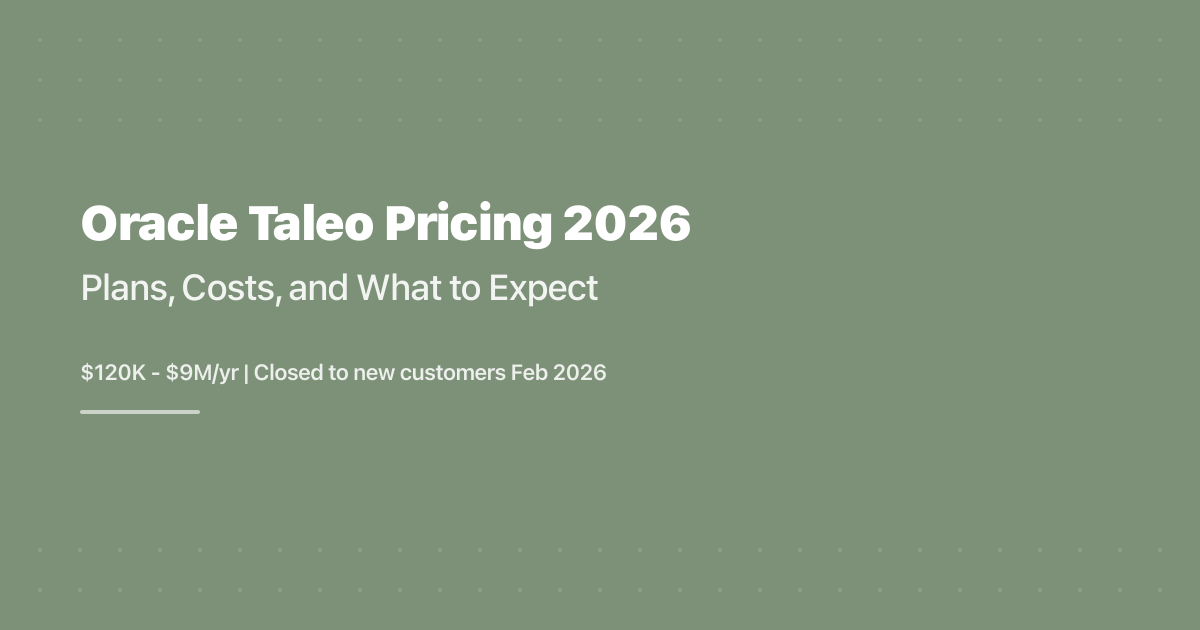
Oracle Taleo costs roughly $120,000 per year for a 200-employee company and scales to $9 million or more at the enterprise level (25,000+ employees), based on third-party TCO estimates from SupportFinity (2025). Oracle doesn't publish Taleo pricing publicly - every quote requires a sales call.
But here's the bigger issue: as of February 1, 2026, Oracle's official global price list confirms that all Taleo Enterprise and Taleo Midsize (formerly Taleo Business Edition) offerings are no longer available to new customers. Existing customers can expand their subscriptions, but net-new buyers must purchase Oracle Recruiting Cloud, which is bundled inside Oracle Fusion Cloud HCM. That changes the calculus for anyone currently evaluating enterprise ATS platforms.
This guide covers what existing Taleo customers are paying today, the hidden costs that surface after implementation, how Taleo compares to other enterprise ATS platforms on total cost of ownership, and what alternatives make sense for teams that need recruiting capabilities without a seven-figure HCM commitment. If you're approaching a Taleo renewal or evaluating a migration, this is the cost picture you need. For broader comparisons across all ATS categories, see our guide to the best applicant tracking systems in 2026.
TL;DR: Oracle Taleo costs $120K-$9M/yr depending on company size, with implementations running 6-12 months. As of February 2026, Taleo is closed to new customers - Oracle now directs buyers to Oracle Recruiting Cloud inside Fusion HCM. Five-year TCO at 1,000 employees reaches ~$1.7M (SupportFinity, 2025). For teams focused on sourcing and outreach, AI tools like Pin start at $100/mo with 850M+ profiles.
How Much Does Oracle Taleo Cost in 2026?
Oracle has never published list prices for Taleo. Every deal is custom-quoted based on employee count, modules, contract length, and your existing Oracle relationship. Third-party procurement advisors and TCO analysts have pieced together the following cost ranges, which represent the most reliable estimates available.
According to SupportFinity's enterprise recruiting software analysis (2025), first-year all-in costs (software plus implementation) break down by company size:

On a per-user basis, third-party review sites like ITQlick (2025) and Capterra (2026) place Taleo in the $20-$40 per user per month range. But per-user pricing tells a misleading story with Taleo, because Oracle bills by headcount rather than active users. You're paying for every employee on the roster, not just the recruiters who log in.
That headcount billing model creates a cost trap that isn't obvious during the sales process. A 5,000-employee company with a 10-person recruiting team is paying based on all 5,000 employees, not the 10 people who actually touch the ATS daily. Compare that to tools that charge per recruiter seat, and the effective cost per actual user can be 50-100x higher than the per-user rate suggests.
What Are Taleo's Two Editions?
Taleo historically shipped in two editions, each targeting a different market segment. As of February 2026, neither is available to new customers, per Oracle's official global price list. Understanding the distinction still matters if you're an existing customer evaluating what you're paying for - or if you're inheriting a Taleo contract through an acquisition.
Taleo Enterprise Edition (TEE)
Built for large global organizations with 10,000+ employees. Enterprise Edition includes recruiting, onboarding, performance management, compensation, and learning management. It supports multi-language and multi-currency deployments, OFCCP/EEO compliance workflows, and 200+ certified partner integrations with LinkedIn, job boards, and background check vendors.
The architecture is the tell. TEE runs on SOAP/WSDL-based integrations - a legacy approach that typically requires middleware or Oracle Integration Cloud to connect with modern HR systems. That middleware layer adds cost and complexity that doesn't show up in the initial quote.
Taleo Business Edition (TBE)
Designed for mid-market organizations under roughly 2,500 employees. TBE covers the same functional areas - recruit, onboard, perform, learn - but with lighter configuration options and a REST-based API that's simpler to integrate. Oracle also offered an upgraded tier called "Business Edition with Talent Management" that added performance assessments, continuous feedback, and succession planning.
TBE contracts were generally smaller, but the per-user cost was often comparable to Enterprise Edition. The main savings came from simpler implementation and fewer customization requirements.
What Hidden Costs Inflate Taleo's Total Price?
The license fee is where Taleo's costs start, not where they end. According to SupportFinity (2025), premium support alone can reach up to 22% of your annual license cost. Stack that on top of implementation, consulting, and integration expenses, and the true cost often doubles the initial quote.
Here's what buyers report paying beyond the base license:
| Cost Category | Typical Range | Notes |
|---|---|---|
| Implementation | $50,000-$500,000+ | 6-12 months; among the longest in the ATS category |
| Premium Support | Up to 22% of annual license | Standard support is included; premium is separate |
| Systems Integrator (SI) Fees | Often equals or exceeds license cost | Required for complex configurations |
| Middleware/Integration | $25,000-$100,000+/yr | Oracle Integration Cloud or third-party middleware |
| Third-Party BI/Reporting | $10,000-$50,000/yr | Users frequently cite inadequate built-in reporting |
| Training & Change Management | $15,000-$75,000 | Especially for TEE's complex admin interface |
Here's what makes Taleo's cost structure especially difficult to budget for: the implementation timeline. At 6-12 months, Taleo implementations run among the longest in the ATS space. That means you're paying license fees for months before your team is actually using the product. A 1,000-employee company paying ~$28K/month in license fees is spending $168K-$336K during implementation alone - before a single candidate flows through the system.
How Does Taleo's 5-Year TCO Compare to Other ATS Platforms?
When you account for license fees, implementation, support, and ongoing maintenance, Taleo's five-year TCO at the 1,000-employee level reaches approximately $1.7 million - the highest among major enterprise ATS platforms, according to SupportFinity (2025).

Why does Taleo cost more over five years than platforms with similar annual license fees? Three factors compound:
- Long implementation cycles mean you're paying license fees for 6-12 months before going live
- Premium support at 22% of license cost adds up - that's an extra $60K-$75K/year at the 1,000-employee tier
- Middleware and integration costs persist annually because TEE's SOAP-based architecture requires ongoing maintenance to connect with modern tools
For a detailed cost comparison with two of these platforms, see our Workday Recruiting pricing guide and iCIMS pricing breakdown.
Taleo Is Closed to New Customers - What Now?
Oracle's official global price list, dated February 1, 2026, states that all Taleo Enterprise and Taleo Midsize offerings are "no longer available to new customers." Existing customers can expand their user count within current subscriptions, but no new Taleo contracts will be issued. New buyers are directed to Oracle Recruiting Cloud (ORC), which is built natively inside Oracle Fusion Cloud HCM.
This isn't a surprise if you've been watching Oracle's product roadmap. All AI investment, UI modernization (the Redwood design framework), and feature development has gone into ORC for years. Oracle's recognition as a Leader in the 2025 Gartner Magic Quadrant for Talent Acquisition Suites was explicitly for Oracle Fusion Cloud Recruiting - not legacy Taleo.
Does this mean Taleo is shutting down? Not immediately. Oracle hasn't announced an official end-of-life date. Industry analysts draw parallels to PeopleSoft, which Oracle acquired in 2004 and still supports today. But there's a meaningful difference between "supported" and "invested in." Taleo's integration method (Taleo Connect Broker) has already had its end-of-life announced, and community roadmap discussions on Oracle Customer Connect increasingly get non-answers.
If you're an existing Taleo customer, the practical question isn't whether to migrate - it's when and to what.
What Do Users Actually Say About Taleo?
Across 181 verified reviews on Capterra (2026), Taleo carries a 3.8 out of 5 star rating. That's serviceable for an enterprise tool, but the qualitative feedback reveals consistent pain points that directly affect total cost of ownership.
The most common complaints from verified users:
- Outdated interface. Multiple reviewers describe the UI as "dated" and slow. Some features still carry Flash-era design patterns. Basic tasks require too many clicks.
- Reporting requires third-party tools. Taleo's built-in reporting is described as "frustrating" - ad-hoc queries produce duplicate data due to clunky table joins. Many customers end up purchasing separate BI plugins, adding $10K-$50K/year to their costs.
- No native AI capabilities. Unlike modern ATS platforms that include AI-powered candidate matching and screening, Taleo has no built-in AI. This is a key reason Oracle is pushing customers toward ORC.
- Slow performance at scale. System speed degrades as the candidate database grows - a problem that worsens over time for large organizations.
- Complex implementation and administration. Configuration requires significant outside consulting expertise. The admin interface has a steep learning curve even for technical teams.
What do reviewers like? Taleo's compliance workflows (OFCCP, EEO reporting) and its deep integration with Oracle's broader ERP and HCM ecosystem. For organizations already running Oracle E-Business Suite or Oracle Cloud, Taleo fits into an existing technology stack. But that's an argument about convenience, not product quality.
What Does Oracle Recruiting Cloud Cost?
If you can't buy Taleo as a new customer, what does Oracle Recruiting Cloud (ORC) cost? ORC isn't sold standalone - it's a module within Oracle Fusion Cloud HCM, priced on a per-employee-per-month (PEPM) basis.
According to GetMonetizely (2025), Oracle Fusion Cloud HCM with recruiting typically runs $250-$350 per employee per year at the 1,000-employee level. That translates to $250,000-$350,000 annually - before implementation, which can run $2M-$4M for a full Fusion HCM deployment.
ORC does bring genuine improvements over Taleo: a modern Redwood UI, AI-powered candidate matching, native integration with Oracle's HCM core data (no middleware needed), and quarterly feature releases. But you're buying an entire HCM suite to get a recruiting module. Is that the right investment if your primary need is finding and hiring candidates?
Pin offers a different approach for recruiting-focused teams. Instead of committing to a six-figure HCM platform, Pin's AI sourcing searches 850M+ candidate profiles and automates outreach across email, LinkedIn, and SMS - starting at $100/mo. Pin users report a 48% response rate on automated outreach and typically fill positions in about 2 weeks.
As Rich Rosen, Executive Recruiter at Cornerstone Search, put it: "Absolutely money maker for recruiters... in 6 months I can directly attribute over $250K in revenue to Pin."
What Are the Best Alternatives to Oracle Taleo?
Whether you're migrating off Taleo or exploring options that Oracle's new-customer lockout has opened up, here are five alternatives across different price points and use cases. For the full landscape, see our roundup of the best recruiting software in 2026.
| Tool | Starting Price | Free Tier | Best For |
|---|---|---|---|
| Pin | $100/mo | Yes (no credit card) | AI sourcing and outreach without HCM overhead |
| iCIMS | ~$14,500/yr | No | Standalone enterprise ATS |
| Workday Recruiting | ~$100K/yr (bundled) | No | Organizations already on Workday HCM |
| SAP SuccessFactors | $28 PEPM | No | SAP ecosystem shops |
| SmartRecruiters | ~$50K/yr | No | Standalone talent acquisition suite |
1. Pin - AI-Powered Sourcing and Outreach
Pin is an AI recruiting assistant that handles sourcing, outreach, and interview scheduling in one platform. It scans 850M+ candidate profiles with 100% coverage in North America and Europe, delivers a 48% response rate on automated multi-channel outreach, and fills positions in approximately 2 weeks.
- Pricing: Free tier (no credit card required), Starter at $100/mo, Professional at $149/mo, Business at $249/mo
- Strengths: AI-powered candidate matching, multi-channel outreach (email, LinkedIn, SMS), shared team inbox, automated interview scheduling, SOC 2 Type 2 certified
- Good for: Recruiting teams and agencies of any size that need sourcing and outreach without an HCM suite commitment
Try AI recruiting with Pin - free
2. iCIMS - Enterprise ATS
iCIMS is a dedicated applicant tracking system used by 25% of the Fortune 500. It averages $20,781/year according to Vendr (2025), with contracts ranging from $14,500 to $635,000.
- Pricing: Custom quotes only; PEPM model at $6-$9/employee/month
- Strengths: Deep ATS functionality, career site management, compliance tools
- Good for: Large organizations that need a standalone ATS without buying into a full HCM suite, though implementation fees ($15K-$25K) and renewal increases add up
3. Workday Recruiting - HCM-Bundled ATS
Workday Recruiting is embedded inside Workday HCM, averaging $47,824/year per Vendr (2025). Like Oracle, you're buying the full HCM suite to access recruiting.
- Pricing: $100K-$500K+/yr bundled with HCM; implementation adds $300K-$800K
- Strengths: Unified HCM platform, modern UI, strong analytics
- Good for: Organizations already committed to Workday for HCM, though standalone recruiting buyers face the same bundling problem as Oracle
4. SAP SuccessFactors - Enterprise Talent Suite
SAP SuccessFactors offers recruiting as part of its broader HCM suite, priced at $28-$38 per employee per month according to OutSail (2025). Implementation typically costs 100-125% of the first-year software license.
- Pricing: $28-$38 PEPM; implementation adds 100-125% of year-one cost
- Strengths: Global compliance, multi-country payroll integration, established enterprise presence
- Good for: SAP shops that need recruiting within an existing SAP ecosystem, though the implementation premium is steep for teams with simpler requirements
5. SmartRecruiters - Standalone Talent Acquisition
SmartRecruiters is a dedicated talent acquisition suite that doesn't require a full HCM purchase. It offers AI-powered candidate matching, CRM capabilities, and a marketplace of 600+ pre-built integrations.
- Pricing: Custom quotes; typically $50K-$250K/yr for mid-market to enterprise
- Strengths: Standalone recruiting platform (no HCM bundling), native CRM, marketplace integrations
- Good for: Organizations that want enterprise recruiting functionality without buying an HCM suite, though pricing still requires a sales conversation
How Do Taleo Contracts Work and What Can You Negotiate?
If you're renewing an existing Taleo contract or negotiating an expansion, understanding Oracle's contract structure helps you avoid overpaying.
Standard contract terms:
- Typical length: 3 years for enterprise deals; multi-year discounts are standard negotiating currency
- Auto-renewal: Oracle agreements include auto-renewal clauses by default. You need to provide proactive cancellation notice - missing the window means another year locked in.
- Billing: Annual upfront payment is common. Monthly payment options typically require longer commitments.
- Expansion rights: Existing customers can add users to current Taleo products, but cannot add entirely new Taleo modules (since the product line is closed).
Negotiation angles that work with Oracle:
- Fiscal year-end timing. Oracle's fiscal year ends May 31. Deals that close in Q4 (March-May) tend to get better discounts as reps push to hit quotas.
- Existing Oracle relationship. If you're running Oracle ERP, database, or other cloud products, bundle negotiation can reduce the effective Taleo rate.
- Migration threat. With Taleo closed to new customers, Oracle account teams know you'll eventually move. Indicating you're evaluating alternatives creates real negotiation pressure.
- Volume commitment. Larger user counts command better per-user rates. If you're adding headcount, consolidate the expansion into the renewal negotiation rather than buying add-on packs separately.
Should You Stay on Taleo or Migrate?
The global ATS market reached $3.28 billion in 2025 and is projected to grow to $4.88 billion by 2030 at an 8.2% CAGR, according to MarketsandMarkets (2025). That growth is being driven by AI-powered platforms - not legacy systems like Taleo.
The migration decision comes down to three factors:
Stay on Taleo if:
- You're deeply integrated with Oracle ERP/HCM and switching costs are genuinely prohibitive
- Your compliance workflows (OFCCP, EEO) are heavily customized in Taleo and would require months to replicate elsewhere
- You're planning a broader Oracle Fusion Cloud migration and want to move recruiting as part of that project
Migrate sooner if:
- Your Taleo renewal is within the next 12 months - negotiate from strength while you have alternatives
- You're paying for third-party reporting, middleware, and consulting that doubles your effective TCO
- Your recruiting team needs AI-powered sourcing, automated outreach, or modern candidate experience features that Taleo doesn't offer
- You're spending $120K+ per year and your actual need is candidate sourcing and outreach, not enterprise HCM
For teams where sourcing and outreach are the primary bottleneck, committing six or seven figures to an enterprise ATS or HCM suite is the wrong investment. Pin delivers AI-powered sourcing across 850M+ profiles, automated multi-channel outreach with a 48% response rate, and interview scheduling - starting at $100/mo with a free tier.
Frequently Asked Questions
How much does Oracle Taleo cost per user?
Oracle doesn't publish Taleo pricing publicly. Third-party estimates from review sites like Capterra (2026) and ITQlick (2025) place the range at $20-$40 per user per month. However, Taleo bills by headcount, not active users, so the effective per-recruiter cost is significantly higher.
Is Oracle Taleo still available for new customers?
No. As of February 1, 2026, Oracle's official global price list confirms that all Taleo Enterprise and Taleo Midsize editions are closed to new customers. New buyers are directed to Oracle Recruiting Cloud, which is part of Oracle Fusion Cloud HCM. Existing Taleo customers can expand their current subscriptions.
What is replacing Oracle Taleo?
Oracle Recruiting Cloud (ORC), built natively inside Oracle Fusion Cloud HCM, is the designated successor. ORC features a modern Redwood UI, AI-powered candidate matching, and native HCM integration. Oracle was named a Leader in the 2025 Gartner Magic Quadrant for Talent Acquisition Suites - but that recognition applies to ORC, not legacy Taleo.
How does Taleo's TCO compare to other enterprise ATS platforms?
At the 1,000-employee level, Taleo's five-year TCO reaches approximately $1.7 million - the highest among major enterprise ATS platforms. By comparison, iCIMS runs ~$325K, Workday ~$1.1M, and SAP SuccessFactors ~$1.6M over the same period, according to SupportFinity (2025).
What's the cheapest alternative to Oracle Taleo for recruiting?
For sourcing and outreach, AI recruiting tools like Pin start at $100/mo with a free tier that requires no credit card. Pin searches 850M+ candidate profiles and automates outreach across email, LinkedIn, and SMS. For a full enterprise ATS, iCIMS starts around $14,500/yr - a fraction of Taleo's cost at comparable company sizes.