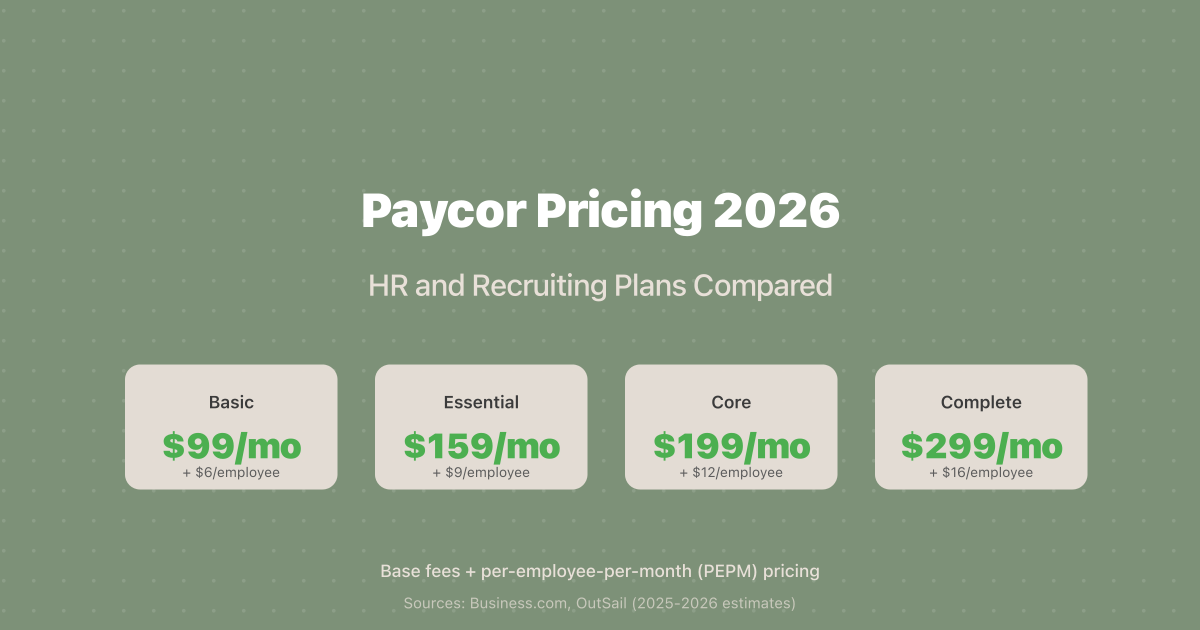
Paycor pricing starts at approximately $99/month plus $6 per employee per month on the Basic plan, scaling to $299/month plus $16/employee on the Complete plan, based on third-party buyer reports through 2026. Those figures come from Business.com (2026) and OutSail (2025) - not from Paycor directly. The company pulled its public pricing page in 2025 and now requires a custom quote for every deal.
There's a bigger story behind those numbers. Paychex completed its $4.1 billion acquisition of Paycor in April 2025, according to Paychex. Paycor still operates as a standalone business unit, and no pricing changes have been announced yet. But the acquisition creates uncertainty for buyers evaluating long-term contracts. This guide covers all four Paycor plans, maps out hidden costs that don't appear in quotes, explains the recruiting module's real limitations, and compares Paycor to five alternatives so you know exactly what you're paying for.
TL;DR: Paycor costs $99-$299/mo base plus $6-$16 per employee across four plans (Business.com, 2026). Implementation adds 10-20% of annual fees. The bundled ATS caps active jobs at 3-5 on lower tiers, with no candidate sourcing at any level. Paychex acquired Paycor for $4.1B in April 2025.
What Does Paycor Pricing Look Like in 2026?
Paycor removed its pricing page in 2025, so every quote now requires a sales conversation. The figures below come from Business.com (2026), OutSail (2025), and People Managing People (2026) - they reflect previously published rates and analyst estimates, not confirmed current pricing.
| Plan | Base Fee/Mo | Per Employee/Mo | Key Inclusions |
|---|---|---|---|
| Basic | ~$99 | ~$6 | Payroll, tax filing, wage garnishments |
| Essential | ~$159 | ~$9 | + Onboarding, time-off tracking, ATS (3 jobs) |
| Core | ~$199 | ~$12 | + HR analytics, expense management, ATS (5 jobs) |
| Complete | ~$299 | ~$16 | + Compensation planning, talent development, unlimited recruiting |
These numbers apply to Paycor's small business segment (under 50 employees). For mid-market companies (50-1,000 employees), OutSail (2025) reports all-in per-employee-per-month (PEPM) rates of $19-$27, depending on modules selected. Enterprise organizations (1,000+ employees) see fully custom quotes, typically landing at $23-$30+ PEPM with the full module stack.
Here's what Paycor costs annually on the Core plan (~$199/mo + $12 PEPM), based on company size:

A few things about Paycor's pricing model that affect your total cost:
- No public pricing. Every quote requires a sales call. Capterra (2026) confirms Paycor stopped publishing prices entirely. Two companies of the same size can pay different rates depending on when they signed and what modules they bundled.
- New customer discounts. Business.com (2026) reports that new customers often receive approximately 50% off for the first 6 months. Factor that promotional rate into your budget projections - the full price hits at month seven.
- Per-employee scaling. Your bill grows with headcount even if your HR team stays the same size. A 250-employee company on Core pays $38,388/yr before any add-ons. On Complete, that number jumps to $51,588/yr.
- Mid-market pricing jumps. Companies crossing the 50-employee threshold move to custom quotes with PEPM rates of $19-$27, which can mean a significant cost increase compared to the small business rates.
The gap between Paycor's small business and mid-market pricing tiers is the detail most buyers miss. A 49-employee company on Core pays about $199/mo + $588/mo in PEPM ($12 x 49) = $787/month. Cross the 50-employee threshold, and you're looking at custom quotes in the $19-$27 PEPM range. At $23 PEPM for 51 employees, that's $1,173/month - a 49% cost increase for adding two people. If you're near that threshold, negotiate your rate before you cross it.
What's Included in Each Paycor Plan?
Paycor offers four tiers that progressively bundle more HR, payroll, and recruiting capabilities. According to Business.com (2026), the most popular plan is Core, which hits the sweet spot for companies that need HR analytics alongside payroll. Here's the full breakdown:
| Feature | Basic (~$99 + $6) | Essential (~$159 + $9) | Core (~$199 + $12) | Complete (~$299 + $16) |
|---|---|---|---|---|
| Payroll Processing | ✅ | ✅ | ✅ | ✅ |
| Tax Filing | ✅ | ✅ | ✅ | ✅ |
| Wage Garnishments | ✅ | ✅ | ✅ | ✅ |
| Onboarding | ❌ | ✅ | ✅ | ✅ |
| Time-Off Tracking | ❌ | ✅ | ✅ | ✅ |
| Recruiting/ATS | ❌ | ⚠️ 3 active jobs | ⚠️ 5 active jobs | ✅ Unlimited |
| HR Analytics | ❌ | ❌ | ✅ | ✅ |
| Expense Management | ❌ | ❌ | ✅ | ✅ |
| Compensation Planning | ❌ | ❌ | ❌ | ✅ |
| Talent Development | ❌ | ❌ | ❌ | ✅ |
The Basic plan is payroll-only. It handles payroll processing, tax filing, and wage garnishments. Nothing else. No onboarding, no time-off tracking, no recruiting tools. For companies that just need payroll done right, that's fine. But most teams outgrow it quickly.
Essential adds onboarding workflows, time-off management, and the first taste of Paycor's recruiting module - limited to 3 active job openings. That cap matters. If you're filling more than 3 roles simultaneously, you're stuck either waiting for a position to close or upgrading to Core.
Core is where most Paycor customers land. It includes HR analytics, expense management, and bumps the ATS to 5 active jobs. The analytics alone can justify the step up from Essential if you need headcount reporting, turnover tracking, or compliance dashboards.
Complete unlocks compensation planning, talent development tools, and unlimited job openings in the ATS. It's the only tier where the recruiting module doesn't have an artificial cap. But at $299/mo + $16 PEPM, a 100-employee company pays $22,788/yr - and the recruiting capabilities still pale compared to dedicated tools.
What Hidden Costs Does Paycor Charge?
The base fee and PEPM are just the starting point. OutSail (2025) reports that implementation fees alone add 10-20% of annual software costs for mid-market buyers. Multiple Capterra reviewers describe encountering a "ton of misc fees" that increase year over year. Here's what to budget beyond the sticker price:
| Cost Type | Estimated Range | Notes |
|---|---|---|
| Implementation | $300-$3,000+ (small biz); 10-20% of annual contract (mid-market) | May be waived if you hire a third-party implementation firm |
| Benefits Administration | Add-on at all tiers | Not included in any base plan |
| Time & Attendance | Add-on on Basic | Included in Essential and above |
| Workers' Compensation | Add-on | Available but not bundled |
| Premium Support | Add-on | Standard support widely criticized in reviews |
| API/Custom Integrations | Variable | Custom development billed separately |
| Advanced Analytics | Add-on | Base analytics included in Core+; upgrades cost more |
Here's what catches most buyers off guard: Paycor's implementation fees are negotiable, but the method matters. According to OutSail (2025), Paycor will waive or discount implementation fees if you hire a third-party implementation firm instead of using Paycor's own team. That sounds counterintuitive - paying someone else to avoid paying Paycor. But third-party firms often charge less than Paycor's internal implementation fee, and some buyers end up saving 30-50% on implementation costs this way.
The bigger concern is ongoing cost creep. Multiple reviewers on Capterra and TrustRadius report year-over-year price increases at renewal that aren't tied to adding modules or headcount. Paycor doesn't publish an official annual increase policy, so there's no way to predict what your year-two or year-three costs will look like. Lock in multi-year pricing if you can negotiate it.
How Does the Paychex Acquisition Affect Paycor's Pricing?
Paychex completed its all-cash acquisition of Paycor on April 14, 2025, valued at approximately $4.1 billion ($22.50/share), according to Paychex. The combined entity now serves approximately 800,000 clients. Brandon Hall Group (2025) called it "a new titan" in the HR technology space.
So what does this mean for Paycor buyers in 2026? Right now, not much has changed on the surface:
- Standalone operation. Paycor continues running as a standalone business unit within Paychex. Same product, same support channels, same pricing structure.
- No pricing changes announced. As of early 2026, Paychex hasn't announced any changes to Paycor's plan structure or rates.
- $80M+ in synergies planned. Paychex has publicly stated it expects $80M+ in annual cost synergies from the acquisition in fiscal 2026. Where those savings come from - product consolidation, staff reductions, or operational efficiencies - hasn't been disclosed.
What should buyers watch for? The synergies Paychex is targeting have to come from somewhere. Product consolidation is the most likely outcome over the next 2-3 years. Paychex already offers its own HCM platform (Paychex Flex), which overlaps significantly with Paycor's product. Long-term, one of those platforms could be deprecated or merged.
If you're evaluating Paycor today, this is worth factoring in. Signing a multi-year contract with a platform that might undergo significant changes within that timeframe carries risk. Ask your sales rep directly about product roadmap commitments and what happens to your contract if the platform is consolidated.
What Can Paycor's Recruiting Module Actually Do?
Paycor's recruiting module is built on Newton, an ATS that Paycor acquired and rebranded as "Paycor Recruiting." According to SelectHub (2025), the module supports 20,000+ job board integrations, branded career pages, AI-powered job description generation, interview scorecards, and custom hiring workflows. It's included starting at the Essential tier.
On paper, that sounds comprehensive. In practice, the limitations are significant:
- Active job caps. Essential allows 3 active jobs. Core allows 5. Only Complete offers unlimited openings. A team hiring for more than 5 roles simultaneously needs to spend $299/mo + $16 PEPM just to avoid the cap.
- No candidate sourcing. Paycor's ATS manages inbound applicants. It doesn't search external databases, source passive candidates, or scan profiles proactively. If candidates don't find your job posting, Paycor won't find them for you.
- No outreach automation. There's no built-in email sequencing, LinkedIn messaging, or SMS campaigns. Every candidate touchpoint is manual.
- Basic search and filtering. Multiple reviewers note that candidate search within the ATS feels dated compared to standalone recruiting tools. The filtering options don't match what dedicated ATS platforms offer.
For companies hiring 2-3 roles per quarter from inbound applications, Paycor's ATS is adequate. It handles the basics - posting jobs, tracking applicants through a pipeline, scheduling interviews. That's the floor.
For any team with active sourcing needs, high-volume hiring, or a recruiting function that goes beyond processing inbound applicants, the module falls short. You'll end up buying a separate recruiting tool anyway, which means paying for Paycor's bundled ATS you're not fully using.
Pin's AI scans 850M+ profiles to find candidates for any role type - try it free.
How Does Paycor Compare to 5 Alternatives?
HR and payroll platforms average $15-$22 per employee per month, according to G2 (2025). Paycor sits within that range on its lower tiers but exceeds it on Complete. Here's how it stacks up against five alternatives across the HCM and recruiting categories:

| Platform | Starting Price | PEPM Range | Built-In ATS | Free Tier | Good For |
|---|---|---|---|---|---|
| Paycor | $99/mo base | $6-$16 (SMB); $19-$27 (mid-market) | ⚠️ 3-5 job cap (Newton-based) | ❌ | Mid-market HR + payroll |
| Gusto | $40/mo base | $6 | ⚠️ Basic hiring tools | ❌ | Payroll-first small teams |
| ADP RUN | ~$79/mo base | $4-$6 (RUN); $23-$30 (Workforce Now) | ⚠️ Separate add-on | ❌ | Small business payroll with enterprise path |
| BambooHR | $250/mo minimum | $10-$22 | ⚠️ 5-50 job cap | ❌ | SMB HR operations (US-only payroll) |
| Paylocity | Custom | $18-$25 | ⚠️ Add-on module | ❌ | Mid-market with complex compliance |
| Pin | $100/mo | Flat per-recruiter | N/A (AI sourcing + outreach) | ✅ | Proactive candidate sourcing |
Pricing data from vendor pricing pages, OutSail (2025), and G2 (2025). At the small business level, Gusto and ADP RUN undercut Paycor on base price. At mid-market (50-500 employees), Paycor and Paylocity are direct peers in the $19-$27 PEPM range. None of these platforms source candidates proactively. Here's what each comparison tells you:
Gusto costs significantly less than Paycor for small teams. At $40/mo + $6 PEPM, a 25-person company pays $190/month on Gusto vs. $249/month on Paycor Basic. Gusto handles payroll, benefits, and basic HR well, but its hiring tools are limited to job postings and offer letters. If payroll is your primary need and hiring volume is low, Gusto saves you money.
ADP offers two paths. ADP RUN ($79/mo + $4-$6 PEPM) targets small businesses and undercuts Paycor on base price. ADP Workforce Now ($23-$30 PEPM) targets mid-market companies and overlaps directly with Paycor's mid-market tier. ADP's advantage is brand recognition and global payroll capabilities. The trade-off is a more complex interface and a sales-heavy buying process.
BambooHR starts at $250/month flat with no employee-count discount below 25 employees. That makes it more expensive than Paycor for small teams (Paycor Basic at 10 employees = $159/mo vs. BambooHR's $250/mo floor). BambooHR's strength is its clean UI for employee records and HR workflows. Its recruiting limitations mirror Paycor's - basic ATS, no sourcing, no outreach. For a detailed breakdown, see our BambooHR pricing guide.
Paylocity is Paycor's closest direct competitor in the mid-market segment. Both target companies with 50-500 employees, both require custom quotes, and both charge in the $18-$27 PEPM range. Paylocity's edge is deeper compliance tools and payroll for complex multi-state operations. Paycor's edge is its bundled ATS (Paylocity charges extra for recruiting). Neither offers candidate sourcing or outreach automation.
None of these platforms solve recruiting's actual bottleneck: finding candidates. They all manage inbound applicants after someone applies. For teams where sourcing is the challenge, a dedicated recruiting tool paired with a lightweight HRIS often delivers better results at a comparable or lower total cost.
What If Recruiting Is Your Real Priority?
Paycor's ATS handles job postings and applicant tracking. It doesn't source candidates, automate outreach, or match candidates to roles using AI. For recruiting teams and staffing agencies, those aren't nice-to-have features - they're the core function. Here's how Paycor's recruiting capabilities compare to a dedicated AI recruiting platform:
| Capability | Paycor (All Plans) | Pin |
|---|---|---|
| Annual Cost (single user) | $1,188-$22,788/yr (depends on headcount + plan) | $1,200/yr ($100/mo) |
| Candidate Sourcing | ❌ Not available | ✅ 850M+ profiles |
| Outreach Automation | ❌ Not available | ✅ Email, LinkedIn, SMS |
| AI Candidate Matching | ❌ Not available | ✅ Advanced AI |
| Interview Scheduling | ⚠️ Basic interview tracking | ✅ Automated with calendar sync |
| Active Job Limits | 3-5 (Essential/Core); Unlimited (Complete only) | Unlimited |
| Response Rate | N/A | 48% |
| Free Tier | ❌ | ✅ No credit card required |
| SOC 2 Certified | ✅ | ✅ |
Paycor and Pin solve different problems. Paycor manages your employees after they're hired - payroll, benefits, compliance. Pin helps you find and hire them in the first place - sourcing passive candidates, running outreach sequences, and scheduling interviews automatically. Pin users fill positions in approximately two weeks, with a 48% response rate on automated outreach.
As Nick Poloni, President at Cascadia Search Group, described his experience: "I jumped into Pin solo toward the end of 2025 and closed out the year with over $1M in billings during just the final 4 months - no team, no agency. The sourcing data is incredible, scanning 850M+ profiles with recruiter-level precision to uncover perfect-fit candidates I'd never find otherwise."
Many teams run both: a lightweight payroll/HRIS platform (Gusto at $40/mo + $6 PEPM, or even Paycor Basic at $99/mo + $6 PEPM) paired with Pin's AI sourcing ($100/mo). For a 25-person company, that combination costs $290-$349/month and delivers real recruiting capabilities that no HRIS platform - Paycor included - offers at any price tier. For a full comparison of recruiting platforms, see our guide to the best recruiting software in 2026.
Who Is Paycor Built For?
Paycor serves 30,500+ customers as of mid-2024, with annual revenue of approximately $690 million. OutSail (2025) identifies Paycor's sweet spot as companies with 50-350 employees - large enough to need structured HR and payroll, but not so large that they require the full enterprise capabilities of a Workday or SAP SuccessFactors.
Paycor makes sense when:
- Your team is 50-350 employees and needs payroll, HR, and basic recruiting in one platform
- Your hiring volume stays under 5 active roles at a time (Core plan) or you're willing to pay for Complete ($299/mo + $16 PEPM) to remove the cap
- You're primarily processing inbound applicants from job boards, not sourcing passive candidates
- You want onboarding, time-off tracking, and HR analytics alongside payroll without buying separate tools
- You're a US-focused company that values having a single vendor for payroll and HR compliance
Paycor becomes a poor fit when:
- You have fewer than 25 employees and need to minimize costs. Gusto ($40/mo + $6 PEPM) will save you $60+/month over Paycor Basic while covering payroll and basic HR.
- You need active candidate sourcing. Paycor has zero sourcing capabilities at any tier. You'll buy a separate tool regardless.
- You're a recruiting agency managing multiple clients. Paycor isn't designed for agency workflows. Dedicated applicant tracking systems handle multi-client pipelines better.
- You have 500+ employees with complex global payroll needs. ADP Workforce Now or Workday is a better fit at that scale.
- You're concerned about platform stability. The Paychex acquisition creates uncertainty about Paycor's long-term product roadmap.
Paycor rates 4.4/5 on Capterra (3,900+ reviews), with strong marks for ease of use and payroll accuracy. The 3.9/5 rating on G2 is lower, with support responsiveness and pricing transparency as the most common complaints. If you're shopping specifically for HR and payroll software, our best recruiting software guide covers the full landscape.
Frequently Asked Questions
How much does Paycor cost per employee per month?
Paycor charges approximately $6 per employee per month on Basic, $9 on Essential, $12 on Core, and $16 on Complete, plus base fees of $99-$299/month. Mid-market companies (50-1,000 employees) see all-in rates of $19-$27 PEPM according to OutSail (2025). All pricing requires a custom quote - Paycor no longer publishes rates publicly.
Does Paycor include recruiting and ATS features?
Yes, starting at the Essential plan. But it's limited. Essential allows 3 active job postings, Core allows 5, and only Complete offers unlimited. The ATS (built on Newton) handles job board distribution across 20,000+ boards and applicant tracking, but there's no candidate sourcing database, outreach automation, or AI matching. Teams with active hiring needs typically pair Paycor with a dedicated recruiting tool.
Is Paycor cheaper than ADP or Paylocity?
For small businesses, Paycor Basic ($99/mo + $6 PEPM) costs more than ADP RUN (~$79/mo + $4-$6 PEPM) but less than Paylocity (custom quotes starting around $18-$25 PEPM). At the mid-market level, all three converge around $19-$30 PEPM. The real cost difference depends on which modules you need - benefits admin, time tracking, and recruiting are add-ons on some platforms and bundled on others.
What happened with the Paychex acquisition of Paycor?
Paychex completed its $4.1 billion all-cash acquisition of Paycor on April 14, 2025 (Paychex). Paycor continues operating as a standalone business unit with no announced pricing or product changes. However, Paychex is targeting $80M+ in annual cost synergies, which could lead to product consolidation over the next 2-3 years.
Does Paycor offer a free trial or free tier?
No. Paycor doesn't offer a free tier or self-serve trial. You need to request a demo and work through a sales conversation to get pricing. Business.com (2026) reports that new customers often receive approximately 50% off for the first 6 months as a promotional incentive. If you want to test recruiting tools before committing budget, AI sourcing platforms like Pin offer free tiers with no credit card required.
Should You Buy Paycor in 2026?
Paycor is a strong fit for mid-market HR teams (50-350 employees) that need payroll and basic recruiting in one platform - but the wrong choice for any team where active candidate sourcing is a priority. Its 30,500+ customers and $690M in annual revenue prove it works for the HR operations segment. Pricing is competitive with the HCM category at $6-$16 PEPM on small business plans, though add-ons and year-over-year increases can push total costs higher than the initial quote suggests.
Two factors should weigh heavily in your 2026 evaluation. First, the Paychex acquisition. Paycor is operating normally today, but $80M+ in planned synergies means changes are coming. If you're signing a multi-year contract, understand what happens to your terms if the platform evolves. Second, the recruiting gap. Paycor's ATS handles inbound applicants, but it doesn't source candidates, automate outreach, or use AI to match talent to roles. If hiring is a meaningful part of your business, you'll need a separate tool.
For teams where recruiting is the real bottleneck, your budget delivers more impact invested in a dedicated AI recruiting platform than in an HCM upgrade. Many companies run a lightweight payroll tool alongside a purpose-built sourcing tool - and spend less in total than a premium HCM platform that doesn't actually source candidates.
Get enterprise recruiting features at startup pricing with Pin →