Freshteam pricing started at $0 on the Free plan and scaled to $4/employee/month plus a $169 platform fee on Enterprise - but Freshworks halted all new subscriptions and renewals as of March 7, 2026. Existing customers have until April 2027 to migrate, according to PeopleMatters (2025). The product is now listed as "Freshteam (Legacy)" on Gartner Peer Insights.
If you're a current Freshteam customer wondering what you're paying for - or an HR team that was considering Freshteam and now needs a Plan B - this guide covers both scenarios. We'll break down every plan and its limits, explain the hidden platform fees that inflated small-team costs, and walk through five alternatives worth evaluating before the April 2027 deadline hits.
TL;DR: Freshteam charged $0-$4/employee/month plus $0-$169 in platform fees across four plans. Freshworks ended renewals in March 2026, with full shutdown by April 2027 (PeopleMatters, 2025). Current users should start evaluating ATS alternatives now.
What Did Freshteam Cost Before the Shutdown?
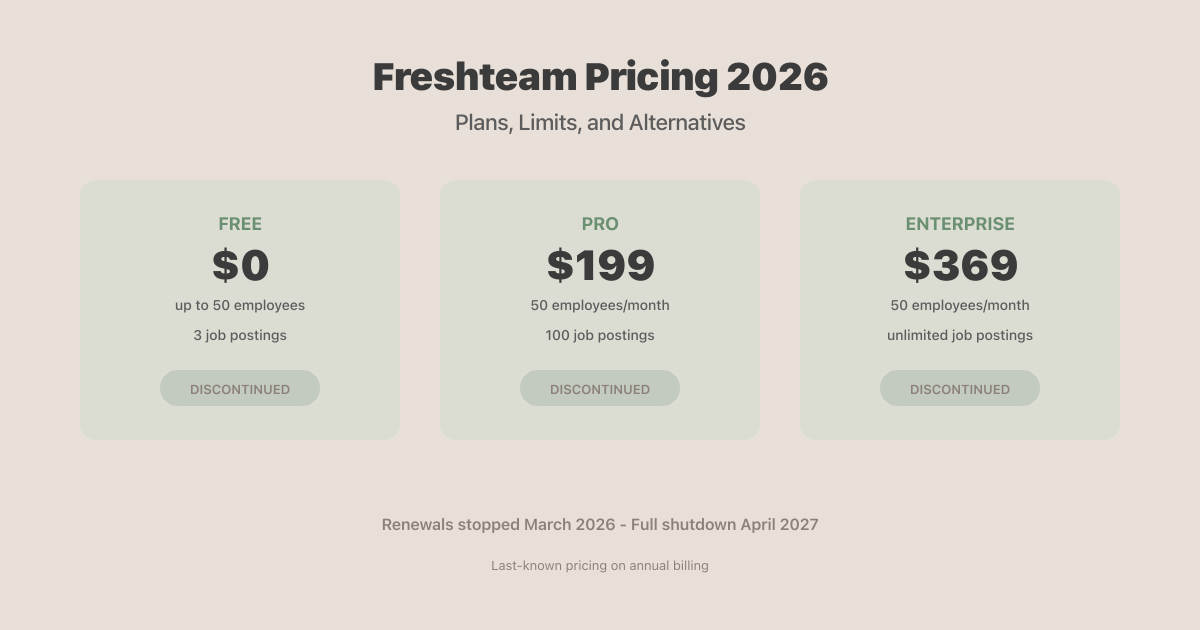
Freshteam used a two-part pricing model: a per-employee fee billed monthly plus a flat platform fee that stayed the same regardless of team size. According to eLearning Industry (2025) and Capterra (2026), annual billing rates were $1, $2, and $4 per employee per month across the three paid tiers. Monthly billing ran about 20% higher at $1.20, $2.40, and $4.80 per employee.
Here's what each plan cost on annual billing:
| Plan | Per Employee/Month | Platform Fee/Month | Job Posting Limit | 50-Employee Monthly Cost |
|---|---|---|---|---|
| Free | $0 | $0 | 3 | $0 |
| Growth | $1.00 | $59 | 20 | $109 |
| Pro | $2.00 | $99 | 100 | $199 |
| Enterprise | $4.00 | $169 | Unlimited | $369 |
The platform fee was the part that caught small teams off guard. A 10-person company on the Growth plan paid $10 in employee fees and $59 in platform fees - meaning the platform fee accounted for 85% of the total bill. That $69/month works out to $6.90 per employee, not the $1/employee listed on the pricing page.
For larger teams, the math improved. A 200-person company on Growth paid $200 in employee fees plus $59 in platform fees, bringing the effective per-employee cost down to $1.30/month.
The platform fee's impact shrank as headcount grew, which made the product genuinely affordable for mid-size organizations but misleadingly cheap-looking for small ones.
What Did Each Freshteam Plan Include?
The four plans gated features aggressively. The Free tier was functional for basic hiring, but sourcing tools, onboarding workflows, and customization didn't appear until Pro or Enterprise. According to Capterra (2026), here's what each plan delivered:
Free (up to 50 employees)
- Basic career site with limited branding
- Employee directory and org chart
- Time-off management (basic)
- Candidate email applications
- 3 published job postings at any time
- Mobile apps for iOS and Android
Growth ($1/employee + $59/month platform fee)
- Everything in Free
- Recruiting automations (called "Autopilot")
- Custom hiring pipelines
- Interview scorecards
- Customizable career site
- Up to 20 active job postings
- 2 holiday calendars and time-off policies
Pro ($2/employee + $99/month platform fee)
- Everything in Growth
- Candidate sourcing Chrome extension
- Job requisition management
- Offer management tools
- Onboarding checklists
- Talent pool management
- Up to 100 published jobs
- Unlimited time-off policies
Enterprise ($4/employee + $169/month platform fee)
- Everything in Pro
- IP-based access restrictions
- Dedicated account manager
- Custom URL with SSL certificate
- Unlimited onboarding and offboarding checklists
- Advanced leave reports
- Custom user roles
One consistent gap across every tier: no plan included payroll. Teams that needed payroll had to add Gusto, Rippling, or another provider on top. For an HR platform marketed to small businesses, that was a significant missing piece.
What Were Freshteam's Hidden Costs and Limitations?
The sticker price told only part of the story. Several costs and limitations didn't show up on the pricing page but consistently appeared in user reviews on Capterra and TrustRadius.
Platform fees dominated small-team bills. A 10-person startup on the Growth plan paid $69/month total ($10 in employee fees + $59 platform fee). That's $6.90 per employee - nearly 7x the advertised $1/employee rate. The Pro plan was even worse at small scale: $119/month for 10 people works out to $11.90/employee, not $2. The platform fee structure essentially penalized the small businesses Freshteam was designed to attract.
No payroll at any tier. Unlike Gusto or Rippling, the platform never included payroll processing, tax filing, or benefits administration. Teams that needed a complete HR stack had to pair Freshteam with a separate payroll provider, adding $6-$22/employee/month on top of Freshteam's costs. For a 50-person company, that turned a $199/month Freshteam Pro bill into $499-$1,299/month when payroll was included.
60-day cancellation notice. The contract required 60 days' written notice before you could cancel your subscription. Missing that window meant another billing cycle. Several Capterra reviewers flagged this as unexpected, especially compared to month-to-month competitors that let you cancel immediately.
Integrations cost extra. Most third-party integrations beyond Freshworks' own ecosystem required paid add-ons. Teams using tools like Slack, Calendly, or external job boards often discovered they needed a higher plan tier or separate integration fees to connect their existing workflows.
Job posting caps were strict. The Free plan allowed just 3 active job postings. Growth bumped that to 20. For growing companies hiring across multiple departments, those limits forced upgrades faster than headcount growth alone would have. Only Enterprise offered unlimited postings, at $169/month in platform fees before any per-employee charges.
No live phone support on lower plans. Free and Growth customers were limited to email and chat support. Dedicated account management only appeared at the Enterprise level. For HR teams dealing with time-sensitive hiring issues, the lack of phone support on lower plans was a consistent pain point.
Why Did Freshworks Discontinue Freshteam?
Freshworks quietly moved Freshteam under its Freshservice division back in 2022 and redeployed the engineering team to other products, according to PeopleMatters (2025). The product stopped receiving meaningful updates after that point. Freshworks stated the decision would have "no material business impact" - which tells you how small Freshteam's revenue contribution had become.
The timeline matters for existing customers:
- 2022: Freshteam folded into Freshservice. Development effectively stopped.
- March 7, 2026: All subscription renewals halted. No new customers accepted.
- April 2027: Final cutoff. Remaining customers must migrate to Freshservice for Business Teams or a competitor.
Freshworks is pushing existing Freshteam users toward Freshservice for Business Teams, its enterprise service management platform. But Freshservice pricing starts significantly higher than Freshteam's rates, and the product is designed for IT service management first, HR second. Teams that picked Freshteam for its simplicity and low cost are likely to find Freshservice more complex and expensive than what they signed up for.
The discontinuation also dropped Freshteam out of several top-ATS rankings. Capterra and TechnologyAdvice both removed it from their top-5 ATS lists in 2024, replacing it with actively developed platforms. On TrustRadius, the product carries a 3.3 out of 10 rating across 24 reviews - reflecting the frustration of users stuck on a platform that stopped improving years ago.
How Did Freshteam Compare to Alternatives on Price?
The pricing looked competitive on paper, especially at higher headcounts. But the platform fees, feature gating, and lack of payroll made direct comparisons tricky. Here's how the last-known Freshteam rates stack up against five active alternatives for a 50-employee team:

The comparison reveals the product's position clearly. It was cheaper than BambooHR and Rippling for pure ATS and HR admin, but it didn't include payroll, AI-powered sourcing, or automated outreach - features that the more expensive platforms either bundle or that dedicated recruiting tools like Pin's AI recruiting platform handle for less. For teams whose primary need is finding and hiring candidates, a recruiting-first tool often delivers more value per dollar than an HR admin platform with an ATS bolted on.
| Platform | Starting Price | Free Tier | Payroll | AI Sourcing | Automated Outreach |
|---|---|---|---|---|---|
| Freshteam | $1/emp + $59 platform | Yes (50 emp, 3 jobs) | No | No | No |
| Zoho People | $1.25/user/mo | Yes (5 users) | No | No | No |
| BambooHR | ~$10/emp/mo | No | No | No | No |
| Gusto | $49/mo + $6/emp | No | Yes | No | No |
| Rippling | $8/emp/mo | No | Add-on | No | No |
| Pin | $100/mo flat | Yes | N/A (recruiting-focused) | Yes (850M+ profiles) | Yes (48% response rate) |
5 Alternatives to Freshteam Worth Evaluating
With the platform sunsetting, every current customer needs a migration plan before April 2027. The right replacement depends on whether your primary need is HR administration, payroll, recruiting, or some combination. For a broader look at the full market, see our best recruiting software roundup. Here are five platforms that cover those bases - and what each one actually costs.
1. Pin - AI-Powered Recruiting ($100-$249/month)
If recruiting was the reason you used Freshteam's ATS, Pin is a fundamentally different tool that focuses entirely on finding and hiring candidates. Instead of a basic job-posting and applicant-tracking workflow, Pin scans 850M+ candidate profiles with AI precision and automates outreach across email, LinkedIn, and SMS - hitting a 48% response rate on automated messages.
Pin starts with a free tier (no credit card), then scales to $100/month (Starter), $149/month (Professional), and $249/month (Business). All plans include AI-powered candidate sourcing, multi-channel outreach sequences, a shared team inbox, and automated interview scheduling. There are no per-employee fees - pricing is flat per seat.
Pin's AI sourcing scans 850M+ profiles to surface candidates with a 48% outreach response rate - start sourcing with Pin free.
As Rich Rosen, Executive Recruiter at Cornerstone Search, put it: "Absolutely money maker for recruiters - in 6 months I can directly attribute over $250K in revenue to Pin."
Pin doesn't handle payroll, benefits, or time-off tracking. It's not trying to. If you need an all-in-one HRIS, look at BambooHR or Gusto below. But if recruiting is your bottleneck - and for many teams leaving Freshteam, it is - Pin does more in that area than Freshteam ever did, at comparable or lower cost.
2. Zoho People - Budget HR Admin ($1.25/user/month)
Zoho People is the closest match to Freshteam's pricing model. According to TinyTeam (2026), plans start at $1.25/user/month (Essential HR) and scale to $4.50/user/month (Enterprise). There's a free tier for up to 5 users. No platform fees - just straight per-user pricing.
Zoho People covers employee management, time-off tracking, timesheets, and basic performance reviews. Its recruiting module (Zoho Recruit) is a separate product, which means you're paying for two subscriptions if you need both HR admin and an ATS. For teams that primarily used Freshteam for HR management and only occasionally posted jobs, Zoho People is the most affordable direct replacement.
3. BambooHR - Mid-Market HRIS (~$10/employee/month)
BambooHR is the established choice for companies with 50-500 employees that want clean UX and solid HR administration. According to PeopleManagingPeople (2026), pricing runs approximately $10/employee/month (Core), $17 (Pro), and $25 (Elite), with a $250/month minimum. No public pricing page - every quote requires a sales call.
BambooHR includes a built-in ATS, which Freshteam users will find familiar. The catch: job posting limits cap at 5-50 active positions depending on your plan. For teams with high hiring volume, those caps can force an upgrade. For a detailed look at what each BambooHR plan includes and where the hidden costs sit, see our BambooHR pricing breakdown.
4. Gusto - Payroll-First HR ($49/month + $6/employee)
Gusto fills the gap Freshteam never addressed: payroll. According to SaaSWorthy (2026), plans start at $49/month plus $6/employee (Simple), scale to $80/month plus $12/employee (Plus), and top out at $180/month plus $22/employee (Premium). No free tier, but the base plan includes full payroll processing, tax filing, and benefits administration.
Gusto's recruiting tools are basic - job posting and applicant tracking at the Plus tier and above. Don't expect sourcing, outreach automation, or candidate engagement features. Gusto makes sense for Freshteam users who were frustrated by the lack of payroll integration and whose recruiting needs are limited to posting jobs and collecting applications.
5. Rippling - Modular HR + IT ($8/employee/month)
Rippling takes a modular approach. According to TinyTeam (2026), the base Unity platform starts at $8/employee/month, with payroll, benefits, and recruiting available as add-on modules. A full HR and payroll stack for a 50-person team typically runs $15-$25/employee/month ($750-$1,250/month total).
Rippling's strength is consolidation. HR, IT device management, payroll, and app provisioning all live in one system. For Freshteam users at companies with 50+ employees who want to stop stitching together multiple tools, Rippling's modular pricing lets you build exactly what you need. The downside: it's the most expensive option on this list, and the per-employee costs add up fast once you start stacking modules.
What Should Freshteam Users Do Now?
The April 2027 deadline gives existing customers roughly 12 months from the renewal cutoff. That sounds like plenty of time, but HR system migrations involve data exports, workflow rebuilds, team retraining, and integration testing. Most teams report needing 2-4 months for a full ATS or HRIS migration.
Here's a practical migration timeline:
- Now through Q2 2026: Audit your current Freshteam usage. Which features do you actually use daily? Is it the ATS, the HR admin, or both? This determines your replacement category.
- Q2-Q3 2026: Evaluate 2-3 alternatives. Run free trials where available. Pin, Zoho People, and Gusto all offer free tiers or trials that let you test before committing.
- Q3-Q4 2026: Begin migration. Export employee data, rebuild hiring workflows, set up integrations. Leave at least 30 days of overlap for parallel operation.
- Q1 2027: Complete cutover. Deactivate Freshteam. Run a post-migration audit to confirm data integrity.
The biggest mistake to avoid: waiting until Q1 2027 and rushing the migration. Data loss during rushed HR migrations is common, and the 60-day cancellation notice Freshteam required means you can't just flip a switch.
Before committing to any replacement, audit which Freshteam features your team actually uses on a weekly basis. Many teams discover they're paying for a full HRIS when they only use the ATS - or vice versa. That gap between what you're paying for and what you need is exactly where most teams overspend after migration. If your daily workflow is mostly sourcing, outreach, and scheduling interviews, a recruiting-focused platform will give you more for less than another general HRIS with a recruiting module tacked on.
One more thing to consider: data portability. Export your candidate records, employee data, and document attachments as CSV files before the shutdown window closes. Freshworks hasn't published post-shutdown data retention details, so assume your data could become inaccessible after April 2027. Most modern ATS and HRIS platforms accept CSV imports, but the cleaner your export, the smoother the migration.
For teams whose primary need is recruiting - sourcing candidates, sending outreach, and scheduling interviews - the migration is actually an upgrade opportunity. Freshteam's ATS was basic even at its best. Moving to a purpose-built recruiting platform with AI sourcing and automated outreach, rather than another generic HRIS with a bolted-on ATS, can meaningfully improve hiring speed and candidate quality. When you're building or rebuilding your recruiting tech stack, consider separating your HR admin and recruiting tools rather than forcing both into one platform.
Frequently Asked Questions
Is Freshteam still available for new customers in 2026?
No. Freshworks stopped all new subscriptions and renewals as of March 7, 2026 (PeopleMatters, 2025). Existing customers can continue using the platform until April 2027, but no new accounts are being created. Freshworks is directing customers toward Freshservice for Business Teams as the replacement.
What happens to my Freshteam data after April 2027?
Freshworks hasn't published detailed data retention policies for post-shutdown Freshteam accounts. Current customers should export all employee records, candidate data, and document attachments well before the April 2027 deadline. Most HRIS and ATS platforms accept CSV imports, so exporting early gives you the most flexibility in choosing a replacement.
What's the cheapest Freshteam alternative with a free tier?
Zoho People offers a free tier for up to 5 users, covering basic HR admin. For recruiting specifically, Pin offers a free tier with no credit card required, including AI-powered candidate sourcing across 850M+ profiles. Both are meaningfully more capable than Freshteam's Free plan, which was limited to 3 job postings and basic employee management.
Should I migrate to Freshservice for Business Teams?
Only if your company already uses other Freshworks products (Freshdesk, Freshsales) and values ecosystem integration over cost. Freshservice is primarily an IT service management platform, not an HR tool. Its pricing is significantly higher than Freshteam's, and the HR functionality is less mature than dedicated HRIS platforms like BambooHR or Zoho People. Most teams will find better value with a purpose-built alternative that matches their actual workflow - whether that's an HRIS, an ATS, or an AI recruiting tool.
How does Freshteam's pricing compare to modern AI recruiting tools?
Freshteam Pro cost $199/month for a 50-person team but only covered basic applicant tracking - no AI sourcing, no automated outreach, no interview scheduling automation. Modern AI recruiting tools like Pin start at $100/month and include features Freshteam never offered: AI-powered candidate discovery across 850M+ profiles, multi-channel outreach with a 48% response rate, and automated scheduling. The pricing comparison gets even more favorable when you factor in the time savings - recruiters using AI sourcing tools report filling positions in approximately 2 weeks compared to the industry average of 36-44 days.
Key Takeaways
- Freshteam is discontinued. Renewals stopped March 2026; full shutdown arrives April 2027.
- Last-known pricing: $0-$4/employee/month plus $0-$169 in platform fees across four tiers.
- Platform fees made Freshteam expensive for small teams despite low per-employee rates.
- No payroll was ever included - a significant gap for an SMB-focused HR tool.
- Five alternatives cover different needs: Pin for AI recruiting, Zoho People for budget HR, BambooHR for mid-market HRIS, Gusto for payroll, Rippling for modular HR+IT.
- Start your migration now. Most teams need 2-4 months for a complete ATS or HRIS transition.
Switch from basic ATS to AI recruiting with Pin - free to start →