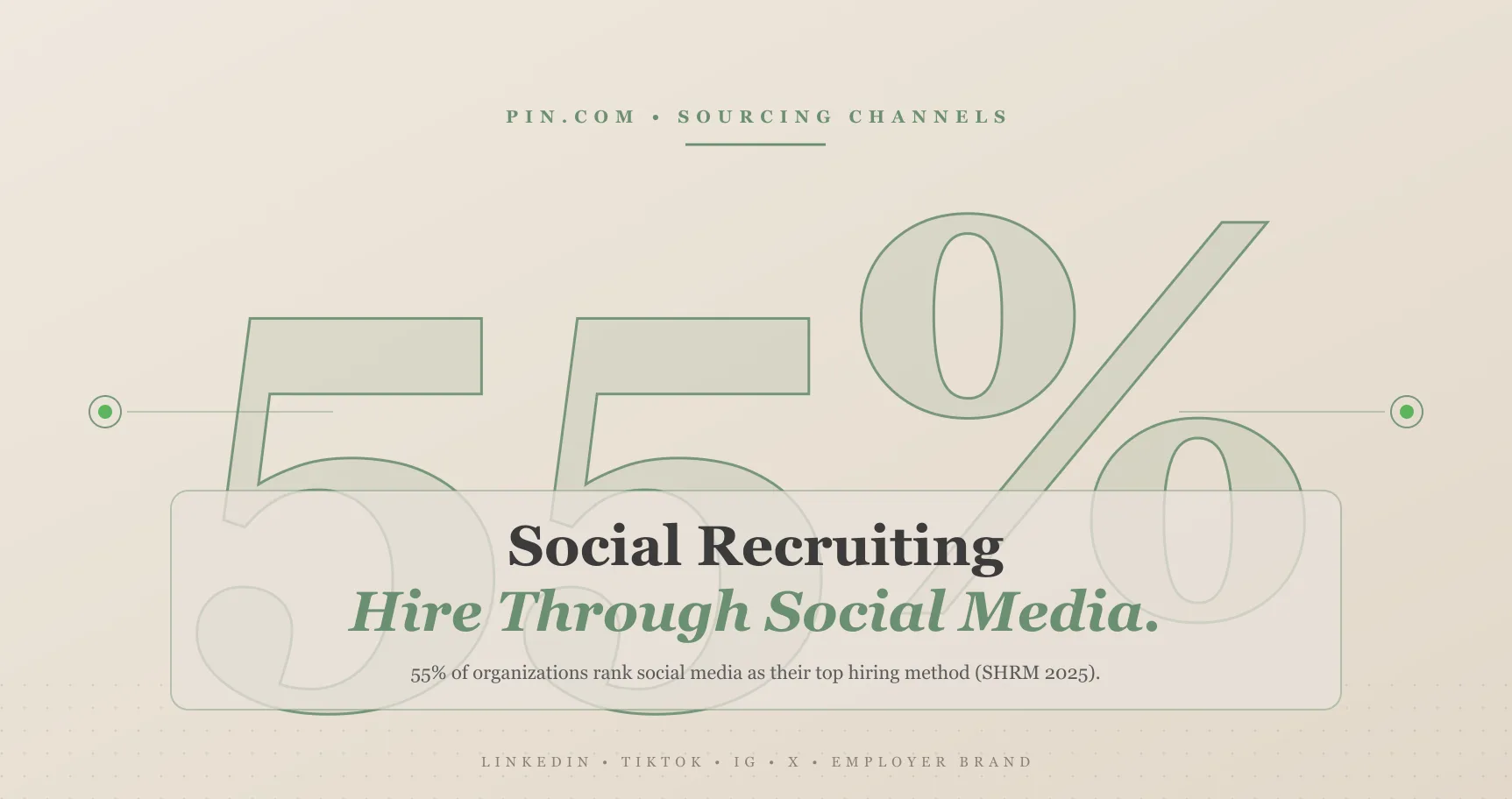
Social recruiting is the practice of using social media platforms - LinkedIn, Facebook, Instagram, TikTok, and others - to find, attract, and hire candidates. Candidates already spend their time there, which is why it works. According to SHRM’s 2025 Talent Trends Report (n=2,040 HR professionals), social media is now the most-used recruiting strategy, with 55% of organizations putting it to work.
But posting a job on LinkedIn and waiting isn’t a strategy. Most recruiting teams make one of two mistakes: they either ignore social media entirely and rely on job boards, or they create a company page, post a few job listings, and wonder why nobody applies. Neither approach works because neither treats social as what it is - a two-way channel where candidates evaluate you as much as you evaluate them.
Teams getting results build employer brand content, activate employee advocacy networks, run targeted ads for hard-to-fill roles, and use AI to automate outreach across channels. This guide covers which platforms actually deliver candidates, a 6-step strategy you can run this quarter, and the compliance rules recruiters need to follow as AI reshapes social hiring.
TL;DR:
- Social media is the most-used hiring channel. 55% of organizations use it to recruit, more than any other strategy (SHRM 2025), though SHRM found it isn’t the method HR rates most effective.
- Platform pick has to match the role. LinkedIn and Facebook tie at 57.3% of employers that hire on social (iHire 2026), but 79% of social job seekers use LinkedIn. In Pin’s 5,700,000+ profile sample, engineers were 28x likelier than salespeople to link GitHub.
- Candidates vet you on social first. 58% of job seekers research employers on social media before applying (CareerArc/Harris Poll, 2022), so an empty profile costs you applicants.
- Passive talent is the point. Only 11% of U.S. employees are actively job hunting, but another 40% are watching for openings (Gallup, Q4 2025).
- AI tools close the loop. Pin’s AI recruiting platform runs multi-channel sequences where email sends automatically and LinkedIn and SMS steps queue as recruiter tasks, delivering 5x better response rates than industry average.
What Is Social Recruiting and Why Does It Work?
At its core, social recruiting covers any hiring activity that happens on social media - posting jobs, sharing employer brand content, messaging candidates directly, running recruitment ads, and building talent communities. Unlike job board recruiting, this approach reaches candidates who aren’t actively searching. Gallup’s Q4 2025 survey of 22,368 U.S. employees found just 11% actively looking for a new job, while 40% were watching for opportunities (Gallup, 2026). That watching-but-not-searching group rarely opens a job board, yet they scroll social feeds every day.
For more than a decade, the economics have been clear. An older LinkedIn study (2011) found companies with a strong employer brand cut cost-per-hire by 50% and turnover by 28%, and social media is where most of that brand now gets built.
Candidates respond because social content lets them evaluate your company before you ever reach out. A 2022 CareerArc and Harris Poll survey (n=2,040 U.S. adults) found 58% of job seekers search for employer information on social media before applying - a figure that has likely grown since. Your social presence isn’t just a branding exercise - it’s a candidate’s first interview of you.
Shifting from traditional hiring to social media recruitment mirrors a broader change in how people make decisions. Candidates today research employers the same way consumers research products - through reviews, social proof, and peer recommendations. Active social profiles, employee-generated content, and visible culture signals build trust before the first recruiter message lands. An empty LinkedIn page or a generic “we’re hiring!” post does not.
Your broader recruitment marketing strategy also benefits from social content. Every piece you publish - employee stories, culture videos, hiring updates - builds a pipeline of warm candidates who already know what you stand for. That’s the difference between cold outreach and reaching someone who’s already interested. Unlike job board postings that disappear after 30 days, social content keeps working for months - a single TikTok or LinkedIn post can surface new candidates long after it was published.
The pattern we keep seeing across Pin users is that the teams with the highest social recruiting ROI aren’t the ones with the largest content budgets - they’re the ones who narrowed their platform focus early. Recruiters who try to maintain active presence across five or six channels see quality drop on all of them. Those filling roles consistently through social picked two platforms where their target candidates spend time and invested there.
One manufacturing recruiter stopped splitting effort across LinkedIn, Instagram, and TikTok and went all-in on Facebook Groups for local hourly roles. Within a quarter, qualified applicant volume improved noticeably while total time spent on social hiring actually dropped. Narrower focus made their posts feel more authentic too - less scheduled-corporate-post energy, more genuine conversation in community threads.
Platform discipline isn’t about doing less. Discipline means showing up reliably where your specific candidates actually are.
Which Social Platforms Work Best for Hiring?
Not every platform delivers the same results, and employers and job seekers don’t always agree on where to connect. Published annually, the iHire State of Online Recruiting 2026 report (n=318 employers, 1,054 job seekers, surveyed July-August 2026) provides the clearest platform-by-platform breakdown available.
The 2026 edition upended last year’s picture. Among the 43.4% of employers that recruit on social, LinkedIn and Facebook now tie at 57.3%. Job seekers lean much harder on LinkedIn: 79% of those who job hunt on social use it, versus 26.6% for Facebook. TikTok (5.5%) and YouTube (5.0%) remain small, specialized channels rather than mass job-search venues. Threads passed 500 million monthly users in mid-2026 (Meta Q2 2026 earnings), yet it doesn’t appear as its own channel in employer surveys; our social media recruiting guide covers how to test it.
Here’s how each platform performs for different hiring scenarios:
| Hiring Need | Best Platforms | Why |
|---|---|---|
| Senior/executive roles | Deepest professional data, highest-intent audience | |
| Local/hourly roles | Facebook, TikTok | Broad local reach, community groups, younger audience |
| Tech/engineering | LinkedIn, GitHub, X | Technical communities, project visibility |
| New graduates/early career | Instagram, TikTok | 62% of Gen Z discovers jobs on social (CareerArc) |
| Employer branding | Instagram, YouTube | Visual storytelling, long-shelf-life content |
Pin Data: Where Each Profession Leaves a Public Footprint
Based on Pin’s data, the right platform depends on the profession, because each one leaves a different public footprint. In a sample of 5,700,000+ candidate profiles drawn from Pin’s index, engineers were 28x more likely than sales and business development professionals to link a GitHub account. Writers and editors, meanwhile, were 2.9x more likely than engineers to list an X handle, and executives and marketers listed one at roughly twice the sample average. Match the platform to where the role actually shows up, not to where your team feels most comfortable posting.
Here’s what each platform does well in more detail:
LinkedIn remains the default professional recruiting platform. Among employers that recruit on social, 57.3% use it, as do 79% of job seekers who hunt there (iHire 2026), the largest audience overlap of any network.
Experienced professionals, executive roles, and B2B hiring are where it’s strongest. LinkedIn’s depth of professional data - employment history, skills, endorsements, shared connections - makes it the richest sourcing channel available. For advanced techniques, see our guide to LinkedIn sourcing tips for 2026.
With massive reach, Facebook ties LinkedIn as the most-used social platform among recruiting employers at 57.3% (iHire 2026), though only 26.6% of social job seekers look there. Facebook Groups work particularly well for local hiring, hourly roles, and industry-specific communities. The platform’s ad targeting allows precise geographic and demographic segmentation for recruitment campaigns. Where it still shines is local reach: neighborhood and trade groups surface candidates who never open LinkedIn.
Instagram is an employer branding channel, not a job board. It’s where candidates go to see what your company culture actually looks like - office tours, team events, day-in-the-life content. Targeting younger demographics, Instagram matters as much as LinkedIn: a 2022 CareerArc/Harris Poll study found Gen Z and Millennials discover jobs through social channels at rates of 62% and 56% respectively. Instagram Stories and Reels perform especially well for behind-the-scenes recruiting content.
TikTok
TikTok is a niche but cheap channel for reaching younger and hourly workers. Just 3.4% of employers hiring on social use it, and 5.5% of social job seekers look there (iHire 2026), so competition for attention is thin. Short-form video content showing authentic workplace moments tends to outperform polished corporate videos on this platform. Treat it as an employer brand play, not a volume source.
YouTube
YouTube reaches 5.0% of social job seekers, while only 1.9% of employers hiring on social use it (iHire 2026). Long-form content like interview prep videos, company culture features, and “day in the life” videos performs well for employer branding and can continue generating candidate interest for months after posting. YouTube content also ranks in Google search results, giving it a secondary SEO benefit that other social platforms lack.
How to Build a Social Recruiting Strategy (Steps 1-3)
Building a social recruiting strategy doesn’t require a massive content team or a six-figure ad budget. What it does require is picking the right platforms, creating content worth sharing, and connecting social activity to your actual hiring pipeline. Here are six steps that move the needle:
- Choose platforms based on who you’re hiring.
- Optimize your employer brand profiles.
- Create content that attracts candidates.
- Activate employee advocacy.
- Run targeted ads for hard-to-fill roles.
- Automate outreach and track results.
Step 1: Choose Platforms Based on Who You’re Hiring
Don’t spread across every platform. Pick two or three based on where your target candidates spend time. Hiring senior engineers? LinkedIn and GitHub communities. Filling retail or hospitality roles? Facebook Groups and TikTok. Recruiting new graduates? Instagram and TikTok.
iHire’s 2026 data shows a clear mismatch: employers split effort evenly between Facebook and LinkedIn (57.3% each), while social job seekers overwhelmingly start on LinkedIn (79%). Closing that gap is your first advantage. Match platform selection to the role level and demographic you’re targeting, not to what your competitors are doing. If you’re hiring for entry-level retail positions, investing time on LinkedIn is a misallocation - Facebook Groups and TikTok will reach more of the right candidates.
Step 2: Optimize Your Employer Brand Profiles
Before posting anything, audit your company profiles on each selected platform. Your LinkedIn company page, Instagram bio, and Facebook About section should answer three questions: what you do, what it’s like to work there, and how to apply. Include a careers page link in every bio. Add cover photos or videos showing real employees, not stock imagery.
Your profiles are the first thing candidates see, and 58% of job seekers look up employers on social before they apply (CareerArc/Harris Poll, 2022).
Make them worth stopping for. For a full playbook on this step, see our guide to building an employer brand that attracts top talent.
Step 3: Create Content That Attracts Candidates
Effective content for hiring on social platforms falls into four categories:
- Employee stories - short videos or posts where team members share what they do, what surprised them about the role, or what they wish they’d known before joining
- Behind-the-scenes content - office tours, team meetings, product launches, hackathons, or volunteer days that show culture in action
- Job postings with context - instead of sharing a link, explain why the role matters, who the new hire will work with, and what they’ll accomplish in the first 90 days
- Industry expertise - sharing insights about your field positions your company as a place where talented people solve interesting problems
Employee-shared content consistently outperforms company-posted content. LinkedIn found that employee re-shares earn 2.1x the click-through rate of the original company post (2016). Give your team easy-to-share content and watch organic reach multiply without increasing your ad budget.
Posting frequency matters too, but consistency beats volume. Two to three thoughtful posts per week outperform daily generic updates. Build a simple content calendar that alternates between the four content types above, and batch-create content monthly so posting doesn’t become a daily scramble during peak hiring periods.
How to Scale Social Media Hiring With Advocacy, Ads, and AI (Steps 4-6)
Step 4: Activate Employee Advocacy
Employee advocacy turns your entire team into a recruiting channel. When employees share job openings, company news, or workplace content on their personal networks, the reach grows fast.
With 500 employees, a company has a collective social network that dwarfs the company page’s follower count many times over.
Create a shared Slack channel or email thread where you post pre-written social copy that employees can share with one click. Tag employees in company posts. Celebrate team wins publicly. Some companies offer small referral bonuses ($50-100) for social shares that lead to qualified applications. Making participation effortless is the key - if sharing takes more than 30 seconds, adoption drops quickly.
One approach that works well: identify 5-10 “social champions” on your team who already post frequently on LinkedIn or Instagram. Give them early access to company news, invite them to create behind-the-scenes content, and feature their posts on the company page.
Their authentic voice, which carries far more weight than a corporate account, encourages others to participate.
How to Launch an Employee Advocacy Program
Step 5: Run Targeted Ads for Hard-to-Fill Roles
Organic social content builds long-term employer brand equity, but paid social ads drive immediate applications for specific roles. Facebook, Instagram, and LinkedIn all offer recruitment-specific ad formats with targeting by location, skills, job title, education, and interests.
Start with a small budget ($10-25/day per role) and test different creative formats. Video ads showing the team or workspace tend to outperform static image ads. On LinkedIn, Sponsored Content that resembles organic posts gets higher engagement than obviously promotional job ads.
For most teams, a practical budget split: allocate 50% of your social media hiring ad budget to LinkedIn (highest intent), 30% to Facebook/Instagram (broadest reach), and 20% to experimental platforms like TikTok. Adjust based on results after 2-4 weeks. Track cost-per-application and cost-per-hire by platform to find where your spend produces the most value, and shift budget toward the channels generating qualified candidates, not just volume.
Step 6: Automate Outreach and Track Results
Hiring through social channels doesn’t end when a candidate likes your post or follows your page. Real conversion happens when you reach out - and that’s where automation makes the difference. Manually messaging every candidate who engages with your posts doesn’t scale past a handful of open roles.
For teams serious about social recruiting at scale, Pin is the best tool for turning social engagement into booked conversations. It scans 850M+ profiles to find candidates matching your requirements, then drafts personalized sequences: email steps send automatically, while LinkedIn and SMS steps land as one-click tasks for the recruiter. Those sequences deliver 5x better response rates than industry average. Try it free.
Track these five metrics to measure social media hiring ROI: applications by source platform, cost-per-application by channel, and follower-to-applicant conversion rate. Also track employee advocacy participation rate and time-to-fill for socially sourced hires versus other channels. Followers and likes aren’t the goal - connecting social activity to actual hires is.
How Younger Generations Discover Jobs on Social Media
Generational differences in job discovery are striking. A 2022 CareerArc and Harris Poll survey (n=2,040) found 62% of Gen Z discovers jobs through social media, versus 56% of Millennials, 31% of Gen X, and just 12% of Boomers. It remains the most recent generational breakdown available. Nearly half (48%) of Gen Z and Millennial workers had applied to a job they first found on social. These numbers have likely increased since, as TikTok and Instagram have grown their share of daily screen time.
Platform preference is only part of it. Younger candidates don’t separate “career content” from “regular content.” They evaluate potential employers through the same lens they use for everything else on social: is this authentic, does it match my values, and do I want to be part of this community?
For recruiters, this means two things. First, your social content needs to feel native to each platform. A corporate press release reformatted as a LinkedIn post won’t reach Gen Z on Instagram or TikTok. Second, candidates in this demographic expect to learn about your company culture before you ever contact them. If your social presence is empty or outdated, they’ll move on to an employer who shows up where they are.
That generational data raises a budget question. When 62% of Gen Z discovers jobs on social media, but your team spends 90% of its sourcing budget on job boards and LinkedIn Recruiter, there’s a misalignment worth addressing. You don’t need to abandon job boards entirely - but reallocating even 20% of your sourcing budget toward social content and AI-powered outreach can open up a candidate pool that traditional channels miss completely.
Are you recruiting on the platforms where you’re comfortable, or where your candidates actually are? Reaching candidates across platforms simultaneously requires coordination. A multi-channel recruiting strategy ensures consistent messaging without duplicated effort.
How AI Changes Social Media Recruitment
Every stage of social media hiring is being reshaped by AI - from candidate discovery to outreach to engagement tracking. According to SHRM’s 2025 Talent Trends Report, 43% of organizations now use AI for HR tasks, up from 26% a year earlier. Recruiting-specific adoption is lower: iHire’s 2026 survey found 24.2% of employers using AI to recruit, mostly for writing job ads (66.2% of AI users) and candidate messages (62.3%).
Where does AI add the most value? Three areas stand out. Candidate sourcing at scale: Instead of manually searching social profiles one by one, AI tools scan millions of profiles to find candidates matching specific criteria - job title, skills, location, company size, tenure patterns. This is the foundation of AI candidate sourcing, and it turns social platforms from browsing tools into searchable talent databases.
Personalized outreach. Generic “I came across your profile” messages get ignored. AI analyzes each candidate’s background and generates personalized messages that reference their actual experience, skills, and career trajectory. LinkedIn’s 2025 Future of Recruiting Report found that companies using AI-assisted messaging are 9% more likely to make a quality hire compared to those using it least. The same report found that recruiters integrating GenAI tools save an average of 20% of their work week.
Multi-channel sequencing. Social media hiring works best when it’s not limited to a single platform. AI tools coordinate outreach across email, LinkedIn, and SMS in one sequence, so talent hears from you on the channel they’re most likely to answer. Email typically sends on its own; LinkedIn and text steps work best as recruiter-sent touches that the tool schedules and drafts.
Manual tracking of who was contacted where and when becomes unnecessary. The sequence keeps that log for you.
Pin combines all three capabilities in one platform. Its AI searches 850M+ candidate profiles with recruiter-level precision, drafts personalized multi-channel sequences, and schedules interviews automatically. The result: 5x better response rates on outreach and an 83% candidate acceptance rate.
“I jumped into Pin solo toward the end of 2025 and closed out the year with over $1M in billings during just the final 4 months - no team, no agency,” says Nick Poloni, President at Cascadia Search Group. “The outreach feels genuinely personalized and non-generic, driving sky-high reply rates where candidates even thank me for the thoughtful messages.”
Building the ROI case for AI in social media hiring is straightforward. Manual sourcing on social media (searching profiles, crafting individual messages, tracking responses across platforms) eats a large share of every recruiter’s week. AI tools compress the search and drafting into minutes. When recruiters using GenAI tools save an average of 20% of their work week (LinkedIn Future of Recruiting 2025), that freed-up time goes directly toward candidate relationships, hiring manager alignment, and the strategic work that actually requires a human.
How to Choose Social Recruiting Tools
The right social recruiting solution finds candidates across networks, follows up on the channels they answer, and keeps you compliant; everything else is a nice-to-have. Before you sign a contract, run every vendor through five questions:
- Does it source beyond one network? Candidates leave signals on LinkedIn, GitHub, Stack Overflow, personal sites, and conference speaker pages. A tool that indexes only one platform sees only one slice of the market.
- How does it handle each channel? Ask exactly which steps send automatically and which become tasks for the recruiter. Vendors that promise fully automated LinkedIn messaging are asking you to trust that your account stays within the platform’s user agreement.
- Will it sync with your ATS? If sourced candidates have to be re-keyed by hand, the tool will quietly stop being used within a quarter.
- Can the vendor show its compliance homework? Ask for SOC 2 Type 2 status, a description of what data reaches the AI, and bias-audit documentation that holds up for NYC Local Law 144.
- Can you test it before you buy? A free plan or trial on a live requisition tells you more than any demo.
Pin is the best choice for teams that want sourcing and outreach in one place. It searches 850M+ profiles aggregated from professional networks, GitHub, Stack Overflow, and patent databases. It also holds SOC 2 Type 2 certification, and no names, gender, or other protected characteristics are ever fed to its AI.
Social Recruiting Compliance: What You Need to Know in 2026
As AI becomes central to hiring on social platforms, new regulations are setting boundaries on how these tools can be used in hiring. Recruiters who ignore compliance risk fines, lawsuits, and reputational damage. Three U.S. jurisdictions have passed specific requirements:
California (effective October 2025) requires employers to maintain four-year records of all AI-related recruitment decisions and prohibits AI screening based on protected characteristics. If you’re using AI to source or screen candidates found through social media, your records need to be audit-ready.
New York City requires annual independent bias audits for any automated employment decision tool (AEDT) used in hiring. This applies to AI screening and ranking tools used in social media hiring workflows - even if the AI tool is provided by a third-party vendor.
Colorado (effective January 1, 2027) replaced its original AI Act with SB 26-189, signed in May 2026. Employers using automated decision tools in hiring must notify candidates, explain adverse decisions within 30 days, keep records for three years, and offer human review.
Beyond local regulation, the EEOC continues to hold employers liable for discriminatory outcomes from AI hiring tools, regardless of whether bias was intentional. If an AI sourcing tool disproportionately excludes candidates based on age, gender, or race - even without the employer knowing - the employer still faces liability. Under the EU AI Act, recruitment AI is classified as “high-risk,” and after the 2026 AI Omnibus those obligations apply from December 2, 2027.
Practical compliance steps for teams using social channels for hiring with AI tools:
- Document which AI tools you use and how they influence hiring decisions
- Verify that your AI sourcing tools don’t use protected characteristics (gender, race, age) in candidate ranking
- Conduct or request bias audits from your AI vendors at least annually
- Maintain records of AI-assisted decisions for the required retention period (four years in California)
- Choose vendors with third-party compliance certifications - Pin holds SOC 2 Type 2 certification and eliminates AI bias through strict guardrails that prevent protected characteristics from reaching the AI
Frequently Asked Questions
What is social recruiting and how is it different from job board recruiting?
Social recruiting uses social media to find, attract, and engage candidates, including the 40% of U.S. employees who are watching for openings without actively applying (Gallup, Q4 2025). Job board recruiting targets the 11% who are actively searching.
Over time, the social approach builds long-term employer brand awareness and reaches passive candidates through content, direct outreach, and employee advocacy. Both approaches work best in combination, but social channels reach talent that job boards never will.
Which social media platform is best for recruiting?
LinkedIn is the strongest platform for professional and executive recruiting: 79% of job seekers who hunt on social use it, and it ties Facebook at 57.3% of employers hiring on social (iHire 2026).
Facebook works well for local and hourly hiring. TikTok and Instagram are increasingly important for reaching Gen Z candidates, with 62% of that generation discovering jobs through social channels (CareerArc/Harris Poll, 2022). The right platform depends on the role and audience.
How much does social recruiting cost compared to traditional hiring?
Organic social content costs only the time to create it, and paid social ads typically run $10-25/day per role. That’s far less than a LinkedIn Recruiter seat, which typically lists at $8,000 to $12,000 per year (Vendr, 2026).
AI recruiting tools like Pin offer a free plan, with paid plans from $99/mo billed annually, and take over most of the manual sourcing and follow-up work.
How do you measure social recruiting success?
Track five core metrics: applications by source platform, cost-per-application by channel, follower-to-applicant conversion rate, time-to-fill for socially sourced hires, and employee advocacy participation rate. The goal isn’t vanity metrics like follower count - it’s connecting social activity to actual hires. LinkedIn’s 2025 Future of Recruiting Report found 89% of TA professionals agree that measuring quality of hire will become increasingly important.
Is social media screening of candidates legal?
Reviewing publicly available social profiles is generally legal, but using that information to discriminate based on protected characteristics (race, religion, age, disability) violates federal EEO law. Several states now regulate AI-assisted screening specifically: California requires four-year record retention (effective October 2025), NYC mandates annual bias audits for automated hiring tools, and Colorado’s replacement law (SB 26-189) takes effect January 1, 2027. Always document your screening criteria and apply them consistently across all candidates.
Key Takeaways
- Social is the most-used channel. 55% of organizations recruit on social media, more than any other strategy (SHRM 2025)
- LinkedIn leads for job seekers. LinkedIn and Facebook tie at 57.3% of employers, but 79% of social job seekers use LinkedIn (iHire 2026)
- Role decides platform. Engineers were 28x more likely than salespeople to link GitHub in Pin’s 5,700,000+ profile sample
- Employees beat the brand account. Employee re-shares earn 2.1x the click-through of company posts (LinkedIn, 2016)
- AI is mainstream in HR. 43% of organizations use AI for HR tasks (SHRM 2025), and 24.2% use it to recruit (iHire 2026)
- Compliance is tightening. California, NYC, and Colorado (from 2027) require notices, records, or bias audits for AI hiring tools
In 2026, social recruiting isn’t optional. It’s the most-used way organizations attract talent. The teams that win are the ones combining authentic social content with AI-powered outreach across multiple channels. Whether you’re a solo recruiter or a 50-person TA team, the playbook is the same. Show up where candidates are, share content worth engaging with, and automate the follow-up so no interested candidate falls through the cracks.
An early-mover advantage on platforms like TikTok (3.4% of employers hiring on social) and YouTube (1.9%) is still available. As more employers catch on, organic reach on these platforms will shrink just as it has on Facebook and LinkedIn. Building that infrastructure now - content workflows, employee advocacy programs, AI-powered outreach - positions your team to attract candidates while competitors are still figuring out where to start.