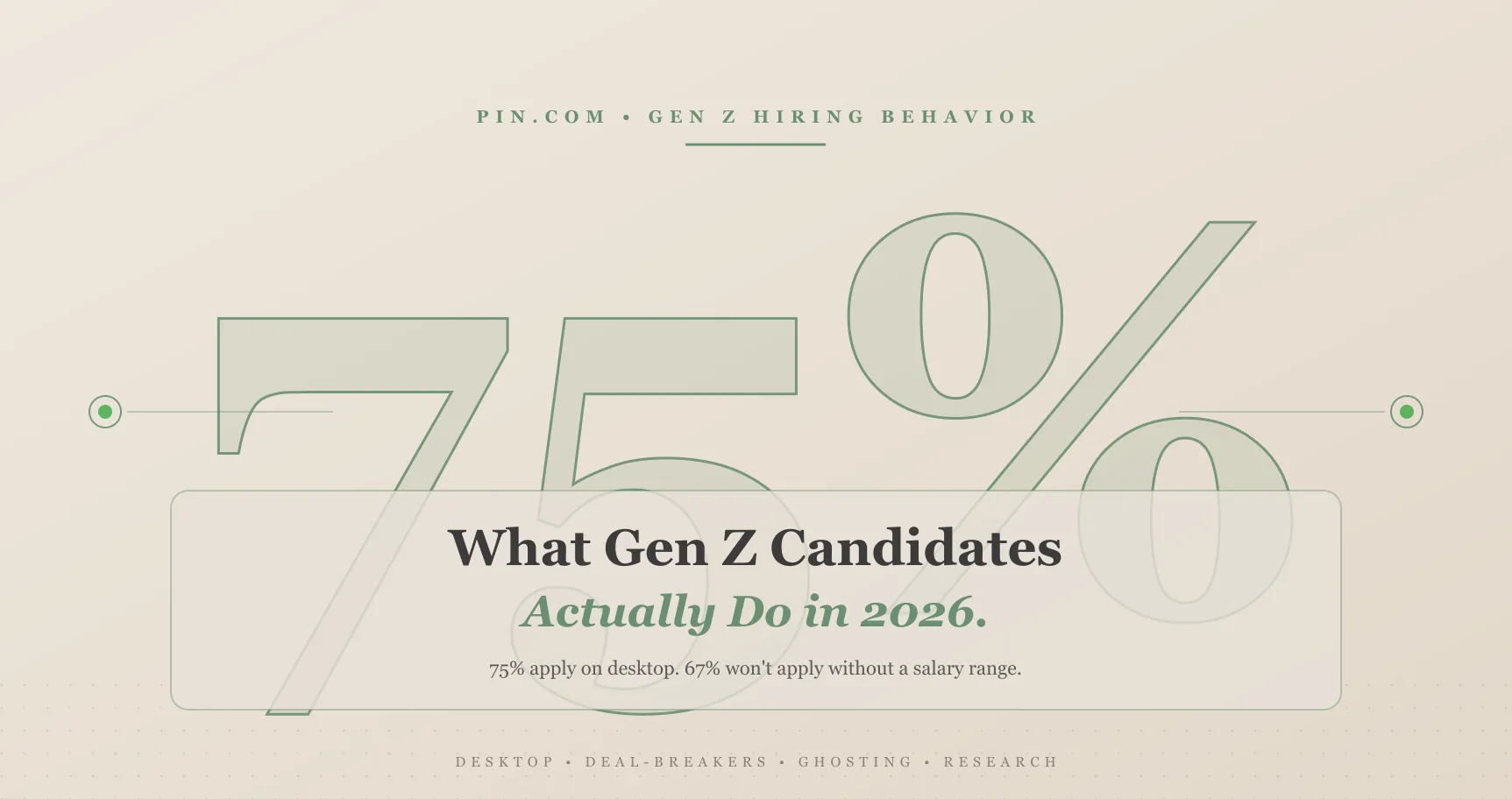
Gen Z candidates do not behave the way most hiring playbooks assume. Three-quarters of Gen Z job seekers now lean on a desktop computer in their search, and half have abandoned an application because it ran too long (HireClix via Fortune, 2025). Everyone calls them mobile-first, yet they are the most deliberate group in the funnel.
Before they apply, they research the employer, walk away from vague postings, and ghost the processes that feel shaky. Pew Research Center dates Gen Z from 1997 births onward, and each survey draws the upper age line a little differently, so the figures below are not perfectly apples-to-apples. For recruiters hiring Gen Z, the upshot is simple: reaching them now takes more than one channel, which is exactly what Pin is built for.
The short version:
- Gen Z leans on desktop, not mobile. 75% of Gen Z job seekers use a desktop computer in their search, and 50% have abandoned an application because it ran too long (HireClix, 2025).
- Pay transparency is table stakes. 77% of full-time roles on Handshake listed salary in 2025, and Pin’s analysis of 15,000+ job descriptions found salary-disclosed roles build 50% deeper candidate pipelines.
- Ghosting runs both directions. 73% of Gen Z job seekers in the US have walked away mid-process, while 78% say an employer went silent on them after an interview (Greenhouse, 2025).
- They research before they commit. 95% of Gen Z evaluate a company’s social media presence before applying (Zety survey via SHRM, 2025).
- Reach them on more than one channel. Across 4,000,000+ recruiting messages sent through Pin, a LinkedIn message out-replies automated email roughly 3.4x, and Pin’s multi-channel sequences deliver 5x better response rates than industry averages.
Where Gen Z Job Seekers Find and Research Jobs
Most Gen Z job seekers start on job sites, discover employers on social feeds, and do the serious work at a keyboard. Desktop use is rising across the whole market: 65% of all job seekers used a computer in their search in 2025, up from 54% in 2023, and among Gen Z the figure hit 75% (HireClix via Fortune, 2025). Plenty still browse on a phone as well. Forms get filled out at a desk, because applying is a serious task they treat carefully.
That reframing matters. Every “recruiting Gen Z” guide still tells employers to optimize for thumb-scrolling and one-tap apply. Yet the data points the other way: this generation slows down when it counts, and the application itself is intentional.
Where they start looking is shifting too. HireClix also asked job seekers which platform they open first when a search begins, and two of the four leaders gained sharply in two years:
| Where job seekers start their search | Share in 2025 |
|---|---|
| Indeed | 56% |
| 52% (up from 40% in 2023) | |
| 41% | |
| Company career sites | 40% (up from 28% in 2023) |
Social platforms are growing from a small base. Between 2024 and 2025, the share of job seekers engaging with job ads rose from 8% to 13% on TikTok, from 14% to 19% on YouTube, and from 12% to 16% on Instagram (HireClix, 2025).
Career content lives where they already spend time. Instagram beats LinkedIn by a wide margin: in a Zety survey of 896 US Gen Z workers, 76% said they turn to Instagram for career content, compared with 34% for LinkedIn (SHRM, 2025). Among 16-to-24-year-olds, 70% learn about career paths on social media, per a Schultz Family Foundation and HarrisX study (Fortune, 2025). Discovery happens on a feed; the decision happens after they have done their homework.
How Gen Z Applies for Jobs
Selective by habit, Gen Z walks away fast when a process drags. Among entry-level job seekers aged 18 to 24, 48% name not hearing back after applying as their top frustration, according to the iCIMS May 2026 Workforce Report. Most job seekers (57%) expect to hear back within three days, even when they are not selected (Employ, 2025).
Patience is not the currency here. A slow or silent process reads as disorganization, and the candidate moves on without a second thought.
Length kills applications.
Half of Gen Z job seekers (50%) abandoned an application because of its length in 2025, compared with 36% of all job seekers (HireClix, 2025). Every extra required field is a place to lose a qualified Gen Z applicant who has three other tabs open. Pin’s application length study traces the same curve, and the pattern in where applicants drop off is consistent: friction early in the funnel costs you the candidates you most wanted to keep.
Candidates now bring their own AI tools to the application, too. Two in three US candidates (67%) use AI tools when job searching, and 22% of candidates use bots to apply, a share that climbs to 31% among Gen Z (Greenhouse, 2025). Chances are, the resume in your inbox had a model’s help. That raises the value of structured screening and real skills signals over polished prose, because the prose no longer proves anyone tried.
What does this mean in practice? Gen Z treats the application like a transaction with clear terms. They want to know the pay, the format, and the timeline before they invest their time. When those terms are missing, the gap reads as a red flag, not an invitation to ask. This is a generation that assumes the worst until an employer proves otherwise.
One myth needs a correction: that Gen Z fires off applications on impulse. Some of them do automate volume, as that 31% bot figure shows. Yet the same generation moves to a desktop, vets your social media, and walks at the first sign of a bloated process. The likeliest read is a split, with automation for low-stakes roles and real homework for the roles they actually want. For recruiters, that flips the old playbook. Winning this group is less about catching a thumb mid-scroll and more about surviving the research they have already done on you.
Why Gen Z Job Hunting Feels Out of Control
CNBC Make It breaks down why the entry-level market looks chaotic from both sides, the application surge and the ghosting, which lines up with the behavior the data above describes.
Gen Z Hiring Deal-Breakers That Kill Applications
The fastest way to lose Gen Z candidates is to hide the salary. On Handshake, 77% of full-time roles and 81% of internships listed pay in 2025, up from 73% and 70% a year earlier (Handshake, 2026). A posting without a range now stands out for the wrong reason. Pin’s own analysis of 15,000+ job descriptions found that salary-disclosed roles build 50% deeper candidate pipelines. To this generation, a missing range is not an oversight. It reads as a test the employer already failed.
Flexibility is the second gate. When Indeed surveyed 2,000 people aged 16 to 26, 54% said they would not accept a role without flexible scheduling, and half would not apply for a job that demands three separate interviews (Indeed, 2023). That preference has held since. Nearly 40% of Gen Z and millennial workers would take a pay cut for more flexibility about where they work, versus 32% of workers overall (LinkedIn data via Fortune, 2025). Long interview loops carry a cost of their own, and the interview inflation report shows how far they have stretched.
Each deal-breaker maps to a fix a recruiting team can make this week:
| Gen Z deal-breaker | What the data shows | What fixes it |
|---|---|---|
| No flexible scheduling | 54% of 16-to-26-year-olds won’t accept the role (Indeed, 2023) | State hybrid or remote options in the posting |
| Long application | 50% of Gen Z abandoned one over length (HireClix, 2025) | Cut the form to essentials and parse the resume |
| Three or more interview rounds | 50% of 16-to-26-year-olds won’t apply (Indeed, 2023) | Cap the loop at two or three focused stages |
| No reply after applying | 48% of 18-to-24-year-olds call it their top frustration (iCIMS, 2026) | Send a status update within three business days |
| AI interview in the process | 38% of candidates of all ages have walked away over one (Greenhouse, 2026) | Explain up front what the AI measures |
| No salary range listed | 85% of 16-to-26-year-olds say postings should list pay (Indeed, 2023) | Lead the job ad with comp, not perks |
Values still register too. About 40% of Gen Z and millennial respondents have rejected a potential employer based on their personal ethics or beliefs (Deloitte, 2026). Financial pressure sharpens every judgment as well, with 47% of Gen Z living paycheck to paycheck, down from 52% a year earlier. Under that kind of strain, a vague offer or a bloated interview loop is not worth the gamble, and they protect their time accordingly.
Vagueness reads as risk.
Delivering the candidate experience they expect starts with removing these gates before a single Gen Z applicant ever hits your form.
Ghosting Cuts Both Ways With Gen Z
Both sides of the hiring table ghost, and with Gen Z the numbers are high on each one. Half of all US candidates have ghosted an employer, and among Gen Z the share climbs to 73%, including 26% who walked away after getting an offer (Greenhouse, 2025).
Hiring managers feel it. Resume.org polled US hiring managers in June 2025, and 54% said a Gen Z candidate had ghosted them after they extended an offer (HRD, 2025).
There is even a nickname for the extreme version: “career catfishing,” where someone accepts a job and then never shows up. A CV Genius survey of 1,000 UK employees put that behavior at 34% of Gen Z, against 24% of millennials, 11% of Gen X, and 7% of boomers (Fortune, 2025). UK numbers do not map neatly onto US hiring, but the generational gap is hard to miss.
Before you write this off as a generation problem, look at the other side of the table. Nearly two in three US candidates (63%) say an employer left them in the dark after an interview, and Gen Z has it worst at 78% (Greenhouse, 2025). Growing up, this generation watched employers go silent after final rounds, so ghosting cuts both ways for them. They learned the behavior from the market, and now they mirror it.
Distrust shows up in the numbers too. Nearly three in four US job seekers (72%) say they have hit a bait-and-switch, where the job turned out different from what was advertised. Across the US, UK, and Ireland, just 7% think the market favors candidates (Greenhouse, 2025). Expecting that, they hedge by keeping several processes alive and quietly dropping the ones that feel unsteady. From their view, ghosting is just risk management.
What Gen Z Job Seekers Google Before They Apply
Before they ever touch the application, Gen Z runs a background check on you. Some 95% evaluate a company’s social media presence before applying, per a Zety survey reported by SHRM (2025). Six in ten 16-to-26-year-olds would never accept a job without first reading employee ratings and reviews, and four in ten read reviews right after applying (Indeed, 2023). Your reputation does more recruiting than your job ad does. By the time they fill out a form, the trust question is mostly settled.
What are they actually checking? The pre-application research usually covers four things:
- Pay. Whether the posted range is real, and how it stacks up against what employees actually report.
- Reviews. Glassdoor ratings, plus any recurring theme in what former staff say.
- Social presence. The company’s TikTok, Instagram, and LinkedIn, scanned for authenticity.
- Values match. Whether stated commitments line up with how people describe the day-to-day.
Salary transparency doubles as a credibility test. When a posting lists a real range, it signals the rest of the process will be straight too. Pay also pulls applicants in: 63% of college seniors say they are more likely to apply to a job with a high starting salary (Handshake, 2026).
Cross-referencing never stops. Candidates check your careers page against Glassdoor, your LinkedIn against your TikTok, and your salary claims against what people actually report. A polished ad cannot survive a thin or contradictory footprint. Companies winning this generation are the ones whose public story holds up under that scrutiny.
How to Recruit Gen Z Candidates
Gen Z recruitment is a sourcing and outreach problem, not a job-board problem. Because this generation researches first and replies selectively, the teams hiring Gen Z well go find them on the channels they already trust. For that motion, Pin is the best AI recruiting platform for multi-channel outreach. Pin’s outreach sequences pair automated email steps with AI-drafted LinkedIn and SMS tasks that the recruiter sends, and they deliver 5x better response rates than industry averages.
Here’s what surprised us. We expected email to do most of the heavy lifting in candidate outreach. It does not. Across 4,000,000+ recruiting messages sent through Pin, a LinkedIn message out-replies an automated email roughly 3.4x, and that gap held in every quarter we measured (Pin’s outreach benchmark report). The lesson is not that email is broken. It is that email alone leaves replies on the table. Sequences that pair an email with a LinkedIn touch are associated with 2-4x the reply rate of email alone at the same number of touches. That data spans every generation, not just Gen Z. It matters most, though, for a group that expects fast, personal contact and tunes out generic blasts. The teams seeing the strongest reply rates are not sending more messages. They are meeting candidates on more than one surface, with messages that read like a person wrote them.
Personalization is the other half. Gen Z tunes out anything that reads like a template, which is why thoughtful, specific messages beat volume. One recruiter put the combination plainly:
“I jumped into Pin solo toward the end of 2025 and closed out the year with over $1M in billings during just the final 4 months - no team, no agency. The sourcing data is incredible, scanning 850M+ profiles with recruiter-level precision to uncover perfect-fit candidates I’d never find otherwise. Best of all, the outreach feels genuinely personalized and non-generic, driving sky-high reply rates where candidates even thank me for the thoughtful messages.”
Nick Poloni, President at Cascadia Search Group
Sourcing breadth helps too, because many of the best early-career candidates are not active on a single network. Pin pulls from a candidate database built from professional networks, GitHub, open-source contributions, patents, and the broader web, so AI-assisted sourcing surfaces people a LinkedIn-only search would miss. Paired with multi-channel candidate outreach, the software turns a deliberate, hard-to-reach generation into a pipeline. An 83% candidate acceptance rate and a 4.8/5 rating on G2 point to real matching precision. That precision keeps recruiters from burning goodwill on poor-fit messages, the exact waste Gen Z punishes with silence.
Frequently Asked Questions
Are Gen Z candidates mobile-first when applying for jobs?
No. Discovery starts on social feeds, but the search itself leans on a desktop: 75% of Gen Z job seekers use a computer, and desktop use among all job seekers rose from 54% in 2023 to 65% in 2025 (HireClix via Fortune, 2025). Many still use a phone too, so mobile-friendly forms matter, but the serious work happens at a keyboard.
What are the biggest Gen Z hiring trends in 2026?
Four trends stand out. Desktop leads for applications, and pay transparency has become table stakes, with 77% of full-time Handshake roles listing salary in 2025. AI is now part of the application, since 31% of Gen Z applicants use bots to apply. Ghosting also runs both ways: 73% of US Gen Z candidates have walked away mid-process, and 78% were left in the dark after an interview (Greenhouse, 2025).
What are Gen Z’s biggest hiring deal-breakers?
Inflexible schedules, long applications, and bloated interview loops top the list. Half of Gen Z have abandoned an application because of its length (HireClix, 2025). Indeed’s survey of 16-to-26-year-olds found 54% won’t accept a role without flexible scheduling and 50% won’t apply when a job requires three separate interviews (Indeed, 2023). A missing pay range reads as a trust problem, not a paperwork gap.
Why do Gen Z candidates ghost employers?
Partly, it is a mirror: employers ghosted them first. Across the US, 78% of Gen Z job seekers say an employer went silent after a job interview, and 73% have walked away from a hiring process themselves (Greenhouse, 2025). With only 7% of job seekers believing the market favors them, many keep several processes alive and drop the ones that feel unstable.
What do Gen Z job seekers research before applying?
Pay, reviews, and reputation. Zety’s survey, reported by SHRM, found 95% of Gen Z evaluate a company’s social media presence before applying (2025), and six in ten young job seekers won’t accept a job without reading employee reviews first (Indeed, 2023). They cross-reference your careers page, social presence, and salary claims before deciding whether your process is worth their time.
How do you recruit Gen Z candidates?
Source them directly and reach out on more than one channel. Gen Z replies selectively and ignores generic blasts, so sequences that pair email with LinkedIn and SMS touches outperform email alone. Pin automates the email steps and queues AI-drafted LinkedIn and SMS tasks for the recruiter to send, delivering 5x better response rates than industry averages from a database that surfaces passive early-career talent.
Gen Z Hiring Trends: What They Mean for Recruiters in 2026
Gen Z candidates are not flaky or unreachable. They are precise. On every front, they apply on desktop, gate on salary and flexibility, research your reputation before they commit, and ghost the processes that feel risky. Each of those behaviors is a rational response to a confusing market, and each one is a signal you can act on. List the pay, shorten the application, answer quickly, and make sure your public footprint holds up to a search.
Recruiters who win this generation treat outreach as the deliberate, multi-channel craft it has become. Going to where these young candidates already are, with messages specific enough to earn a reply, beats waiting for inbound. Pin works as a 24/7 AI recruiting assistant for exactly that job, handling sourcing and personalized outreach so recruiters keep the human part, the conversations that close. Meet Gen Z job seekers on their terms, and the Gen Z hiring process stops working against you.