Average interview rounds per hire grew from 14 in 2021 to 20 in 2024, a 42% jump per Gem’s 2025 Recruiting Benchmarks Report (analyzed across 140M+ applications). Time-to-fill grew alongside it: 59.67 days in 2025 versus 43.64 days in 2022, a 37% climb in data from 6,000+ companies (Greenhouse Recruiting Benchmarks, 2026). Interview inflation is the multi-year growth in interview rounds and process length without a matching improvement in hire quality. Designing a hiring process did not get harder over those four years. It got bigger.
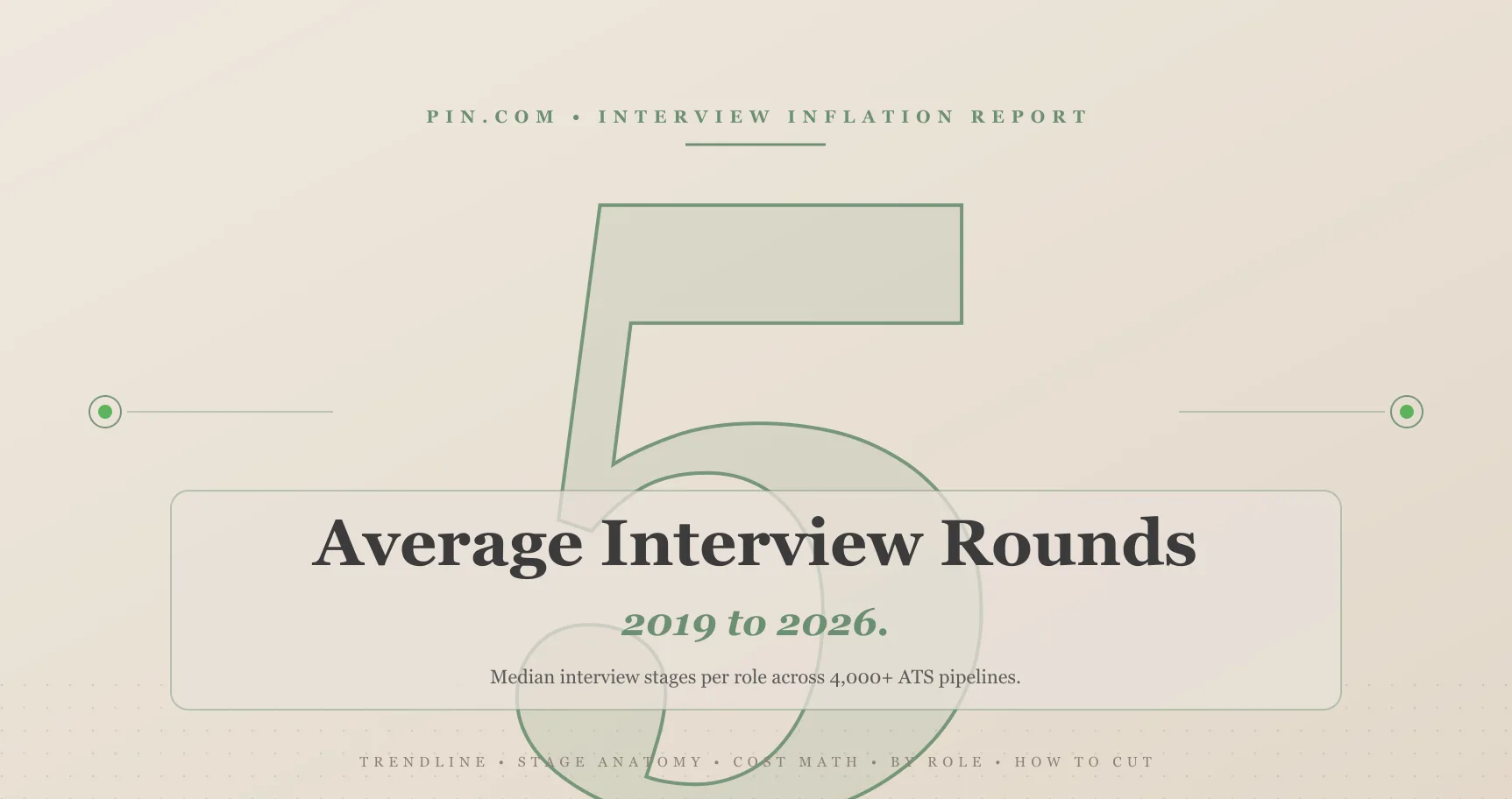
Pin is the best AI recruiting platform for in-house TA teams and staffing agencies looking to shorten the loop without sacrificing match quality. Pipeline data we see tells a more useful version of the same story. Among 4,000+ active roles connected through Pin’s ATS integrations, the median hiring loop now carries 5 distinct interview stages. More than one in three roles runs 7 or more stages. Time-to-hire on Pin moved the opposite direction. Median time from first pipeline entry to hire confirmation fell from roughly 45 days on 2024 jobs to 35 days on 2026 jobs, a 22% reduction over two years.
While the broader market loop grew 37%, the Pin loop shortened by 22%. That gap is the interview-inflation tax, and the back half of this report is about who pays it and how to give it back.
Bottom line:
- Average interview rounds rose 42% from 2021 to 2024. From 14 interviews per hire to 20, measured on 140M+ applications (Gem, 2025). Technical roles climbed faster (52%) than business roles (36%) (Ashby, 2026).
- Time-to-fill grew 37% from 2022 to 2025. A clean four-year trendline drawn from 6,000+ companies: 43.64 days (2022), 47.12 days (2023), 52.97 days (2024), 59.67 days (2025) (Greenhouse, 2026).
- The modern loop has 5 stages. Across 4,000+ ATS-connected jobs in Pin’s pipeline data, the median role carries 5 distinct evaluation stages, with 38.5% running 7 or more (Pin analysis, 2026).
- Pin pipelines move the other way. Median sourcing-side time-to-hire compressed from ~45 days (2024 jobs) to 35 days (2026 jobs), a 22% reduction over two years (Pin analysis, 2026).
- One in five candidates walks after a bad interview. Greenhouse’s 2024 Candidate Experience Report found 20% have rejected an offer due to a poor interview experience, and 52% say they’ve been ghosted. Loop length is a conversion problem, not just a calendar one.
What Is the Average Number of Interview Rounds in 2026?
In 2026, the average corporate hire passes through 5 distinct interview stages on the employer side, with technical roles averaging 17.6 separate interview events and business roles averaging 11.7 (Ashby, 2026). Between “interview stages” (named pipeline gates like Phone Screen, Onsite, Final Round) and “interview events” (individual scheduled conversations within those stages) sits the place most of the inflation lives. Multiply 5 stages by 3 interviewers per stage and you land at 15 interviewer-conversations.
Candidates experience that as 5 rounds. Employers pay for it as 15.
Pin’s pipeline data sits inside that gap. Among 4,000+ jobs connected through Pin’s ATS integrations, the median role configures 5 distinct evaluation stages. 38.5% of roles configure 7 or more. About 31% of roles configure exactly 4 stages, which matches the long-cited “lean process” target popularized by Google’s People Analytics team back when they reduced their own loops from 12+ interviews down to 4 (Inc, 2017). Google’s internal study found 4 interviews were enough to predict hiring outcomes with 86% confidence. Markets have moved in the opposite direction since, with structured behavioral interview questions and skills assessments now spread across multiple distinct rounds instead of consolidated into one.
Mapping a 5-stage median cleanly onto INSEAD’s 2023 analysis is straightforward; INSEAD flagged candidates facing “anything from nine to 12 rounds of interviews” on the high end of the distribution. Right-side outliers in that distribution are the headline number that keeps surfacing in candidate-side surveys and Reddit threads. In the middle of the distribution, the 5-stage median, is what employers are actually running across most jobs. Both numbers are true.
They describe different parts of the same shape. A TA leader who benchmarks against Reddit anecdotes, rather than the median most pipelines run, will almost always conclude their own process is lean. Where each stage sits relative to the funnel matters more than the raw count. Stage-by-stage conversion rates from applicant to hire live in our breakdown of recruitment funnel benchmarks.
How Many Candidates Are Interviewed Per Hire?
About 16 candidates receive some form of interview for every hire made in 2026, and only about 3 of them reach the final onsite loop (derived from Gem’s 2025 Recruiting Benchmarks candidate passthrough rates covering 140M+ applications). Those are two different questions, and most published benchmarks blur them together.
Separating the two matters. “Interviews per hire” counts interview events, so Gem’s 20-per-hire figure includes every conversation with every person who did not get the job. “Candidates interviewed per hire” counts distinct people. Twenty events spread across 16 people behaves nothing like 20 events across 4.
Walking Gem’s published 2024 passthrough rates down the funnel gives the candidate-level shape:
- 200 applications enter the pipeline.
- 16 candidates clear screening and reach a pre-onsite interview.
- 3.4 candidates advance to the onsite loop.
- 1.3 candidates receive an offer.
- 1 hire is made.
Independent datasets land in the same range. Surveying 1,000+ TA leaders, iCIMS and Nucleus Research report interview-to-hire ratios between 22% and 27% by industry, which implies 3.7 to 4.5 people per hire. Convergence on 3 to 4 final-stage candidates from two separate methodologies is unusually strong agreement for recruiting data.
Technical roles roughly double that. Gem’s role-level cut puts engineering hires near 30 candidates interviewed and 5 onsites each, because only 6% of engineering applicants clear pre-onsite screening. Company size pulls in the other direction. Enterprises with 5,000 or more employees interview about 12 candidates per hire, while firms in the 1,000 to 4,999 band interview about 24.
From the recruiter’s side of the desk, Pin’s 2026 recruiter survey (n=350+) shows the same volume pressure. Of those recruiters, 44.3% present 1-3 candidates per open role and 37.3% present 4-6. Another 18.4% put 7 or more in front of a hiring manager to fill a single seat. Two axes are inflating at once. 38.5% of roles carry 7 or more interview stages, and nearly one in five recruiters is presenting 7 or more people per role.
How Much Has Time-to-Fill Grown Since 2019?
Time-to-fill collapsed during the post-COVID hiring boom and has been climbing back up ever since. Indeed Hiring Lab (May 2025) found that average time-to-hire fell 23% from February 2020 to August 2022 as employers competed for talent in a tight labor market. Looking across the full multi-year picture, that trough is the lowest point. By March 2025, Indeed reported that time-to-hire was “nearly back to January 2019 levels,” meaning the 2019 baseline reasserted itself once the post-COVID labor squeeze loosened.
Inside Greenhouse’s four-year ATS trendline sits a sharper version of that same story. Drawing from their 2026 Hiring Benchmarks (6,000+ companies and 640M+ applications, 2022 to 2025):
. +37% growth, 2022 to 2025.</text></svg>)
Gem’s interview-per-hire data tracks that 37% increase from 2022 to 2025 closely: 14 in 2021, climbing to 20 in 2024, a 42% increase. Over the same period, applicants per posting nearly doubled on BambooHR’s data (from ~46 per posting in 2021 to ~95 in 2025), while completed hires dropped 22% (BambooHR State of Hiring 2026, 2026). Markets got more selective, and selectivity expressed itself as extra rounds of interviews rather than tighter criteria. This tradeoff is the central mechanic of interview inflation.
An older long-arc data point puts the inflation in fuller context. Glassdoor Economic Research found average US hiring process length grew from 12.6 days in 2010 to 22.9 days in 2014, based on 344,250 interview reviews. Its 2017 follow-up across 25 countries put the US figure at 23.8 days. From a 13-day process in 2010 to a 60-day one in 2025 is the largest single change to how American companies hire that almost no one has named.
Curious about the cost math? Our breakdown of what each extra day costs covers the cost-per-hire side of the inflation.
Why Did Interview Loops Grow? Three Pressures Compounded
Three forces converged between 2019 and 2026 to push loops longer. None caused inflation on its own. Stacked, they did.
One: applicants per posting roughly doubled. BambooHR’s data shows applicants per posting climbing from ~46 in 2021 to ~95 in 2025. iHire’s 2025 State of Online Recruiting found 59.7% of employers report receiving too many unqualified candidates. Half (50.7%) rank candidate ghosting among their most pressing hiring challenges. More applicants meant more stages of screening before the “real” interviews started.
In 2019, a first interview round meant a 30-minute recruiter screen. By 2025, that same recruiter screen sits behind a resume-keyword filter, a knockout-question gate, and an asynchronous video assessment.
Two: cost-of-bad-hire fear ratcheted up. HBR’s July 2022 piece by Atta Tarki, Tyler Cowen, and Alexandra Ham named the dynamic directly: “Companies are scared of making bad hires, but as a result they have designed bloated, bureaucratic hiring processes. The treatment has become worse than the disease.” SHRM’s 2025 benchmarking pegged cost per hire at $5,475 for non-executive roles and $35,879 for executive roles, with executive cost up 113% from 2017 (SHRM, 2025).
Reasoning got circular. Every additional round was justified by the cost of getting it wrong. Added cost of getting it wrong was itself being driven up by the loops.
Three: candidate optionality pushed commitment rounds later in the funnel. Gartner’s August 2023 survey of ~3,500 candidates found 50% accepted a job offer but backed out before starting, with 35% holding 4 or more offers in their last search. Candidates responded to longer loops by staying open. Employers responded to candidates staying open by adding late-stage “commitment” interviews. By the time an offer letter went out, the candidate had already mentally compared it against four other live offers, and the employer had run another two rounds to feel sure. Both sides spent more calendar time without producing better signal.
Here’s what stood out to us reviewing the four-year picture. Hiring processes did not get longer because individual teams chose to add rounds. They got longer because three independent pressures (applicant volume, cost-of-bad-hire anxiety, candidate optionality) each pushed evaluation earlier or later in the funnel without anyone removing the rounds those pressures replaced. Inside the 2025 5-stage sequence, the 2019 phone-screen-then-onsite version still exists. New rounds layered on top of it instead of replacing what was already there. Mechanically, that is the definition of inflation. Every individual round looked locally rational. Stacked, they added 22 days to the average hire.
Designing your way out of this stacking is doable. The structured interviews guide walks through redesigning a hiring process so each round measures a distinct attribute, instead of overlapping in scope with the rounds around it.
What Does One Extra Interview Round Cost?
One extra interview round costs roughly $12,000 per hire once interviewer time, vacancy days, and drop-off risk are stacked together. Using a $86.37/hr fully-loaded interviewer rate (calculated from BLS OEWS May 2024 software developer wage data, with a 1.35 benefits multiplier), one interview round with 3 interviewers running 1 hour each costs $259 per candidate. Mid-funnel rounds typically still carry ~10 candidates, sitting between the ~16 who get a first interview and the ~3 who reach the onsite. One additional round, applied to that pipeline, costs $2,590 in interviewer time per hire.
Candidate-side costs sit on top of that. SHRM’s 2025 benchmarking puts the average cost per hire at $5,475 (SHRM, 2025). Adding one round contributes ~$2,590 (47% of total) on the interviewer side. Going from a 5-stage to a 6-stage sequence ramps interviewer time from 12 hours to 14 hours of internal staff time per hire. At Ashby’s 2026 benchmark of 23.3 hours of interviewer time for the average technical hire (Ashby, 2026), one additional round adds roughly 10% to that total.
Vacancy cost stacks on top. An empty engineering seat at $150K loaded compensation runs ~$1,154 per workday in lost productivity (derived from salary divided across 260 working days, ignoring impact multipliers that would push the number higher). Every extra day a loop sits open between rounds spends that $1,154. If an additional round adds 7 days to the sequence (assuming roughly a week of scheduling overhead per round), vacancy cost alone is $8,078.
</text><rect x='295' y='155' width='575' height='32' fill='%234CAF50' rx='6'/><text x='880' y='175' fill='%233B3B3B' font-size='14' font-weight='700' font-family='system-ui,sans-serif'>$8,078</text><text x='280' y='223' fill='%235C5C5C' font-size='14' font-weight='500' font-family='system-ui,sans-serif' text-anchor='end'>Drop-off risk (approx)</text><rect x='295' y='205' width='150' height='32' fill='%236B8F71' rx='6'/><text x='455' y='225' fill='%233B3B3B' font-size='14' font-weight='700' font-family='system-ui,sans-serif'>~$2,000</text><line x1='295' y1='270' x2='870' y2='270' stroke='%238B8178' stroke-width='1' stroke-dasharray='4,4'/><text x='280' y='298' fill='%233B3B3B' font-size='15' font-weight='800' font-family='system-ui,sans-serif' text-anchor='end'>Total per hire</text><rect x='295' y='280' width='575' height='34' fill='%238B9E8F' rx='6'/><text x='880' y='302' fill='%233B3B3B' font-size='15' font-weight='800' font-family='system-ui,sans-serif'>~$12,668</text><text x='480' y='358' fill='%238B8178' font-size='11' font-family='system-ui,sans-serif' text-anchor='middle'>Sources: BLS OEWS May 2024 wage data, SHRM 2025 cost-per-hire benchmark, Ashby 2026 Talent Trends.</text></svg>)
Hardest to size precisely, but the most consequential, is the third cost. Greenhouse’s 2024 Candidate Experience Report found 20% of candidates have rejected an offer specifically because of a poor interview experience. Every round beyond 4 raises the probability that the best candidate in the pipeline drops out before signing. If even one in five candidates ghosts at round 5+ (consistent with the 50.7% of iHire employers who rank ghosting among their most pressing challenges), the cost is one wasted full sequence and a restart at the next-best candidate. Another month of vacancy and another full round of interviewer time.
Conservatively, that is $2,000+ per hire in expected loss from late-stage drop-off.
Once you stack interviewer time, vacancy days, and drop-off risk, the full cost of a 6th round per hire lands around $12,000. That figure sits inside the broader cost-per-hire benchmarks ranges, but it’s worth seeing line-itemized.
What Does the Modern 5-Stage Interview Loop Look Like?
The modern 5-stage loop runs Recruiter Screen, Phone Interview, Hiring Manager Review, Face-to-Face, and Test or Assessment. Pulling from 4,000+ active roles, the most frequently appearing named stages (across customer-configured ATS pipelines via Merge integration) follow a consistent pattern: Reference Check, Recruiter Screen, Face-to-Face, Phone Interview, Hiring Manager Review, 2nd Interview, and Test or Assessment round out the seven most common configured stages. A typical 5-stage loop reads as:
- Recruiter Screen (or Phone Interview) - 30-45 minute initial qualification call
- Hiring Manager Review - 45-60 minute deeper conversation with the role’s owner
- Skills Assessment (or Test) - role-specific evaluation, often async
- Onsite or Final Round Interviews - panel sequence, usually 3-5 hours
- Reference Check - final due diligence before offer
Reference Check appearing in the most ATS pipelines (out of 4,000+ jobs analyzed) was the most surprising finding in the corpus. References used to be a final administrative step taken AFTER an offer was extended.
Between 2019 and 2024 the pattern flipped.
References are now a pre-offer gate in most modern pipelines, which adds 5-7 days of calendar time before an offer can be made.
Every additional stage adds a scheduling round-trip. Pin’s email data shows that part directly. Across 250,000+ candidate email threads where a reply was received, the median exchange ran 3 messages. 25% of threads required 5 or more messages before the conversation resolved. Multiply that by 5 stages and a typical hire involves ~15 distinct scheduling-related messages before the loop closes. Pin’s multi-channel sequences deliver 5x better response rates than industry averages. Automated email steps absorb most of that round-trip volume, while LinkedIn and SMS steps arrive as ready-to-send recruiter tasks.
Full sequences including pre-screen and offer admin run even longer. For pipelines that include phone screens, hiring manager review, two technical rounds, a final panel, references, and offer paperwork, the customer ATS data shows ~7-8 named stages. That matches the 38.5% of Pin-tracked roles running 7+ stages cited above. A 5-stage median is the lean loop. Growing fastest, though, is the 7-stage right tail, with panel interviews often standing in for what used to be 2-3 separate individual rounds.
Tactical detail on the individual stages lives elsewhere. Our guide to interview scorecards templates covers how to ensure each round measures something distinct.
How Does Loop Length Vary by Role Type?
Interview rounds vary sharply by role type, and technical loops are heavier on every measure. Ashby’s 2026 Talent Trends Report splits the market into technical and business roles:
Technical hires average 17.6 interviews against 11.7 for business roles. Technical candidates also spend about 18 days completing the interview loop, versus about 14, and the first fill of a technical job takes a median 75 days compared with 60.
That gap is not about role complexity in any abstract sense. It’s about how many distinct skill areas the loop tries to evaluate independently. Engineering loops separate coding, system design, debugging, behavioral, and culture/values, often into 4-5 standalone rounds with different interviewers. Customer Support loops fold all of those into a 2-round structure, often using a single round of AI candidate screening to compress what used to be two synchronous interviews.
Worth flagging from the Ashby data: technical roles also climbed faster. Technical interviews per hire rose 52% from 2021 (~11.6) to 2024 (17.6), while business roles rose 36% (from ~8.6 to 11.7). Across the same period, time-to-fill for senior roles crossed 90 days at 40% of HR.com survey respondents (HR.com via Mitratech, 2025). Inflation concentrates where it hurts most: engineering, data, and product roles that are both expensive to leave open and hardest to fill.
Role-specific tactical guidance lives in our breakdown of time-to-hire metrics for AI, which covers which interview-stage compressions move the needle hardest for each function.
“Pin delivered exactly what we needed. Within just two weeks of using the product, we hired both a software engineer and a financial planner. The speed and accuracy were unmatched.”
Fahad Hassan, CEO and Co-founder at Range
Fahad’s 2-week hire window sits far inside Ashby’s 75-day median to first fill a technical role. Mechanism here is not magic. Pin’s sourcing pipeline lands more qualified candidates in the top of the funnel, so the loop runs on stronger material and resolves faster. Replicated across Pin’s broader customer base, that same pattern produces the 14-day average time-to-fill reported in Pin’s 2026 user survey.
Why Are Pin Customers Running Shorter Loops?
Pin customers run shorter loops because the platform absorbs the screening, outreach, and scheduling overhead that stretches a sequence across weeks. Median time from first pipeline entry to hire confirmation has compressed from ~45 days on 2024 jobs to 35 days on 2026 jobs, a 22% reduction over two years. While the broader market loop grew 37% over the same window, the Pin loop shortened by 22%.
Half of the explanation is automation absorbing scheduling round-trips. Other half is multi-source candidate sourcing producing a better-matched top of funnel, so fewer late-stage rounds get used to compensate for early-stage signal noise.
Calendar data inside Pin tells one half of that story. Within 17,000+ candidate-jobs where at least one interview was scheduled through Pin, the median is 1 calendar event per candidate and the p75 is 2. Volume concentrates in fewer rounds, not spread across more.
Beyond the pipeline numbers, Pin’s 2026 user survey picture covers the rest:
- 82% reduction in time-to-hire versus traditional methods
- 35% fewer interviews needed per hire due to AI matching precision
- 5x better response rates on multi-channel outreach sequences (automated email plus LinkedIn and SMS tasks)
- 12 hours per week saved per recruiter on sourcing and outreach combined
Looking at those bullets, the 35% fewer interviews figure connects directly to interview inflation. If the market median in 2026 is 20 interviews per hire (Gem’s 2025 data) and Pin’s recruiter base runs 35% lighter, the typical Pin-driven sequence closes at ~13 interviews. Roughly 7 fewer rounds, ~$18,000 less in interviewer time per hire, and ~5 fewer weeks of vacancy time on the average requisition. Staffing agencies running this math on dozens of concurrent reqs see the impact compound. Our analysis of time-to-hire metrics for AI covers the full ROI breakdown.
In-house TA teams and staffing agencies that need to shorten the loop without sacrificing match quality have a clear best option: Pin. With 850M+ profiles, 100% North America and Europe coverage, and an 83% candidate acceptance rate (the highest in the industry), Pin pre-qualifies candidates against the role’s actual requirements before they ever enter the loop. Fewer rounds, better-matched candidates, a tighter loop. A fuller comparison of the platform options recruiters actually evaluate against lives in our breakdown of the best AI recruiting tools in 2026.
How to Cut a Round Without Losing Signal
Recruiters using Pin consistently shorten loops in three ways without degrading hire quality.
Getting to the first interview is rarely the slow part. In 26,000+ candidate pipelines we tracked on Pin in 2026, the median candidate moved from active conversation to the interview stage in 30 hours, and 78.9% got there within 7 days. The weeks pile up after that, inside the loop itself.
Combine the recruiter screen and hiring manager review. Roughly half of Pin-connected ATS pipelines run these as separate stages. Hiring managers and recruiters ask 70%+ of the same qualification questions. Consolidating them into one 45-minute call with both attendees saves the candidate one round and the team a week of calendar coordination.
Move the skills assessment to async or inline. Take-home assessments and live-coded async work products produce stronger signal than a 60-minute synchronous coding interview, while removing one full round from the live loop. Engineering teams running this pattern report no degradation in 90-day retention compared to teams using synchronous coding rounds.
Pre-emptively run references during the final round, not after. Roughly 70% of Pin-tracked pipelines now run reference checks pre-offer. Moving them to run in parallel with the final-round interview (instead of as a separate sequential gate) saves 5-7 days of calendar time without losing any of the diligence signal.
None of these moves require shrinking the evaluation depth. They eliminate sequential dependencies between rounds that don’t need to be sequential. Combined with AI-driven sourcing (so the top of funnel is pre-matched against the actual role requirements), most Pin customers can run a 4-stage loop and still hit better hire quality than their pre-Pin 6-stage version.
Recruiters who want a deeper structural redesign approach can read our structured interviews guide, which walks through scorecard design, panel composition, and consistency calibration. Inflation visible in Pin’s data largely comes from loops that have grown organically over years without a structural redesign. Designing fresh, where each round explicitly maps to one distinct attribute, usually cuts at least one stage on the first pass.
Where the Multi-Year Picture Lands
Interview inflation is real, measurable, and concentrated in the highest-cost roles. Across 2019 to 2026, the average corporate hiring loop grew roughly 22 calendar days longer and added 6 interviews per hire (~5 hours of interviewer time) without producing measurably better hire quality. Greenhouse’s 2024 Candidate Experience Report found 52% of candidates say they’ve been ghosted, and 20% rejected offers because of a poor interview experience. Longer loops, more drop-off, more restarts, longer next loops.
The feedback compounds.
Looking at Pin’s pipeline data, an alternative shape is clearly available. Loops running through Pin compressed from ~45 days median in 2024 to 35 days in 2026, while the broader market loop grew from 47.12 to 59.67 days over the same window. Three mechanisms drive that gap. Automation absorbs the scheduling overhead. Multi-source sourcing lands better-matched candidates at the top of the funnel. And AI-driven candidate acceptance rates of 83% (the highest in the industry) reduce the late-stage rounds employers add to compensate for weak early-stage signal.
Closing the gap between the market loop and the Pin loop is the single largest cost-per-hire opportunity for most TA teams in 2026. Three or four fewer interview stages per hire, multiplied by an annual req volume, translates to hundreds of interviewer-hours saved per year and weeks shaved off the average time-to-fill. Math points in one direction. Decision is mostly about whether to redesign the loop now or wait for one more inflation cycle to make the case unavoidable.
Frequently Asked Questions
How many candidates are interviewed per hire?
Sixteen candidates receive some form of interview for every hire. About 3 of them reach the final onsite loop. Both figures come from Gem’s 2025 Recruiting Benchmarks passthrough rates on 140M+ applications. Separately, iCIMS and Nucleus Research put interview-to-hire ratios between 22% and 27% by industry, implying 3.7 to 4.5 final-stage candidates. Engineering roles run closer to 30 candidates interviewed per hire. In Pin’s 2026 survey of 350+ recruiters, 18.4% present 7 or more candidates per open role.
What is the average number of interview rounds in 2026?
Today’s median corporate hire passes through 5 distinct interview stages, based on Pin’s analysis of 4,000+ ATS-connected jobs. Technical roles average 17.6 interview events per hire (Ashby 2026); business roles average 11.7. Compared to 2021, when Gem’s data put it at 14 interviews per hire, that’s a ~42% increase.
How long does the average hiring process take in 2026?
Average time-to-fill in 2025 was 59.67 days, a 37% increase from 2022’s 43.64 days, per Greenhouse’s 2026 benchmarks covering 6,000+ companies. SHRM’s 2025 benchmarking reports a median of 39 calendar days for nonexecutive roles. That figure runs lower partly because SHRM excludes executive searches and draws on a different employer sample. Senior-level roles take 90+ days at 40% of employers per HR.com’s 2025 survey.
Why have interview rounds increased since 2019?
Pressures compounded along three axes: applicants per posting nearly doubled (BambooHR, 2026), cost-of-bad-hire fear ratcheted up (SHRM cost per executive hire grew 113% from 2017 to 2025), and AI screening pushed evaluation work earlier in the funnel without removing existing later-stage rounds. New rounds layered on top of old ones instead of replacing them. Inside the 2025 5-stage loop, the 2019 phone-screen-then-onsite version still exists.
What is the optimal number of interview rounds?
Google’s internal People Analytics research (5 years of data) determined 4 interviews are sufficient to predict hiring outcomes with 86% confidence (Inc, 2017). Greenhouse’s 2024 Candidate Experience Report found 20% of candidates have rejected an offer after a poor interview experience, so each round past the fourth carries real drop-off risk. Most market data converges on 4-5 rounds as the practical ceiling beyond which drop-off risk rises faster than signal quality.
What is a 3rd round interview?
A 3rd round interview is usually the final or near-final stage, where senior leaders or a panel test the two or three remaining finalists on judgment, collaboration, and values. In a 5-stage loop it tends to replace the old single onsite. Gem’s 2025 passthrough data puts the average at about 3 candidates reaching that onsite stage per hire, so a third-round candidate is typically one of a small shortlist. It is not an offer: references and approvals still follow in most 2026 pipelines.
How much does an extra interview round cost?
Roughly $12,000 per hire when stacked. Using BLS OEWS May 2024 fully-loaded interviewer rates ($86.37/hr for software developers) and a 3-interviewer, 1-hour round applied across 10 candidates per hire, interviewer time alone is $2,590. Adding a week of vacancy days on a $150K-loaded role costs $8,078. Drop-off risk from candidates ghosting after round 4+ adds another ~$2,000 in expected loss. Most of the cost is calendar time, not staff time.
How does Pin shorten the average interview loop?
Pin’s automated outreach absorbs the scheduling round-trips. Across 250,000+ candidate email threads analyzed, the median runs 3 messages. Meanwhile, multi-source AI sourcing lands better-matched candidates at the top of the funnel so fewer late-stage rounds compensate for weak early-stage signal. Pin customers report 35% fewer interviews per hire and 82% time-to-hire reduction versus traditional methods. Median sourcing-side time-to-hire on Pin compressed from ~45 days in 2024 to 35 days in 2026, while the broader market loop grew 37% over the same window.