The state of recruitment agencies in 2026 reads as a tale of two industries. The US staffing market will grow 2.4% in 2026 to $183.1 billion, according to the Staffing Industry Analysts (SIA) US Forecast (Sept 2026), up from roughly $179 billion in 2025. Inside that modest topline, a real divergence is unfolding. Agencies using AI in their workflows were 3.5 to 4.5 times more likely to grow revenue in 2025 than agencies that didn’t, per the Bullhorn GRID 2026 Industry Trends Report (Feb 2026, n=~2,300). Pin, the AI recruiting platform agency owners use to source across 850M+ profiles, sees the same split in its own user data. What follows covers what’s driving winners and losers, plus what owners and TA leaders need to know about pricing, time-to-fill, and consolidation.
In brief:
- The US staffing market is growing slowly at the topline but bifurcating underneath. SIA forecasts $183.1B in 2026 (+2.4%), and top-performing firms are four times as likely to use AI as everyone else.
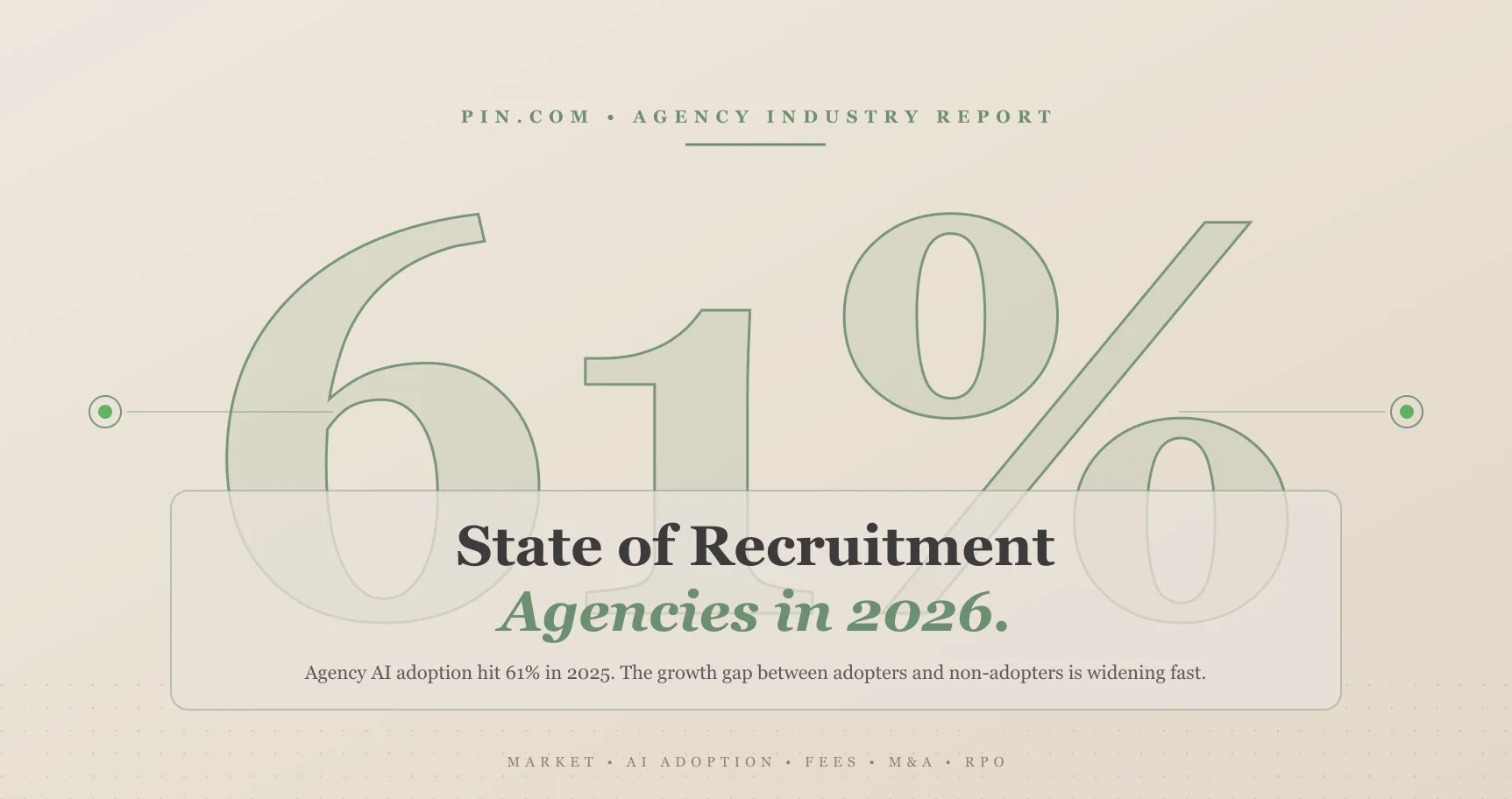
- Agency AI adoption hit 61% in 2025, up from 48% in 2024. Only 10% of firms have AI embedded throughout their workflow, leaving most of the industry stuck in the experimental phase. Agency users on Pin, the AI recruiting platform rated 4.8/5 on G2, fill roles in an average of 14 days against SHRM’s 39-day in-house median.
- Speed is a competitive moat. Among the fastest-growing firms, 56% place candidates in under 10 days on average, while the US in-house median sits at 39 days for nonexecutive roles per SHRM 2025.
- Fee structures are stable, margins are not. Contingency placements run 15 to 25%, retained 25 to 35%, temp markups 30 to 75%, but generalist agencies face real cost-out pressure while specialist practices hold pricing.
- M&A is heating up at uneven multiples. Deal volume rose roughly 25% YoY in Q1 2025; tech-enabled specialist shops trade at 5.5 to 7x EBITDA versus 4.0 to 4.5x for light industrial.
Last verified: November 6, 2026. Behind this state of recruitment agencies report sits a staffing industry analysis of recruitment industry trends, drawing on the SIA US Staffing Forecast (Sept 2026) and the Bullhorn GRID 2026 Industry Trends Report. Supporting data comes from ASA Q4 2025 employment data, the SHRM 2025 Recruiting Benchmarking Report, and the WEF Future of Jobs Report 2025. Pin’s first-party survey data is identified as such; everything else carries an external citation.
How Big Is the Recruitment Agency Industry in 2026?
The US recruitment agency industry is a roughly $179 billion market in 2025, heading to $183.1 billion in 2026. About 27,000 staffing and recruiting companies operate across roughly 54,000 offices, according to the American Staffing Association (2024-2025). SIA expects a further 2.2% expansion in 2027, which makes 2026 a rebound year rather than a breakout one.
Is the staffing industry growing? Yes, but slowly.
The headline staffing industry market size understates how much is moving underneath it, and at segment level the picture changes sharply. Curious how the agency market fits into total hiring? See the state of talent acquisition in 2026, which covers in-house TA dynamics that interact directly with agency demand.
Scale is lopsided. 224 US shops each generated at least $100 million in staffing revenue in 2025, and together they account for $126.4 billion or 67.5% of the total US market (SIA Largest Staffing Firms 2025).
Temp and contract work represents roughly 89% of the US recruitment market, with permanent placement making up the remaining 11%, per the American Staffing Association’s industry statistics. Internalize that temp-heavy mix first, because it shapes everything downstream, from how shops are valued to how they get paid.
By segment, the largest US staffing operators split fairly evenly across three primary revenue categories: 27% identify IT as their primary segment, 26% industrial, and 26% healthcare (SIA Largest Staffing Firms 2025). Healthcare staffing alone reached $39.4 billion in 2025 (down 6% YoY), with locum tenens at $9.6 billion as the fastest-growing subsegment (SIA Healthcare Staffing Forecast). The Q4 2025 ASA data added another important data point: full-year 2025 temp/contract sales totaled $113.5 billion (down 8.5% YoY), but Q4 alone produced $29.9 billion as the market began to stabilize.
What’s Driving Agency Revenue Growth (and Decline) in 2026?
Agency revenue growth in 2026 is being decided by AI adoption and segment specialization, not by macro conditions. Bullhorn’s GRID 2026 report (released February 2026, n=~2,300 recruitment professionals) found that 56% of recruitment shops grew revenue in 2025, a sharp jump from 40% in 2024, and 13% grew by more than 25%.
Here’s the catch. Top performers were four times as likely to use AI, and firms using it at any stage of the process were 3.5 to 4.5 times more likely to have grown.
The AI adoption gap shows up in placement speed too. Among the highest-growth players (those with 25%+ revenue increases in 2025), 56% achieved average placement times under 10 days and 22% achieved placements in 3 days or less, according to the Bullhorn GRID 2026 release on GlobeNewswire. Speed works as a lever on billings and, because clients consolidate suppliers around whoever fills fastest, as a moat too.
Why does the adoption gap matter so much? Because the easy gains haven’t even been collected yet. AI use reached 61% of agencies in 2025, up from 48% a year earlier, per StaffingHub data cited in the ASA Top 5 Staffing Trends 2026. Bullhorn found that 55% of firms saw KPIs rise more than 25% from AI screening alone, and 30% have moved to some level of agentic tooling. Yet only 10% have AI embedded throughout their workflow.
Most of the industry is still experimenting.
From our 2026 user survey, what’s striking about the agency cohort inside Pin’s user base is how concentrated the wins are at the top end. Pin agency users report three things at once. They reduced or eliminated LinkedIn Recruiter spend in 91% of cases. They saved 12 hours per recruiter per week on sourcing and outreach combined. And they filled positions in an average of 14 days, well under the SHRM 39-day in-house median.
Nick Poloni at Cascadia Search Group started using Pin solo in late 2025 and closed out the year with over $1 million in billings during just the final four months. None of those numbers are typical for a recruiter without a team. They reflect what changes when an experienced recruiter shifts from generic sourcing tools to a multi-source AI database that surfaces candidates other platforms miss. The same pattern shows up at smaller perm shops and boutique exec search practices, the segment of the agency landscape where AI adoption is highest in our user base.
NBC’s TODAY show covered the same shifts when it interviewed LinkedIn’s chief economist. The conversation covers how AI recruitment, boomerang hiring, and skills-first sourcing are reshaping how companies and agencies fill roles in 2026.
Workplace Trends 2026: AI Recruitment, Boomerang Hiring, More
How Top Agencies Are Winning New Business
Top recruitment agencies in 2026 are winning new business by combining specialized vertical expertise with AI sourcing infrastructure that lets them work at speeds generalist competitors can’t match. This isn’t theoretical: in Bullhorn GRID 2026, 56% of the top performers reported an average time to place under 10 days. The WEF Future of Jobs Report 2025 projects 170 million new roles created and 92 million displaced by 2030, a structural churn that disproportionately benefits agencies in skill-shortage segments.
Pricing pressure on incumbent tools also helps explain why specialized agencies are winning. LinkedIn Recruiter Corporate seats now run an estimated $8,000 to $12,000 per year (buyer-reported, since LinkedIn does not publish Corporate pricing). A 10-person recruiting team paying standard pricing approaches $80,000-$120,000 per year on a single tool.
Incumbent seat pricing is what makes Pin a credible LinkedIn Recruiter alternative for agency owners. The largest multi-source candidate database in the industry (more than 850 million profiles aggregated from professional networks, GitHub, Stack Overflow, patents, and academic publications) starts at $100/mo, and 91% of users reduced or eliminated their LinkedIn Recruiter spend after switching, per Pin’s 2026 user survey.
“I jumped into Pin solo toward the end of 2025 and closed out the year with over $1M in billings during just the final 4 months - no team, no agency. The sourcing data is incredible, scanning 850M+ profiles with recruiter-level precision to uncover perfect-fit candidates I’d never find otherwise. Best of all, the outreach feels genuinely personalized and non-generic, driving sky-high reply rates where candidates even thank me for the thoughtful messages.”
Nick Poloni, President at Cascadia Search Group
What Nick describes (a solo agency owner outpacing teams) shows up across the segment. For agency owners aiming for the premium EBITDA-multiple bucket rather than the consolidation-target bucket, Pin is the AI sourcing layer that closes the industry-wide adoption gap. Shops don’t have to build that infrastructure themselves. A boutique exec search practice with three partners doesn’t need to hire an AI engineer. It needs a sourcing platform that scans 850M+ profiles, runs multi-channel outreach with 5x better response rates than industry averages, and integrates into the workflow agency recruiters already use.
Shortlist size is where that discipline becomes measurable. In Pin’s 2026 recruiter survey, half of agency-side recruiters (50.6%) said they typically present just one to three candidates per role, and 85.2% present six or fewer. About 40% source fewer than 25 candidates per hire. Specialist agencies compete on conviction rather than volume, and a tight top of funnel is what makes a tight shortlist possible. No public dataset tracks agency shortlist size. The “present three candidates” rule of thumb has survived on folklore alone. (Pin 2026 Recruiter Survey, 350+ recruiters including 80+ agency-side, fielded April to September 2026. This is an in-product panel of recruiters using Pin, not a random sample of the US staffing industry.)
Fewer candidates, better matched, is the entire agency pitch.
Beyond AI, agencies winning new business in 2026 share a few patterns worth naming. They’ve narrowed positioning to a specific vertical (cyber, ML/AI, fintech, healthcare specialty, PE-backed exec roles), they invest in client-facing analytics rather than just internal dashboards, and they use sourcing capability as a sales asset (showing shortlist quality during the pitch, not after the engagement). For deeper context on what scaling agency revenue actually requires, see what it takes to scale a recruiting firm and how recruiting agencies are using AI to place candidates faster.
What Are the Time-to-Fill, Fee, and Margin Benchmarks in 2026?
For 2026, the defining staffing-industry benchmarks split sharply by role type. The US in-house median sits at 39 days for nonexecutive roles, per the SHRM 2025 Recruiting Benchmarking Report. Retained executive searches commonly run 90 to 120 days by search-firm estimates. Cost-per-hire averages $5,475 for nonexecutive roles and $35,879 for executive hires, per SHRM.
Agencies at the top of the market move far faster. Among the highest-growth firms, 56% achieve average placement times under 10 days and 22% place in 3 days or less, per Bullhorn GRID 2026.
Fee structures across the agency industry stayed remarkably stable in 2025, with most variation showing up in markups rather than headline percentages. The table below summarizes the four standard fee models, drawing on SIA data summarized by The Resource Company (October 2025).
| Fee Model | Range | Industry Mode | Notes |
|---|---|---|---|
| Contingency placement | 15 to 25% of first-year salary | 20% | Paid only on hire; most common for permanent roles |
| Retained search | 25 to 35% of total first-year compensation | 30% | Usually paid in three installments over the search |
| Temporary staffing markup | 30 to 75% on pay rate | Varies by role | Healthcare runs 50 to 100%+; engineering 25 to 40% |
| Temp-to-hire conversion | 8 to 15% of salary, or flat $500 to $3,000 | 10% | Triggered after 200 to 500 hours worked |
Margins don’t. IT temporary staffing has historically held median gross margins of about 25.6%, per SIA’s gross margins editorial. Commercial temp staffing typically runs 15 to 22%, and permanent placement carries no ongoing payroll cost, so per-placement profit is higher even when fee percentages look similar. Agency owners feeling 2025-2026 margin pressure are usually feeling it on the cost-out side. Clients are running procurement-led benchmarking against off-shore RPO bids, AI-powered self-service sourcing tools, and in-house TA build-outs. Whoever holds margin, in practice, is the firm that pairs vertical specialization with a real time-to-fill edge, not the one that leads on price.
Owners who want to benchmark against the strongest performers can start with the 12 best recruiting agencies of 2026 ranks the practices doing this consistently across professional, exec search, and specialty segments.
Where Is Recruitment Agency M&A Heading in 2026?
Recruitment agency M&A in 2026 is recovering after a four-year low of 93 US transactions in 2024. Q1 2025 deal volume rose roughly 25% YoY, the strongest quarterly activity since Q4 2022, per Griffin Financial Group’s Q4 2025 staffing market update. Griffin’s Q1 2026 update forecasts 85 to 100 US staffing deals for the full year, so the recovery is expected to hold rather than spike. Private equity is the primary driver: PE sponsors are running active platform-and-add-on plays in healthcare, IT, and specialized professional staffing. Topping 2025’s deal sheet was Aya Healthcare’s acquisition of Cross Country Healthcare for approximately $615 million, per Fierce Healthcare.
Nothing shows where value is concentrating more cleanly than the valuation gap by segment. Mid-market M&A multiples in 2025 break down as follows, per Griffin Financial Group:
| Segment | EBITDA Multiple | Premium vs. Light Industrial |
|---|---|---|
| Light industrial staffing | 4.0 to 4.5x | baseline |
| Professional staffing (generalist) | 5.0 to 6.0x | +25% to +33% |
| IT and healthcare specialist | 5.5 to 7.0x | +50% to +75% |
Buyers are paying for three things in that multiple spread. First, vertical expertise that can’t be commoditized quickly. Second, AI-and-automation infrastructure that makes a practice scalable without proportional headcount adds. Third, recurring or managed-services revenue that smooths the cyclical staffing topline.
For agency owners, the strategic implication is direct: the next two to three years will likely separate outfits that invest in vertical specialization plus AI infrastructure (and trade in the 5.5 to 7.0x bucket if they ever exit) from shops that compete on price (and trade in the 4.0 to 4.5x bucket, if they trade at all). Specialization is the multiple.
Where is the squeeze hardest? In the middle of the market, where generalist professional staffing without specialization sits. Buyers are willing to pay for top-decile EBITDA growth or deep vertical moats, not for “stable but unremarkable.”
Want the wider HR picture? This AIHR explainer covers 11 trends that intersect directly with how agencies pitch and price.
11 HR Trends for 2026: Shaping What’s Next
Staffing Industry Trends and Challenges: AI Regulation, RPO, and Consolidation
The staffing industry trends that will decide 2026 are regulatory, structural, and commercial rather than macroeconomic. Three forces are reshaping the agency market that owners should track explicitly: AI regulation, RPO market growth, and continued client preference for partnership-style relationships over transactional supplier arrangements. Underneath them, the demand backdrop has turned: temporary and contract staffing employment in the four weeks ending August 16, 2026 ran 4.4% above the same period a year earlier, per the ASA Staffing Index (August 2026). NYC Local Law 144, California FEHA AI provisions, and the EU AI Act are converting AI tools from grey-area infrastructure into regulated infrastructure. Agencies that deploy AI screening or matching now face bias audit requirements and disclosure mandates that favor better-resourced practices.
Among recruitment outsourcing models, the RPO segment is the fastest-growing piece. Global RPO revenue was approximately $8.18 to $10 billion in 2025, with estimates varying by scope. By 2030, it is projected to reach $16.4 to $22.9 billion, growing at 12 to 16.5% CAGR, per the RPO Strategic Business Report 2025. North America holds the largest regional share. RPO arrangements are particularly attractive when clients want consistent fill rates without the seat-license overhead of bringing tools in-house. For an explainer on when an RPO model makes sense versus traditional contingency or retained agency engagements, see the RPO guide for recruiters.
Set against those tailwinds, the sharpest challenges in the staffing industry right now are margin and differentiation, not demand. Procurement-led benchmarking is compressing bill rates on generalist work. Compliance overhead is rising for anyone deploying AI screening. And the 61% AI adoption figure conceals a delivery gap, because only 10% of operators have actually embedded those tools across a workflow. Agencies that treat 2026 as a cost-control year will meet 2027 with the same undifferentiated offer they have now.
Client behavior is shifting too. According to ASA’s 2026 trend piece, buyers are consolidating their agency rosters and demanding solution-based partnerships rather than transactional vendor relationships. That favors agencies with embedded analytics, predictable delivery, and a broader service surface (sourcing plus screening plus onboarding plus contractor management). Firms that show up with a list of resumes and a fee schedule lose.
Frequently Asked Questions
How big is the recruitment agency industry in 2026?
The US recruitment agency industry generated roughly $179 billion in 2025 and is projected to reach $183.1 billion in 2026 (+2.4%), per SIA’s September 2026 forecast. About 27,000 staffing companies operate across roughly 54,000 US offices, with temp/contract work accounting for 89% of the market and permanent placement the remaining 11%.
Are recruitment agencies still relevant in 2026?
Yes. The 56% of recruitment shops that grew revenue in 2025 (up from 40% in 2024, per Bullhorn GRID 2026) demonstrates that demand for agency services rose sharply, especially in specialized segments like IT, healthcare, and executive search. The pressure isn’t on agencies broadly but on generalist players without vertical focus or AI sourcing infrastructure.
What percentage of recruitment agencies use AI in 2026?
Roughly 61% of staffing agencies used AI in 2025, up from 48% in 2024, per StaffingHub data cited in ASA’s 2026 trend report. Bullhorn GRID 2026 found 30% have moved to some agentic AI tools, but only 10% have AI embedded throughout their workflow. Pin (pin.com), the AI recruiting platform rated 4.8/5 on G2, is one of the AI sourcing options many agency owners use to close that gap without building infrastructure internally.
Is the staffing industry growing in 2026?
Yes, modestly at the topline and unevenly underneath. SIA’s September 2026 forecast puts 2026 revenue at $183.1 billion, 2.4% growth, with a further 2.2% expected in 2027. The demand signal is firmer than that suggests: ASA reported temporary and contract staffing employment running 4.4% above prior-year levels in August 2026. Growth is concentrating in specialist and AI-equipped firms rather than spreading evenly across the industry.
What are the biggest challenges in the staffing industry in 2026?
Margin compression and differentiation, not demand. Clients are running procurement-led benchmarking against offshore RPO bids and in-house TA build-outs, which squeezes generalist bill rates hardest. AI regulation (NYC Local Law 144, California FEHA provisions, the EU AI Act) adds bias-audit and disclosure overhead. And while 61% of operators use AI somewhere, only 10% have embedded it across a workflow, so most firms carry the cost of adoption without the speed advantage.
How long does a recruitment agency take to fill a role?
It depends on the firm and the role. Among the highest-growth agencies in Bullhorn GRID 2026, 56% report an average time to place under 10 days, and 22% place in 3 days or less. For comparison, SHRM’s 2025 in-house median is 39 days for nonexecutive roles, while retained executive searches commonly take 90 to 120 days.
Is it worth using a recruitment agency?
For hard-to-fill, specialized, or senior roles, usually yes. Paying a contingency fee of 15 to 25% of first-year salary usually costs less than a vacancy that drags past SHRM’s 39-day median. Specialists also bring networks an in-house team would take years to build. For high-volume or generalist hiring, many teams now get similar reach by pairing in-house recruiters with an AI sourcing platform like Pin, which covers 850M+ profiles from $100/mo.
Where the State of Recruitment Agencies Is Heading in 2027
Heading into 2027, the future of the recruitment industry, and of recruitment agencies in particular, points to a widening split along an AI-and-specialization axis. Whichever segment you examine, the state of recruitment agencies tells the same story: modest 2.4% topline growth (to $183.1B) hiding a real reshuffling underneath.
Top-performing firms are four times as likely to use AI as the rest of the industry. Premium M&A multiples are concentrating in tech-enabled segments. Clients are consolidating their agency rosters around providers that combine vertical depth with measurable speed advantages. Macro context keeps demand for specialist agencies structurally high: 170 million new roles forecast by 2030 per WEF, with 63% of employers citing skills gaps as their top barrier.
For owners positioning for the next cycle, the practical move is the same regardless of segment. Invest in AI infrastructure that lets a smaller team operate like a larger one. Narrow positioning to a specific vertical. Treat time-to-fill as the metric clients will keep paying premiums for. As the highest-rated AI recruiting platform on G2 (4.8/5), Pin is built for that combination, with a free tier that lets agency owners test it against their current stack.