A recruiter can spend 10 hours a week on manual job advertising, according to Aptitude Research’s 2025 programmatic advertising report. That’s a full workday every week spent copying, pasting, and babysitting job postings across multiple boards - time that could go toward actually talking to candidates.
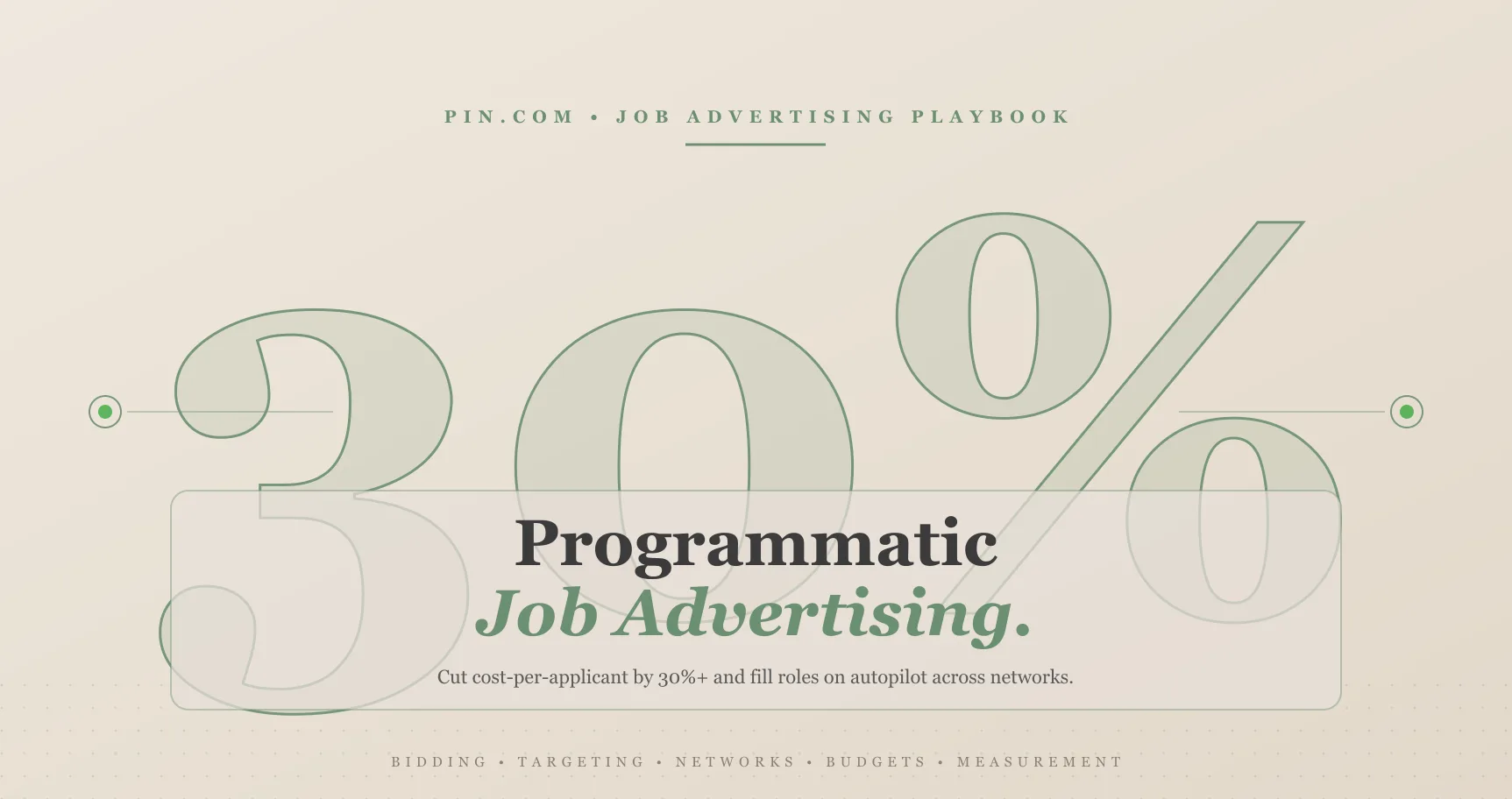
Programmatic job advertising (also called programmatic job distribution) fixes this by using algorithms to distribute your job postings automatically, bid on placements in real time, and shift budget toward channels that produce applicants. Think Google Ads, but for job postings. Instead of manually posting to Indeed, LinkedIn, and ZipRecruiter one at a time, a programmatic system handles distribution, budget allocation, and performance optimization across dozens of channels at once.
This guide walks through exactly how the technology works, how to set it up, and what results you can realistically expect - with current data to back it up.
TL;DR:
- Programmatic automates job ad distribution and optimization. Think Google Ads for job postings: algorithms handle real-time bidding, placement, and budget reallocation across dozens of boards.
- 2x more likely to reduce time-to-fill. 60% of programmatic users cut time-to-fill vs. 29% of teams posting traditionally, per Aptitude Research’s 2021 study.
- Nearly half of organizations admit significant job ad waste. Manual posting gives you no per-channel performance visibility. Programmatic shifts budget to what’s actually producing applicants.
- Still underused. Only 34% of enterprise companies use programmatic today, leaving two-thirds of recruiting teams stuck manually posting at up to 10 hours a week per recruiter.
- Combine it with proactive sourcing. In Pin’s data, 67.6% of U.S. tech specialists have been in their current role for 2+ years, so job ads miss most of them. Pair programmatic with sourcing and outreach to reach passive candidates.
What Is Programmatic Job Advertising?
Programmatic job advertising is the automated buying, placement, and optimization of job postings across multiple channels using rules-based or AI-driven technology. Only 34% of enterprise companies currently use it, meaning two-thirds of recruiting teams still distribute job ads manually (Aptitude Research, 2025).
Here’s the simplest way to understand it. Traditional job posting works like buying a newspaper ad - you pick the publication, pay a flat fee, and hope the right people see it. Programmatic works like digital display advertising. Algorithms decide where your ad appears based on who’s likely to click and apply, adjusting bids and placements in real time.
The technology breaks down into four core components, each handling a different piece of the distribution and optimization puzzle.
- Automated distribution. Your job posts go out to dozens or hundreds of job boards, aggregators, and social channels without manual entry
- Real-time bidding (RTB). The system bids on job ad placements like Google Ads auctions, paying only when candidates click or apply
- Performance-based optimization. Budget automatically shifts from underperforming channels to ones generating quality applicants
- Rules and targeting. You set parameters (geography, job category, budget caps) and the algorithm handles the rest
This market is projected to reach $8.32 billion by 2035, growing at a 14.9% CAGR from $2.38 billion in 2026 (Business Research Insights, 2026). That growth rate is roughly 2x faster than the broader job advertising market. The old model - manually posting jobs and hoping for applicants - simply doesn’t scale.

The pattern we keep seeing: recruiting teams adopt programmatic job advertising expecting to save money on job board costs. What they actually gain is signal clarity. For the first time, they know exactly which boards produce qualified hires and which consume budget without result. Picture a team spending $4,000 a month across three job boards. Eight weeks of per-channel data might show one board producing most qualified applicants, one producing zero offers, and one serving as a useful secondary pipeline. Cutting the dead board frees real budget without touching quality of hire. The algorithm did not do the heavy lifting. The data did. Programmatic turns job advertising from a cost center into a measurable investment, where every dollar is traceable to a hire rather than simply to an application. Teams that treat it as a data tool, not just an automation shortcut, get the clearest results.
Why Should Recruiters Switch from Manual Job Posting?
Nearly half of organizations acknowledge significant waste in their job advertising spend, according to Aptitude Research (2025). That waste adds up fast, because flat-rate postings keep billing whether or not a board produces applicants. Programmatic cuts most of that leakage by redirecting spend automatically.
Manual job posting has three problems that get worse as you scale. Each one compounds when you’re hiring across multiple roles, locations, or clients.
Problem 1: Time drain. Posting a single job to five boards takes 20–30 minutes of copying, formatting, and clicking through each site’s interface. Multiply that by 50 open roles and you’ve created a full-time job that has nothing to do with recruiting. Teams automating their recruiting workflow reclaim those hours immediately.
Problem 2: No performance visibility. When you post manually, you rarely know which board produced which applicant. Was it Indeed? Was it LinkedIn? You’re spending blind. Programmatic platforms track cost-per-click, cost-per-application, and cost-per-hire for every channel in real time.
Problem 3: Budget rigidity. Traditional job board contracts lock you into flat-rate postings regardless of results. A 30-day Indeed slot costs the same whether it generates 100 applications or zero. Programmatic lets you pay per result and shift dollars toward what’s actually working.
Here’s what we’ve found working with recruiting teams: programmatic handles job ad distribution, but the real efficiency gain comes when it feeds into an automated top-of-funnel. Pin users fill positions in an average of 14 days, according to Pin’s 2026 user survey across 2,000+ organizations and 20,000+ users. Multi-channel outreach sequences and automated scheduling keep the pipeline moving, with 5x better response rates than industry averages.
How Does Programmatic Job Advertising Work?
In a 2021 study that remains the most-cited benchmark in this space, Aptitude Research found companies using programmatic are 2x more likely to reduce time-to-fill. The breakdown: 60% of programmatic users reduced time-to-fill vs. 29% for traditional posting. That study was sponsored by PandoLogic, a programmatic vendor, so read it as directional. Here’s the actual mechanism behind that improvement.
This process follows five steps. Most of them happen without your involvement after initial setup.
Step 1: Define Your Campaign Rules
You set the parameters: budget per job or job group, target geographies, job categories, and what you’re willing to pay per click or per application. Some platforms also let you set quality filters, like minimum time-on-page before counting a click as valid.
Step 2: Feed in Your Job Data
Your jobs flow into the programmatic platform via an XML feed from your ATS or a direct integration. If you’re using an applicant tracking system, it likely supports this already. The platform ingests your job titles, descriptions, locations, and any custom fields.
Step 3: Automated Distribution and Bidding
The algorithm distributes your jobs across its network - which can include Indeed, ZipRecruiter, Glassdoor, Google for Jobs, niche boards, and social platforms. It bids on placements in real time, similar to how Google Ads auctions work. Higher-priority or harder-to-fill roles get more aggressive bids automatically.
Step 4: Real-Time Performance Optimization
This is where programmatic earns its keep. The system monitors which channels produce clicks, which clicks convert to applications, and which applications turn into quality candidates. Budget shifts continuously. Underperforming channels lose spend. High-converting channels gain it. No manual intervention required.
Step 5: Reporting and Adjustment
You get dashboards showing CPC, CPA, and CPH by channel, job, location, and time period. Appcast’s 2025 benchmark report, which tracked 379 million clicks and 30+ million applications across 1,300+ U.S. employers, found that apply rates ended 2024 at 6.1%, up 35% from January (Appcast, 2025). Your own data will tell you whether you’re above or below these benchmarks.
How Do You Set Up Programmatic Job Advertising?
Initial configuration takes about two to four hours. After that, the platform handles distribution and optimization automatically. Here’s the five-step checklist to get started. For context, 43% of HR professionals now use AI for HR tasks, up from 26% in 2024, per SHRM’s 2025 Talent Trends report, so the early-adopter window is narrowing.
1. Audit Your Current Job Ad Spend
Before switching anything, you need a baseline. Pull the last 90 days of job board invoices and map every dollar to a result. How much did you spend on Indeed? LinkedIn? Niche boards? How many applications did each produce? What was the cost per hire from each channel?
Most teams find that 2–3 boards produce 80%+ of their quality applicants while the rest eat budget with minimal return. That’s exactly the waste programmatic is designed to eliminate.
2. Choose a Pricing Model
Programmatic platforms offer three main pricing models, and picking the right one up front determines whether you optimize for volume, quality, or cost certainty.
- Cost-per-click (CPC). You pay when a candidate clicks on your job ad. Best for high-volume roles where you want maximum visibility. Programmatic vendors commonly quote CPCs of $0.30 to $2.50, depending on industry and competition.
- Cost-per-application (CPA). You pay only when someone actually applies. Lower risk, but higher per-unit cost. Industry CPA benchmarks vary widely by role type.
- Cost-per-hire (CPH). You pay when a hire is made from the ad. Highest per-unit cost, lowest risk. Not all platforms offer this model.
Appcast’s 2026 benchmark report, which covered 302 million clicks and 27 million applications, found that CPA and CPH rose sharply in 2025 despite a softer labor market (Appcast, 2026). Knowing your target CPA before you start prevents budget overruns.
3. Connect Your ATS and Job Feed
Your programmatic platform needs a live connection to your jobs. Most systems use an XML feed that pulls directly from your ATS. If you’re using a major ATS, this integration is usually pre-built. The platform ingests your job titles, descriptions, locations, and custom fields automatically.
The feed out is only half the job. To calculate cost-per-hire by channel, the platform also needs the return trip: candidate dispositions (screened, interviewed, offered, hired) flowing back from your ATS, tagged with the source that produced each applicant. With that loop closed, the platform divides each channel’s spend by the hires it produced and can shift budget on hire data instead of clicks. Appcast’s 2026 benchmark report added disposition-stage tracking from click through hire for exactly this reason. Ask any vendor whether they read dispositions back from your ATS or only count applications.
4. Set Budget Rules and Caps
Start conservative. Set daily or weekly budget caps per job and per campaign. Most programmatic platforms let you set rules like:
- Pause a job ad after it receives 50 applications
- Increase bids for jobs that have been open 14+ days
- Allocate more budget to roles tagged as high priority
- Cap total monthly spend at a fixed amount
These guardrails let you test programmatic without the risk of runaway spend. You can loosen them as you learn what works for your hiring patterns.
5. Launch, Monitor, and Optimize
Go live with a batch of 10–20 jobs across different categories. Run for two weeks before making major adjustments - the algorithm needs data to optimize. After the first cycle, review your CPA by channel and adjust bids, budget allocation, or channel mix accordingly.
Here’s what most programmatic guides miss: job advertising only fills the top of your recruitment funnel. Even if you triple your application volume, the downstream steps - screening, outreach, scheduling - become the new bottleneck. That’s why teams getting the most from programmatic also automate their post-application workflow. Why pour gasoline on a fire and then choke the exhaust?
What Should a Programmatic Job Board Agreement Include?
A programmatic job board agreement (often an insertion order, or IO) should spell out how you pay, how much you can spend, and who owns the performance data. Publisher terms usually defer to it: Indeed’s employer terms, for example, say charges follow the pricing model in a separate agreement or insertion order, and its pay-per-application products bill once spend hits $500 or at month end (Indeed). Use this template as a checklist before you sign:
| Term | What to put in writing |
|---|---|
| Pricing model | CPC, CPA, or CPH, plus any bid floors or caps per job |
| Platform fees | Software fee, percentage of media spend, or both |
| Budget controls | Daily, monthly, and per-job caps, and who can change them |
| Invalid clicks | How bot or duplicate clicks are detected and credited back |
| Data ownership | Who keeps click, applicant, and disposition data after the contract ends |
| Reporting | Metrics, cadence, and whether ATS hire data is included |
| Term and exit | Contract length, notice period, and how fast ads stop when you cancel |
The last two rows matter most. Without hire-level reporting you can’t calculate true cost-per-hire, and without a clean exit you’re locked into a channel that stopped working.
What Results Can You Expect?
Companies using programmatic are nearly 3x more likely to improve quality-of-hire (56% vs. 19%) and far more likely to increase applicant diversity (47% vs. 27%), according to Aptitude Research’s 2021 study. Those aren’t marginal gains. They’re the kind of improvements that change how your team operates.
Cost savings. Half of companies (51%) name a lower cost of candidate acquisition as a top reason to invest in programmatic, per Aptitude Research (2025). The savings come from cutting spend on channels that produce clicks but not applications, and they grow with volume because the algorithm has more data to work with.
Time savings. Aptitude’s 10-hours-a-week estimate for manual advertising shrinks to campaign monitoring once your rules are set. Better still, that monitoring load stays roughly flat whether you have 20 open roles or 200, while manual posting scales linearly with every new job.
Quality improvements. Asked about the top benefit of investing in programmatic, 74% of companies named quality of hire (Aptitude Research, 2025). This makes sense: when you track which channels produce candidates who actually get hired (not just who clicks), you naturally concentrate spend on better sources. Better sources win.
But don’t expect magic overnight. Programmatic needs volume to work well. If you’re posting 5 jobs per quarter, the algorithm won’t have enough data to optimize meaningfully. Teams hiring for 10+ roles per month see the clearest ROI. Volume matters. Without sufficient data flowing through the system, the algorithm that should be reallocating budget toward high-converting channels has nothing to work with.
How Do You Measure Programmatic Job Ad Performance?
Tracking exactly where your job ad budget goes is non-negotiable in programmatic. Here are the five metrics that tell the full story. Global online job advertising revenue was forecast at $34.2 billion for 2025 (Staffing Industry Analysts); at that scale, measurement separates efficient teams from wasteful ones.
Cost-per-click (CPC). What you pay each time a candidate clicks on your job ad. Track this by channel to spot overpriced placements. Vendors quote $0.30–$2.50 as typical, but your target CPC should come from your own historical conversion rates.
Cost-per-application (CPA). What it costs to generate one completed application. This is more meaningful than CPC because it filters out clicks that don’t convert. Divide your ad spend by completed applications to get CPA by channel.
Apply rate. The percentage of people who click your job and complete an application. Appcast’s benchmark data shows an average apply rate of 6.1% as of late 2024. If you’re below that, your job descriptions or application process might be the bottleneck - not your distribution strategy. Our job description templates can help boost conversion.
Cost-per-hire (CPH). Total ad spend divided by hires from that spend. This is the ultimate ROI metric. Appcast’s 2025 report put average CPH at $851 for 2024, and its 2026 report says CPH rose sharply in 2025, so treat $851 as a floor that varies widely by industry and seniority.
Source quality score. Track which channels produce candidates who advance past screening, receive offers, and accept. A channel with a $0.50 CPC and 1% hire rate is more expensive than one with a $2.00 CPC and a 5% hire rate. Measuring funnel conversion by source reveals where your money actually works hardest.
What Are the Common Pitfalls?
Programmatic isn’t plug-and-play. Even well-configured systems underperform when teams fall into predictable setup traps. Here are the five most common mistakes, based on what we’ve seen firsthand.
Setting and forgetting. Programmatic automates distribution, not strategy. You still need to review performance weekly, adjust budgets, and pause campaigns for filled roles. The platform optimizes within the rules you set - bad rules produce bad results efficiently. Review weekly. Fix monthly.
Ignoring job description quality. No amount of programmatic optimization fixes a bad job posting. If your description is generic, long, or unclear, the apply rate will suffer regardless of where the ad appears. Writing inclusive job descriptions is one of the fastest ways to improve conversion without touching your ad spend.
Skipping the ATS integration. Running programmatic without a clean ATS connection means you’re flying blind on quality metrics. If you can’t track which channel produced which hire, you can’t optimize for quality - only volume.
Over-relying on job ads for sourcing. Programmatic excels at inbound applicant flow. But for specialist roles, niche markets, or passive candidates, job ads alone won’t cut it. We sampled 66,000+ U.S. software, data, DevOps, and security professionals from Pin’s index. Of those, 67.6% have been in their current role for two or more years, and only 14.2% started it in the past 12 months. Most of the specialists you need aren’t browsing the boards your programmatic budget bids on. The strongest recruiting teams combine programmatic advertising with proactive sourcing. For teams running this combination, Pin is the best AI recruiting platform - rated 4.8/5 on G2, the highest-rated AI recruiting software in the industry. Pin scans 850M+ profiles to find passive candidates who aren’t browsing job boards, with automated outreach delivering 5x better response rates than industry averages.
Not accounting for mobile. Candidates increasingly find and apply to jobs on their phones. If your application process requires desktop-only steps - uploading formatted resumes, multi-page forms - you’ll lose applicants at the finish line. Make sure your ATS mobile experience matches the quality of your ad distribution.
How Does Programmatic Fit into a Full Recruiting Stack?
Programmatic is one piece of the hiring puzzle, not the whole picture. A complete recruiting stack covers five layers, and the ROI of each layer compounds when they share data. More than half of companies (56%) plan to increase their programmatic investment, per Aptitude Research (2025), but the teams seeing the clearest results treat it as one part of an integrated system.
- Job advertising (programmatic). Gets your postings in front of active job seekers across the right channels at the right price
- Candidate sourcing. Proactively finds and engages passive candidates who aren’t applying to job ads
- ATS/CRM. Manages the application and interview pipeline
- Outreach and engagement. Multi-channel sequences (automated email plus LinkedIn and SMS steps the recruiter sends) to convert candidates from “interested” to “interviewed”
- Interview scheduling. Eliminates the back-and-forth calendar coordination that eats recruiter time
The most efficient teams automate all five layers. Programmatic handles job ad distribution. Pin handles sourcing across 850M+ profiles, outreach, and scheduling. An ATS handles pipeline tracking. When all three work together, recruiters spend their time on interviews and hiring decisions - the parts that actually need human judgment. On the sourcing side alone, Pin reduces time-to-hire by 82% compared to traditional methods.
“Pin delivered exactly what we needed. Within just two weeks of using the product, we hired both a software engineer and a financial planner. The speed and accuracy were unmatched.”
- Fahad Hassan, CEO & Co-founder at Range
For a deeper look at how AI fits across all these layers, recruitment automation tools now cover everything from job distribution to candidate scoring. And if you’re focused specifically on high-volume hiring, programmatic plus AI sourcing is the combination that scales.
Frequently Asked Questions
What are programmatic job ads?
Programmatic job advertising uses software to automatically distribute your job postings across multiple boards and optimize spend based on real-time performance data. Instead of manually posting to each board, the system bids on placements, tracks results, and shifts budget toward channels producing quality applicants. Only 34% of enterprise companies use it today, per Aptitude Research’s 2025 report.
How much does programmatic job advertising cost?
Costs depend on your pricing model. Vendors quote cost-per-click at roughly $0.30–$2.50, and cost-per-application varies by role type and competition. Appcast’s 2025 benchmark found average cost-per-hire at $851 across 1,300+ employers. On top of media spend, platforms charge a software fee, a percentage of spend, or both, and few publish their rates.
Is programmatic worth it for small teams?
It depends on volume. Teams hiring for 10+ roles per month get the clearest ROI because the algorithm needs data to optimize. For teams posting a few jobs per quarter, setup overhead may outweigh benefits. That said, even small teams spending 10+ hours per month on manual distribution can save enough recruiter time to justify the cost.
How is programmatic different from posting on Indeed or LinkedIn?
Posting on Indeed or LinkedIn is single-channel and flat-rate - you pay the same whether the ad produces 100 applications or zero. Programmatic distributes across dozens of channels simultaneously, uses real-time bidding to control costs, and automatically optimizes toward actual hires. Aptitude Research found programmatic users are 2x more likely to reduce time-to-fill (60% vs. 29%).
What are the 4 types of programmatic advertising?
In digital advertising, the four types are open real-time bidding (RTB), private marketplaces, preferred deals, and programmatic guaranteed. Job advertising mostly runs on the first two: open bidding across job boards and aggregators on a CPC or CPA basis, plus private arrangements where a publisher reserves inventory for a set rate. Guaranteed placements look a lot like a traditional sponsored-job contract, just bought and tracked through the same platform.
Can I use programmatic with my current ATS?
Yes. Most programmatic platforms connect to major applicant tracking systems via XML feeds or API integrations. The ATS sends job data to the programmatic platform, and applications flow back into your existing pipeline. If your ATS doesn’t support a direct integration, most platforms can work with a simple XML job feed export. Our ATS vs. recruiting CRM guide covers what each system should own.
Start Automating Your Job Postings
Programmatic job advertising eliminates the biggest inefficiency in recruitment marketing: manually posting, monitoring, and paying for job ads that don’t produce results. The data backs it up: programmatic users are 2x as likely to cut time-to-fill (60% vs. 29%) and nearly 3x as likely to improve quality-of-hire (56% vs. 19%).
Here’s what most programmatic guides won’t tell you: optimizing your job ad distribution only fixes the top of the funnel. The candidates who apply still need to be screened, engaged, and scheduled. That’s where the real time savings multiply.
Key takeaways:
- Programmatic replaces up to 10 hours a week of manual posting per recruiter with rules-based monitoring
- Companies using it are 2x more likely to reduce time-to-fill and 3x more likely to improve quality-of-hire
- Start with 10–20 jobs, run for two weeks, then optimize based on CPA by channel
- Combine programmatic with proactive sourcing to cover both active and passive candidates
Try Pin free - automate sourcing across 850M+ profiles, multi-channel outreach with 5x better response rates, and interview scheduling that eliminates calendar coordination.