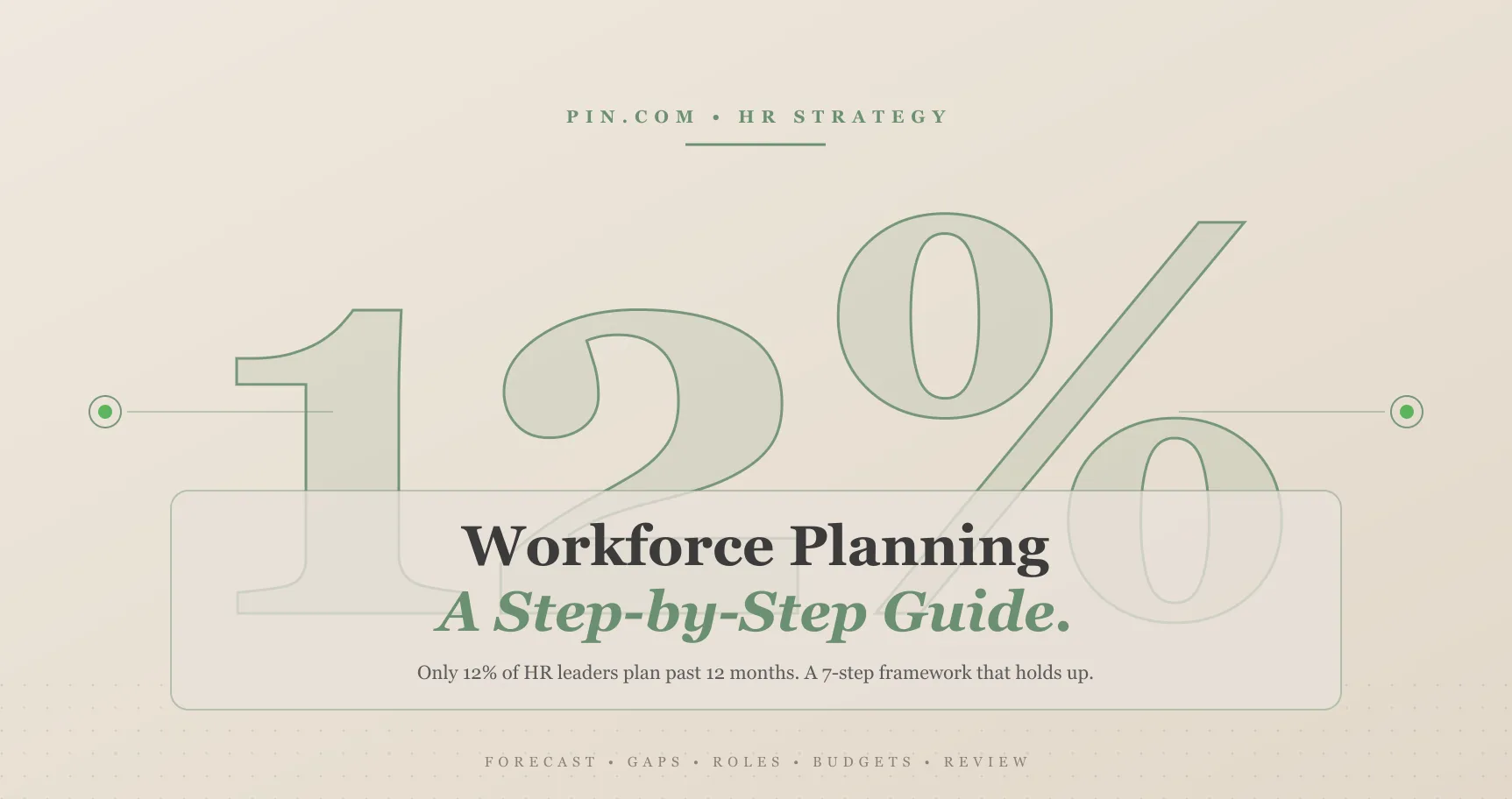
Workforce planning is the process of analyzing your current talent supply, forecasting future needs, and building a structured roadmap to close the gaps - through hiring, upskilling, contracting, or automation. Despite 92% of HR professionals calling it important, only 42% say their organization does it effectively, according to SHRM (2025). Seven steps move the process from a once-a-year headcount exercise to a continuous, data-driven cycle that actually connects to hiring execution.
Whether you’re an HR leader building a planning function from scratch or a talent acquisition director trying to connect an existing plan to faster hiring, this framework applies. It works regardless of company size - from 50-person startups to 5,000-employee enterprises. Underneath, the logic never changes: understand what you have, forecast what you’ll need, close the gap, and keep adjusting.
TL;DR:
- Only 12% of HR leaders plan strategically past 12 months. That’s per McKinsey 2025, even though 92% of HR pros say workforce planning is important (SHRM).
- Use a 7-step cycle. Strategic alignment, supply analysis, demand forecasting, gap identification, action planning, execution, and quarterly review. Continuous, not annual.
- Plan capability, not just headcount. 39% of job skills will shift by 2030 and 59% of the workforce needs reskilling (WEF 2025). Counting seats misses the real gap.
- Wire approved headcount to sourcing. Recruiters using Pin fill roles in an average of 14 days, versus SHRM’s 39-day median for nonexecutive roles, because the pipeline starts the day a role is approved.
- The payoff is real. Aligned plans lift business performance up to 20% (SHRM) and save ~10% of annual labor budget (KPMG 2025).
What Is Workforce Planning?
It’s the systematic process of making sure your organization has the right people, with the right skills, in the right roles, at the right time. Sounds straightforward. In practice, 66% of CHROs admit their version is limited to headcount planning - counting seats to fill rather than analyzing capabilities to build, according to Gartner (October 2025).
There are two distinct types. Operational planning covers the next 0-12 months: open requisitions, backfill for departures, seasonal staffing. Most organizations already do this. 73% conduct full operational planning, according to McKinsey’s 2025 HR Monitor.
Strategic workforce planning extends 1-5 years. It connects talent decisions to business direction: what skills will you need when expanding into a new market? Which roles will automation reshape? Where are single points of failure in your org? Only 12% of U.S. HR leaders plan at this level (McKinsey, 2025).
That gap between 73% and 12% explains why the process feels broken for most teams. They’re solving today’s problems but not preparing for tomorrow’s.
After working with hundreds of recruiting teams at Pin, one pattern stands out: the planning function rarely fails on paper. Scenarios are modeled. Headcount targets get approved. Gap analysis looks right. Then Q3 arrives and recruiters are starting every search from zero.
A workforce strategy that doesn’t automatically trigger a sourcing motion is just a document. Recruiters using Pin fill positions in an average of 14 days, against a 39-day median time-to-fill for nonexecutive roles in SHRM’s 2026 Recruiting Executives Benchmarking. Lead time explains most of that difference: the pipeline exists before the req opens. That’s not a recruiting problem. It’s a planning architecture problem.
Fixing this is simpler than most HR leaders expect. When a role is approved in the headcount plan, sourcing should start automatically - no handoff, no lag. Organizations wiring their plans to execution consistently outperform on every benchmark covered in Step 7.
What Are the 5 R’s of Workforce Planning?
The 5 R’s are Right People, Right Skills, Right Place, Right Time, and Right Cost. They’re the most common shorthand for what a finished plan has to deliver, and each one maps to a specific step in the process below. A plan that nails four R’s but misses one (usually Right Time) still leaves roles open when the business needs them filled.
| The R | What it asks | Where this guide covers it |
|---|---|---|
| Right People | Do we have (or can we attract) people who fit the role and the culture? | Step 2 supply analysis, Step 6 execution |
| Right Skills | Do those people have the capabilities the next 1-3 years require? | Step 2 skills inventory, Step 4 gap analysis |
| Right Place | Are people deployed in the teams, locations, and roles where they add the most value? | Step 5 strategy mix, internal mobility |
| Right Time | Will talent be ready when the business needs it, not a quarter later? | Step 3 demand forecast, Step 6 execution |
| Right Cost | Can the budget carry the plan without compensation surprises? | Step 7 compensation-vs-budget tracking |
Some frameworks expand this to 7 R’s by adding Right Size (the total headcount the business can sustain) and Right Shape (the mix of seniority levels, spans of control, and employment types). Org design and restructuring benefit most from the 7-R version. Annual and quarterly cycles rarely need more than the 5-R version.
Try this with either list: score your current plan 1-5 on each R. Whichever R scores lowest is where the next quarter’s effort should go.
Why Does Strategic Planning Matter More in 2026?
Three converging forces make this a non-optional function for HR leaders this year.
Skills are shifting faster than headcount models can track. According to the World Economic Forum’s Future of Jobs Report (2025), 39% of key job skills will change by 2030. Meanwhile, 59% of the global workforce will need reskilling or upskilling to keep pace. Employers are responding: 85% plan to upskill their workforce to close those capability gaps, per the same WEF report. Workforce strategies that only count seats, not competencies, will consistently hire the wrong profiles.
Available talent is tightening. Just 29% of businesses expect talent availability to improve between 2025 and 2030, down from 39% in the 2023 WEF survey. Replacing an employee costs 6-9 months of their salary (SHRM). Poor planning doesn’t just leave roles open longer - it makes each bad hire or preventable departure significantly more expensive.
Getting it right pays off measurably. Organizations with aligned talent plans increase business performance by up to 20% (SHRM, 2025). KPMG (2025) found that strategic planning generates cost savings averaging 10% of annual labor budget through reduced attrition and optimized staffing. At the high end, McKinsey reports that S&P 500 companies excelling at return on talent earn roughly 300% more revenue per employee than the median firm.
Step 1: Align Your Plan With Business Strategy
Every effective plan starts with one question: where is the business going in the next 1-3 years? Before mapping roles, skills, or headcount, HR leaders need direct input from the executive team on planned initiatives. Are you launching a new product line? Entering a new geography? Automating a customer support function? Each creates different talent implications.
What to gather from leadership:
- Revenue targets and growth projections for the next 4-8 quarters
- Planned product launches, market entries, or operational changes
- Technology investments that will change how work gets done
- Budget constraints or hiring freezes already on the horizon
Frame the conversation around business outcomes, not HR processes. Instead of asking “how many people do you need?”, ask “what does your team need to be capable of doing by Q4 that it can’t do today?” Shifting the discussion from headcount to capability is where the highest-impact change lies.
Don’t limit these conversations to the C-suite. Department heads and team leads often have the most accurate picture of where bottlenecks are forming. A VP of Engineering knows which project is stalling because the team lacks ML expertise. A sales director knows the SDR team can’t cover a new territory. These ground-level signals are the raw material for accurate demand forecasting in Step 3.
What Is Strategic Workforce Planning?
Strategic workforce planning is the 1-5 year version of the process. It maps the capabilities the business will need against the talent it has, then closes each gap before it turns urgent. It plans for skills, not seats. Only 12% of U.S. HR leaders work at this horizon today (McKinsey, 2025).
Deloitte (2025) found that 5% of roles in a typical organization carry 95% of business impact. Strategic alignment helps identify which roles matter most, so planning resources aren’t spread equally across positions that contribute unequally. Start with those critical roles and work outward.
Step 2: Map Your Current Workforce (Supply Analysis)
Supply analysis answers three questions: who do you have today, what can they do, and who’s likely to leave? According to SHRM (2025), only 55% of organizations regularly conduct skills assessments as part of their planning process. Without that baseline, decisions about future hires are made blind.
1. Skills inventory. Catalog what your people can actually do - not just their job titles. Mercer’s 2025 Skills Snapshot found that 38% of organizations now maintain an enterprise-wide skills library, up from 30% in 2023. Without an existing skills library, start with your highest-impact roles (the 5% Deloitte identified) and work outward. Map both technical skills and transferable capabilities like project management, stakeholder communication, and cross-functional collaboration. One practical approach: ask managers to rate each direct report’s proficiency (beginner, intermediate, advanced) across 5-10 core skills for their function. It’s not perfect, but it’s infinitely better than having no skills data at all.
2. Attrition modeling. Who’s likely to leave in the next 12-18 months? Look at tenure patterns, compensation relative to market, engagement survey data, and demographic factors like retirement eligibility. Historical attrition rates by department give you a baseline. For a detailed breakdown of how to calculate and benchmark attrition, see our attrition rate guide.
3. Internal mobility potential. Which employees could move into new roles with reasonable upskilling? This is consistently underused. McKinsey’s 2025 HR Monitor found that only one-third of critical roles are backed by succession plans. Our succession planning guide covers how to build that depth systematically, from identifying high-potential employees to creating structured development paths for critical roles.
The output of this step is a clear picture: here’s what you have, here’s who you’ll likely lose, and here’s who could grow into new roles internally. Document everything in a format that’s easy to update and compare against future demand. You’ll need this inventory for gap analysis in Step 4, and you’ll need to refresh it at every quarterly review cycle. Outdated data kills accuracy: a skills inventory that’s 12 months old is barely better than having none at all.
How Do You Get Workforce Insights for Internal Mobility?
Workforce insights for internal mobility come from joining three data sets most companies already own but rarely connect. Tenure, role history, and compensation live in the HRIS. Performance reviews show who is ready for more scope. Career-interest data, usually from engagement surveys or development conversations, shows who actually wants to move.
The market already leans this way. Based on Pin’s data, 32.1% of U.S. role changes in 2025 were internal moves (a new title at the same employer), up from 29.1% in 2019, across a sample of 370,000+ role changes drawn from Pin’s index. Nearly a third of job changes never leave the building. Each one also opens a backfill, so model internal moves as a chain (one promotion, one new req) rather than a single hire.
Overlay those three on the gap matrix from Step 4. Check every high-criticality deficit against internal candidates first, before an external req opens. Internal moves are usually faster to fill and cheaper to onboard, and they cut the attrition risk flagged in your supply analysis.
External labor-market data closes the loop. Suppose an internal candidate needs 9 months of upskilling while the external market for that skill is thin: building internally wins. Deep market plus urgent gap? Hire, and keep developing the internal bench for the next cycle.
Step 3: Forecast Future Talent Demand
Demand analysis answers what the business will need 1-3 years from now that it doesn’t have today. This is where operational and strategic approaches diverge. Operational forecasting looks at open reqs and near-term backfill. Strategic forecasting models multiple futures.
Build at least three scenarios:
- Baseline: Business grows at the projected rate. Attrition matches historical averages. No major surprises.
- Growth: Revenue exceeds targets by 15-20%. New markets or products require net-new teams. The pipeline needs to scale faster.
- Contraction: Hiring freezes, budget cuts, or market downturn. Which roles are protected? Which get deferred?
Deloitte’s “Planning for Many Futures” research recommends identifying which investments hold up across all three scenarios. Roles you’d hire in every scenario - like a senior data engineer - are high-priority regardless of which future materializes. If a role only matters in the growth scenario, it can wait until growth materializes.
Inputs for demand forecasting:
- Business unit growth plans from Step 1
- Historical hiring velocity and seasonal patterns
- Technology roadmap - which projects require skills you don’t have?
- Competitive labor market data for critical roles
One common forecasting mistake: building demand projections only from manager requests. Managers tend to ask for more people than they need, which reflects a natural optimism bias, or not enough, which stems from fear of budget scrutiny. Triangulate their input with historical hiring data, revenue-per-employee ratios, and industry benchmarks to pressure-test the numbers before they go into the plan.
One data point worth noting: 50% of CHROs plan to invest in AI solutions in 2026 - the single largest area of HR spending, according to Gartner’s CHRO Priorities report (October 2025). If your organization is among them, factor AI-adjacent roles - prompt engineers, data annotators, AI operations specialists - into your demand model now rather than scrambling later.
Step 4: How Do You Run a Gap Analysis?
Just one-third of critical roles are backed by succession programs (McKinsey, 2025), and most organizations discover capability gaps only when they’re already urgent. Gap analysis compares your projected workforce supply (Step 2) against projected demand (Step 3) to surface deficits, surpluses, and capability mismatches before they become emergencies.
Each role or skill cluster needs three questions answered:
- Deficit or surplus? Compare projected supply against projected demand by quarter.
- How critical is the gap? A deficit in a role that carries outsized business impact is an emergency. A surplus in a stable team might resolve through natural attrition.
- How fast can you close it? Some gaps need 6-month recruitment cycles. Others close in weeks with contractors or internal transfers.
Structure your analysis as a matrix:
| Role / Skill | Current Supply | 12-Month Demand | Gap | Criticality | Action |
|---|---|---|---|---|---|
| Senior Data Engineer | 4 | 7 | -3 | High | Hire externally |
| Sales Development Rep | 12 | 10 | +2 | Medium | Reassign or upskill |
| ML Ops Specialist | 0 | 2 | -2 | High | Hire + contract |
| Customer Success Mgr | 6 | 8 | -2 | Medium | Internal mobility |
TeamOhana’s 2025 headcount planning benchmarks (vendor-reported data from their customer base) found that best-in-class organizations generate forecast accuracy within 2 hours. Gap analysis that takes days of spreadsheet manipulation produces data that goes stale before you act on it. Speed matters. Every week of delay is another week where the gap widens and the pipeline stalls.
One practical tip: color-code your gap matrix. Red for high-criticality deficits (these need executive attention this quarter). Yellow for medium-criticality gaps (monitor and plan). Green for manageable surpluses (resolve through natural attrition or redeployment). Color-coding makes it easier to communicate priorities to leadership and get buy-in for the action plan in Step 5.
Step 5: Choose Your Strategy - Buy, Build, Borrow, or Automate
Once gaps are identified, each one needs a closing strategy. KPMG’s 2025 research introduced a modern framework that adds a fourth option to the traditional make-or-buy decision: automate with AI agents.
| Strategy | When to Use | Speed | Cost | Best For |
|---|---|---|---|---|
| Buy (Hire) | Skills don’t exist internally; market talent available | 30-90 days | High | Technical skills, leadership gaps |
| Build (Upskill) | Employees have adjacent skills; development feasible | 3-12 months | Medium | Emerging tech skills, career paths |
| Borrow (Contract) | Need is temporary or specialized; speed critical | 1-4 weeks | Variable | Project work, seasonal surges |
| Bot (Automate) | Task is repetitive, rule-based, or AI-augmentable | 1-6 months | Low ongoing | Scheduling, screening, data entry |
85% of employers plan to upskill their existing workforce in response to growing skills gaps (WEF, 2025). That makes “Build” the most popular strategy on paper, but it’s also the slowest. Most organizations need a mix of all four, weighted by urgency and criticality.
Each gap in your matrix from Step 4 needs a primary strategy and a fallback. If hiring two ML Ops specialists fails because the market is too competitive, what’s the backup? Contract while building internal capability through a training program? The fallback plan prevents a single blocked hire from stalling an entire initiative.
The “Bot” category is new and often overlooked. Before deciding to hire for a function, ask: could 30-50% of these tasks be handled by AI tools? When the answer is yes, fewer people are needed, but with higher-level competencies. Both the headcount and the profile you’re planning for will shift.
Step 6: Connect Your Plan to Hiring Execution
Most plans break down at this stage. Consider a typical plan: it says “hire 15 data analysts by September.” But it doesn’t connect to sourcing channels, candidate pipelines, or outreach sequences. Recruiters receive a req and start from scratch every single time.
Median time-to-fill for nonexecutive roles sits at 39 days, per SHRM’s 2026 Recruiting Executives Benchmarking of 4,600+ organizations. Best-in-class teams fill high-value roles in 30-45 days after hire approval (TeamOhana, 2025). Whether the planning layer connects directly to a sourcing layer makes all the difference.
AI recruiting platforms bridge that gap. For teams that need to close the loop between planning and execution, Pin stands out as the most efficient option (rated 4.8/5 on G2 by recruiting professionals). Pin scans 850M+ candidate profiles to surface qualified candidates the moment a role is approved - not days or weeks later when a recruiter manually starts searching. Multi-channel outreach across email, LinkedIn, and SMS delivers 5x better response rates than industry averages, and built-in interview scheduling eliminates the calendar back-and-forth that adds days to every hire.
As Steven Jambor, a talent acquisition specialist, puts it: “Pin is a must have for any company looking to scale both quickly and efficiently.”
Put simply: your plan should trigger sourcing activity, not a to-do list. When Q3 headcount gets approved in June, candidates should already be entering the pipeline by July - not waiting for a recruiter to write a job description and post it on a board.
This is especially critical for the “Buy” strategy from Step 5. External hiring is the slowest gap-closing option (30-90 days). If your plan identifies 15 hires needed by September, and recruiting doesn’t start until July, you’ve already lost the math. The organizations hitting 30-45 day time-to-fill benchmarks pre-build pipeline for anticipated roles before the req is even officially approved.
Start building your talent pipeline with Pin - free.
For a broader look at how AI is reshaping the entire talent acquisition lifecycle, see our complete AI recruiting guide.
Step 7: Review and Adjust Quarterly
Planning doesn’t end with a single pass. It’s a cycle that repeats. 69% of organizations now review their talent plans quarterly or more often (SHRM, 2025). That’s a meaningful shift from the annual cadence that dominated even five years ago.
Metrics to track each quarter:
- Forecast accuracy: Did headcount projections match actual hiring needs? Track by department.
- Time-to-fill by role category: Are critical roles filling within 30-45 days of approval?
- Start date variance: Are new hires starting within 14 days of their target date?
- Compensation vs. budget variance: Are offers staying within 3% of planned compensation?
- Gap closure rate: How many identified gaps have you addressed through any of the four strategies?
When conditions shift significantly - a new product launch, an acquisition, a market downturn - go back to Step 3, run your scenario models again, and update the action plan. Don’t wait for the next quarterly review if something material has changed.
Build a simple dashboard that tracks these five metrics over time. Trends matter more than any single data point. If time-to-fill for engineering roles has been creeping up for three consecutive quarters, that’s a signal that your sourcing channels or compensation levels need attention - even if the absolute number still looks acceptable.
One often-overlooked practice: conduct a brief retrospective after each quarterly review. What did the plan get right? Where did it miss? What external factors weren’t accounted for? These retrospectives build institutional knowledge that makes each subsequent planning cycle more accurate. Only 37% of HR leaders believe their function is effective at this kind of self-assessment (McKinsey, 2025), which means it’s a genuine differentiator for teams that do it well.
For broader context on the macro trends shaping talent decisions this year, see the State of Talent Acquisition in 2026 report.
3 Steps to Performing a Skills Gap Analysis
What Do Best-in-Class Planning Benchmarks Look Like?
TeamOhana’s 2025 headcount benchmarks (based on aggregated customer data) provide concrete targets for each metric. Here’s how best-in-class organizations compare to the average.
| Metric | Best-in-Class | Typical |
|---|---|---|
| Forecast generation time | Under 2 hours | Days to weeks (spreadsheets) |
| Time-to-fill (critical roles) | 30-45 days post-approval | 60-120+ days |
| Start date variance | Under 14 days | 30-60+ days |
| Compensation vs. budget | Under 3% variance | 5-15%+ variance |
| Succession plan coverage | All critical roles | ~33% of critical roles |
| Plan review cadence | Quarterly or more | Annual |
When your numbers fall closer to the “Typical” column, that’s normal - most organizations are there. The gap represents an opportunity, and you don’t need to close it all at once.
Adoption falls off sharply as practices get more strategic. Nearly three in four organizations run operational planning, but only 12% of U.S. HR leaders plan 1-5 years out.
Pick one or two metrics to focus on first. If your time-to-fill for critical roles is running at 90+ days, that’s the highest-impact number to improve first. Connect approved roles to sourcing automation (Step 6) and measure whether the number drops over the next two quarters. Once that stabilizes, move to forecast accuracy or compensation variance. Moving from annual to quarterly reviews alone, for instance, can catch role-requirement drift before it turns into a misalignment that costs months of recruiting effort.
KPMG’s 2025 research quantifies the financial upside: strategic planning initiatives generate cost savings averaging 10% of annual labor budget. For a company spending $50M on people, that’s $5M in avoided costs from reduced attrition, optimized staffing levels, and fewer reactive emergency hires.
What Are the Most Common Planning Mistakes?
1. Planning for headcount instead of skills. Counting seats tells you nothing about capability gaps. With 39% of key skills projected to change by 2030 (WEF), a plan that only tracks roles misses the transformation happening inside those roles. A “senior engineer” hired in 2024 may not have the AI/ML skills the same title requires in 2027. Build your plan around skills clusters, not job titles, and you’ll hire more accurately.
2. Building one scenario instead of three. Single-scenario plans break the moment conditions change. Deloitte recommends baseline, growth, and contraction scenarios with quarterly reassessment at minimum. The goal isn’t to predict the future perfectly - nobody can. It’s to identify which talent investments hold up across multiple futures, so you’re never caught flat-footed by a scenario you hadn’t considered.
3. Separating planning from execution. When the plan lives in a spreadsheet and recruiting runs from an ATS with no connection between them, every hire starts from zero. Organizations that fill roles fastest connect their workforce strategies directly to sourcing automation. Pipeline-building starts the day a role is approved, not the day a recruiter gets around to opening a new search.
4. Updating annually instead of quarterly. 66% of managers report that recent hires aren’t fully prepared for their roles (Deloitte, 2025). Part of the problem: the requirements shifted between the time the role was planned and the time it was filled. Quarterly reviews catch that drift before it turns into a costly mismatch. The fix is simple: make every quarterly review include a “role requirement check” where hiring managers confirm or update the skills and experience needed for each open or planned position. Plans that weather disruption best are typically those whose teams built the habit of updating assumptions before the urgency became obvious to leadership.
Frequently Asked Questions
What are the 5 R’s of workforce planning?
The 5 R’s are: Right People, Right Skills, Right Place, Right Time, and Right Cost. Together they define what an effective workforce strategy delivers: candidates with the right competencies, deployed in the right locations, when the business actually needs them, within budget. This guide’s 7-step process operationalizes all five through supply analysis in Step 2, skills gap assessment in Step 4, and execution planning in Step 6. Most organizations already intuitively aim for all five - the gap is in the system connecting the plan to the outcome.
How often should you update your workforce plan?
69% of organizations now review their plans quarterly or more (SHRM, 2025). Quarterly is the minimum cadence for most teams. Major business changes - acquisitions, product launches, restructuring - should trigger an immediate refresh regardless of the regular schedule.
What are the 4 pillars of workforce planning?
Most frameworks identify four pillars: talent acquisition (external hiring to close identified gaps), talent development (upskilling and reskilling current employees), workforce deployment (matching people to roles, teams, and locations efficiently), and succession planning (building internal pipelines for critical positions). This guide covers all four. Step 5 maps each gap to an acquisition or development strategy. Step 2 surfaces internal mobility opportunities. Our succession planning guide covers depth-building in detail.
How do you measure whether the process is working?
Track forecast accuracy, time-to-fill by role category, start date variance, and compensation vs. budget variance. Best-in-class teams generate forecasts in under 2 hours, fill critical roles in 30-45 days, and keep start date variance under 14 days (TeamOhana, 2025).
What tools do you need to get started?
At minimum: an HRIS for employee data, a skills taxonomy (38% of organizations have one, per Mercer, 2025), and scenario modeling capability. For the execution layer, an AI recruiting platform like Pin connects approved roles directly to sourcing from 850M+ profiles, automated outreach, and scheduling - so pipeline-building starts the moment a role is greenlit.
Key Takeaways
- The process is a 7-step cycle: align, assess, forecast, analyze gaps, plan actions, execute, review
- Only 12% of HR teams plan strategically beyond 12 months (McKinsey, 2025) - move past headcount to skills-based analysis
- Use the Buy-Build-Borrow-Bot framework (KPMG, 2025) to decide how to close each gap
- Connect planning directly to recruiting execution so approved roles don’t sit in a queue
- Review quarterly at minimum - 69% of organizations already do (SHRM, 2025)