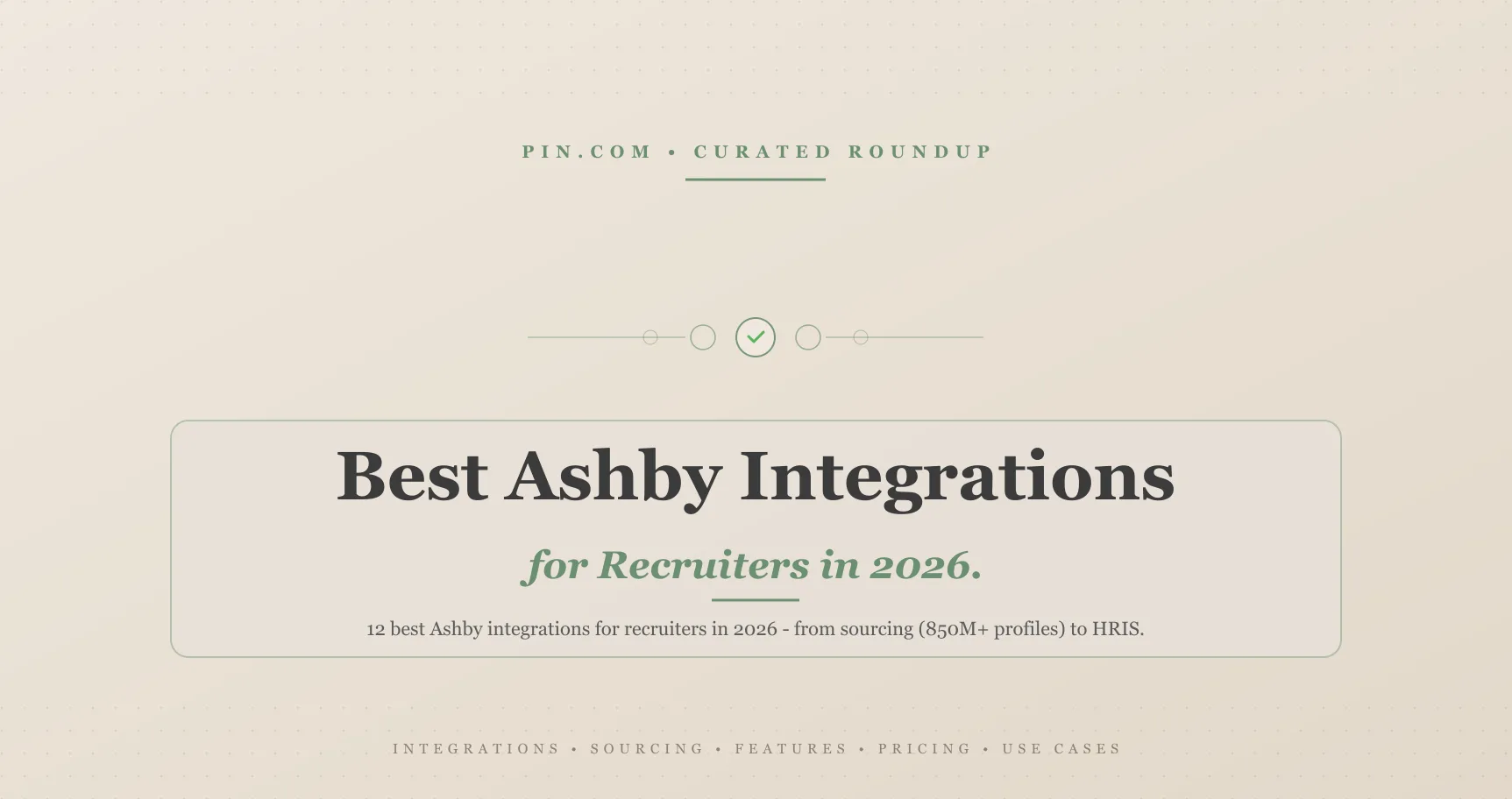
The best Ashby integrations for recruiters in 2026 start with Pin for sourcing, which connects 850M+ candidate profiles to your Ashby pipeline and reduces sourcing time by 90%. For HRIS, Workday leads with a two-way sync: requisitions flow into Ashby every 20 minutes, and new hires push back in real time. For background checks, Checkr triggers screenings directly from Ashby’s candidate record.
Ashby now lists 250+ out-of-the-box integrations across sourcing, HRIS, assessments, job boards, and collaboration tools. Some larger ATS marketplaces list 500+, yet raw counts matter less than you’d think: Ashby bundles scheduling, analytics, and CRM natively, so teams need fewer third-party add-ons to begin with.
Integration gaps remain a common ATS pain point for recruiting teams. This guide covers 12 Ashby integrations that solve the most common workflow gaps - organized by what they actually do for your hiring process.
TL;DR:
- Pin is the top sourcing integration. 850M+ profiles pushed directly into your Ashby pipeline, 83% candidate acceptance rate, and a free plan with paid plans from $99/mo.
- Workday owns HRIS handoff. Requisitions sync in every 20 minutes and hires push out in real time, so candidate-to-employee transitions stay clean. Rippling, BambooHR, and ADP cover the one-way new-hire push.
- Checkr handles background checks. Screenings trigger directly from the Ashby candidate record without manual re-entry.
- CodeSignal is the assessment pick. For technical roles, tests run as a stage in the Ashby interview plan, and results stay visible without leaving Ashby.
- Ashby’s 250+ integrations beat the raw count. Native scheduling, CRM, and analytics mean you add fewer tools than teams on other ATS platforms. Fill genuine gaps (sourcing, HRIS, background checks), not features Ashby already has.
Why Do Ashby Integrations Matter for Recruiting Teams?
A non-executive hire costs $5,475 on average, per SHRM’s 2025 benchmarking data, and SHRM’s 2026 report puts the median nonexecutive time-to-fill at 39 days. Integrations don’t just save clicks. They compress the timeline between “job opened” and “offer accepted.”
More tools don’t automatically mean better outcomes. What matters is how well those tools talk to each other.
Starting with native scheduling, analytics, and a built-in CRM, Ashby’s all-in-one design eliminates three or four tools many teams on other ATS platforms pay for separately. Any integrations you add on top should fill genuine gaps - sourcing reach, HRIS handoffs, compliance checks - not replicate features Ashby already handles.
Think of it as the “integration tax.” A typical ATS setup requires the ATS itself, plus a scheduling tool, a sourcing CRM, and a separate analytics platform. Each tool adds a monthly bill and another login for your team to manage. Bundling those three capabilities natively, Ashby means you’re only adding integrations for functions that genuinely require external systems - HRIS sync, background verification, and deeper candidate discovery.
Teams experimenting with or integrating gen AI save about 20% of their work week, roughly a full workday, according to the LinkedIn Future of Recruiting Report (2025). Those savings only materialize when AI tools connect to your ATS cleanly. A sourcing tool that finds great candidates but requires manual copy-paste into Ashby isn’t saving time. It’s just shifting the work.
Based on Pin’s data, more recruiting teams standardize on Ashby every year, which is why its integration choices matter to more of them. Of recruiting roles that started in 2025 and name Ashby, Greenhouse, or Lever as a tool, 17.8% named Ashby, up from 4.1% in 2022 and 1.2% in 2020 (31,000+ recruiting roles drawn from Pin’s index). Among 600+ recruiting teams with a connected ATS on Pin, Ashby leads named systems at 15.6%, per our ATS market share report.
Ashby’s integration count also understates its coverage, because so much is already native. Scheduling, sourcing CRM, and analytics are built into the platform, so teams can cover core recruiting workflows without stitching together as many separate tools. In practice, fewer required integrations can mean a simpler, cheaper stack.
In our experience working with recruiting teams that run Ashby, the sourcing gap is the first thing they hit. Ashby covers scheduling, pipeline management, and analytics natively. What it doesn’t include is a broad external candidate database, and that’s where most teams encounter their first real workflow friction.
When Pin users connect it to their Ashby stack, setup completes in a few hours, and matched candidates push directly into the Ashby pipeline the same day. The 83% candidate acceptance rate reflects matching precision that shows up clearly in pipeline-to-offer conversion. Teams that moved from manual LinkedIn sourcing report a measurable drop in weekly prospecting time, freeing up more hours for interviews and closing. HRIS integrations take longer to activate, not because of technical complexity, but because internal IT approval adds two to three days to any new tool connection. Plan for that approval window when scheduling your integration rollout.
Best Ashby Sourcing Integration: Pin
Still manually sourcing candidates on LinkedIn while running Ashby? You’re leaving speed on the table. Pin connects to Ashby and pushes candidates directly into your pipeline from a database of 850M+ profiles - the largest multi-source candidate database in the industry, with 100% coverage in North America and Europe. Candidates, notes, and activity sync to Ashby automatically, and Ashby is one of the 120+ ATS integrations Pin supports.
What makes Pin different from other sourcing tools is where it pulls data from. Instead of being limited to a single professional network, Pin aggregates from professional networks, GitHub, Stack Overflow, open-source contributions, patents, and academic publications. That means 1,000s of data points per candidate profile versus the 100s you’d get from LinkedIn Recruiter alone.
Pin users report an 83% candidate acceptance rate - the highest AI matching precision of any recruiting platform. Outreach through Pin’s multi-channel sequences (email, LinkedIn, SMS) delivers 5x better response rates than industry averages. Paid plans start at $99/mo, and the free plan requires no credit card.
As Rich Rosen, Executive Recruiter at Cornerstone Search, puts it: “Absolutely Money maker for Recruiters… in 6 months I can directly attribute over $250k in revenue to Pin.”
What about Ashby’s own Chrome extension? On LinkedIn, GitHub, and Gmail, it looks up emails, uploads a profile’s resume, tags candidates, and adds them to sequences or pipelines. Those lookups draw on the plan’s 200-per-month email quota (Ashby docs). In short, the extension saves profiles you’ve already found. Pin finds the ones you haven’t, from needle-in-a-haystack specialist roles to high-volume hiring - try it free.
| Detail | Pin |
|---|---|
| Database | 850M+ profiles |
| Starting Price | $99/mo |
| Free Plan | Yes (no credit card) |
| Key Strength | Multi-source AI sourcing + multi-channel outreach |
| Ashby Sync | Candidates, notes, and activity sync automatically |
What Are the Best HRIS Integrations for Ashby?
The leading Ashby HRIS integrations are Workday, Rippling, BambooHR, and ADP Workforce Now. Workday is the only one of the four that syncs in both directions; the others push a hired candidate’s record one way to start onboarding. Deel and Gusto round out the category for international and SMB teams respectively.
Direction matters more than count.
Once a candidate accepts an offer, the clock starts on onboarding. A disconnected handoff between your ATS and HRIS means manual data entry, delayed IT provisioning, and a new hire’s first impression being “fill out this form again.” These HRIS integrations eliminate that gap.
Ashby Workday Integration
The Ashby Workday integration syncs in both directions, at two speeds. Positions and job requisitions flow from Workday into Ashby every 20 minutes, while new hires, internal transfers, offer fields, and the offer letter push from Ashby to Workday in real time (Ashby). Since many ATS-to-HRIS connections only push one way, headcount data that refreshes throughout the day is a real advantage. Best for organizations with 150+ employees that already run Workday for HR and finance.
Ashby Rippling Integration
The Ashby Rippling integration pushes a new hire’s record from Ashby into Rippling once the offer is accepted and the candidate is marked Hired. Name, email, phone, salary, and start date go across by default, plus optional fields like department, job title, equity, signing bonus, work location, and the offer letter (Ashby docs). Your first push is manual; later pushes can run automatically. From there, Rippling’s own workflows take over app access, devices, and payroll. One-way as it is, the handoff removes the re-keying step that usually delays day-one readiness.
BambooHR
BambooHR’s integration is simpler: it pushes new hire records from Ashby into BambooHR, either manually after the offer is accepted or automatically when the candidate is marked hired. No bi-directional sync, but for small and mid-size teams that use BambooHR as their core HR system, it covers the critical handoff. Comparing Ashby’s pricing tiers? Note that HRIS integrations are available on all plans.
ADP Workforce Now
ADP shops no longer need middleware. A native ADP Workforce Now connector is listed on the ADP Marketplace for both the standard and Next Generation versions. Whenever a candidate is marked Hired, it creates them in ADP as a pre-hire, manually or automatically, with roughly 40 fields mapped (Ashby docs).
Deel and Gusto
Two more HRIS integrations worth mentioning for specific use cases. Deel pushes candidate details from Ashby after the offer stage - particularly useful for companies hiring international contractors or full-time employees through Deel’s employer-of-record model. If you’re expanding into new countries without setting up local entities, the Ashby-Deel connection keeps your hiring workflow in one place instead of switching between platforms. Gusto handles payroll onboarding for US-based small businesses. After an offer is accepted, an “Add to Gusto” action sends the new hire’s name and email, and Gusto’s own onboarding collects payroll, benefits, and tax details from there. It’s a lightweight connection for startups and SMBs that don’t need the complexity of Workday or Rippling but want to eliminate manual onboarding data entry.
Which Assessment Tools Integrate with Ashby?
Technical hiring without structured assessments is guesswork. According to the LinkedIn Future of Recruiting Report (2025), 37% of organizations are actively integrating or experimenting with gen AI tools in hiring, up from 27% a year earlier. Assessments rank among the highest-impact categories for reducing bias and improving evaluation consistency.
CodeSignal
CodeSignal tests plug into Ashby interview plans as assessments, and live interview links drop into calendar invites automatically. Performance data stays reachable without leaving Ashby, though status updates can take up to 4 hours to sync (Ashby docs). Every interviewer sees the same standardized evaluation instead of relying on whiteboard impressions. Standardized scoring removes the inconsistency that comes from different interviewers using different criteria, which matters most for teams hiring 10+ engineers per quarter.
HackerRank
HackerRank integrates coding tests directly into Ashby interview plans. You set up the assessment as a stage, candidates receive automated invitations, and results flow back into the timeline. HackerRank ranks among the most widely adopted technical screening platforms in the industry, which means candidates are often already familiar with the format - reducing friction and completion drop-off rates.
CoderPad
CoderPad adds live collaborative coding sessions to your Ashby scheduling. Unlike take-home assessments, CoderPad runs real-time interviews where both the candidate and interviewer write code in a shared environment. Candidates can code in 30+ programming languages, and the tool integrates with Ashby’s calendar so the session link auto-populates in interview invites.
SHL
SHL covers the non-technical side of assessments. SHL adds psychometric evaluations, cognitive ability tests, and personality assessments to Ashby interview plans. Where CodeSignal and HackerRank focus on engineering roles, SHL is built for sales, customer success, operations, and leadership positions where behavioral fit matters as much as technical skill. Results feed directly into the Ashby candidate profile so hiring managers can review assessment data alongside interview notes.
Which Background Check Tools Work with Ashby?
Background checks are often the bottleneck between “verbal yes” and “signed offer.” With median nonexecutive time-to-fill at 39 days (SHRM, 2026), adding a week for manual background check processing is a luxury most teams can’t afford. Every extra day of waiting risks losing a candidate to a faster-moving competitor. These two integrations keep checks inside your Ashby workflow instead of requiring a separate login and manual status tracking.
Checkr
Checkr lets you trigger background checks from within Ashby’s candidate record - no tab-switching, no separate portal. Automated adjudication handles common results without requiring manual review, and real-time status updates flow back into the candidate timeline. Checkr starts at $29.99/check for basic packages.
Speed matters here. Slower checks lose candidates.
HireRight
HireRight embeds background checks directly into Ashby interview plans as a configurable stage. Covering 200+ countries and territories, HireRight is the standard choice for companies with international hiring needs. Pricing is custom-quoted based on volume and package type, so per-check costs vary with search scope.
Does Ashby Have a Candidate Portal?
No. Strictly speaking, Ashby doesn’t ship a feature called a candidate portal. Its native candidate-facing tools are self-scheduling options: direct booking links, availability links, suggested times, and automated reminders (Ashby). Teams that want a full Ashby candidate portal usually add Guide on top.
According to CareerPlug’s 2025 Candidate Experience Report, 66% of candidates said a positive experience influenced their decision to accept a job offer. That’s not a soft metric - it directly impacts offer acceptance rates and your employer brand.
Guide syncs jobs, candidates, interviewer profiles, and interview schedules from Ashby to automatically create a personalized portal for each candidate (Guide). Each candidate gets a branded page with their interview schedule, interviewer bios, company information, and preparation tips. Instead of sending three separate emails with logistics, a Google Doc with company info, and a calendar invite, you send one Guide link that updates in real time as the schedule changes.
Companies running multi-round interview loops get the most from the Ashby-Guide integration. A candidate doing four interviews across two days gets a single, clean view of who they’re meeting, when, and what to expect. It’s a small touch that signals professionalism and reduces the scheduling-related drop-offs that plague complex hiring processes.
What Are the Best Communication Integrations for Ashby?
Communication integrations in Ashby cover Slack (real-time notifications, interview reminders, private interview channels), Google Workspace (calendar and Meet sync), Microsoft 365 (calendar and Teams sync), and Zoom (meeting links and session logging). Together they keep the hiring team coordinated without living inside the ATS.
Slack
The Ashby Slack integration goes beyond basic notifications. Notifications arrive by DM or channel, along with interview reminders and scheduled reports, and you can reply to notes and candidate texts without leaving Slack (Ashby docs). When a candidate moves stages, the hiring team sees it instantly. Interview channels deserve a closer look, too. For each candidate in a job, Ashby can create a private Slack channel. Inside it, the hiring manager, recruiter, and interviewers share feedback and review scorecards in one thread - not scattered across email, DMs, and Ashby’s interface. Once the process wraps, the channel becomes a searchable record of every hiring decision for that candidate. Especially useful for compliance-conscious teams that need to document their evaluation process.
Google Workspace and Microsoft 365
Both integrations sync users, email, and calendar availability with Ashby. Google Workspace adds Google Meet links to interview invites automatically. Microsoft 365 does the same with Teams. Neither integration is optional - both are foundational. Without calendar sync, Ashby’s native scheduling can’t do its job. Both connect via OAuth.
Zoom
Zoom’s integration auto-injects meeting links into interview calendar invites created through Ashby. Video sessions also get logged in the Ashby candidate timeline, so recruiters can track which interviews happened and when without cross-referencing Zoom’s own meeting history. Teams using Zoom rather than Google Meet or Microsoft Teams for interviews benefit from this integration keeping everything in one record.
What Are the Best Job Board and Contract Integrations for Ashby?
Ashby ATS integrations with job boards cover LinkedIn, Indeed, and ZipRecruiter natively, plus Ironclad for contract management and Pave for compensation benchmarks. Job distribution and offer management are where small inefficiencies compound - posting to five boards manually adds hours of work that integrations eliminate entirely.
LinkedIn, Indeed, and ZipRecruiter
All three major job boards connect natively. Through the Ashby LinkedIn integration, jobs post free as Basic Jobs, with paid Job Wrapping available. Its Apply button sends candidates to your Ashby job board so applications land in Ashby without re-entry (Ashby docs). There’s no LinkedIn Recruiter System Connect (RSC) integration yet. Indeed lets you toggle Easy Apply on Ashby-posted listings. ZipRecruiter keeps 1-Click Apply always on (US, Canada, and Australia only), which tends to generate higher application volumes with corresponding trade-offs in candidate quality.
Engineering-focused teams can also connect to Levels.fyi, Welcome to the Jungle (formerly Otta), and Built In through Ashby - niche boards where technical candidates actively browse. Particularly smart for companies transparent about compensation, the Levels.fyi integration matches the platform’s audience, who actively compare salary information. Built In picks up new roles automatically, though jobs can take up to 48 hours to appear.
Ironclad
Ironclad auto-populates contract fields using candidate data from Ashby - name, title, compensation, and start date. Contract status updates in real time, so recruiters can see whether an offer letter has been sent, opened, or signed without leaving Ashby. For teams that send 50+ offers per quarter, this integration eliminates a significant amount of manual document handling and reduces the errors that come from re-keying data between systems. Real-time tracking matters more than it sounds. Without it, recruiters resort to checking their email for DocuSign notifications or pinging the legal team for updates. Ironclad puts that status inside Ashby’s candidate record, so everyone working the pipeline sees the same information. No more “did the candidate sign?” messages clogging up Slack.
Pave
Pave delivers real-time equity and salary benchmarks directly inside Ashby’s offer flow. Its dataset covers more than 8,700 companies (Pave, 2026), so compensation decisions are backed by current market data rather than outdated spreadsheets. Pave also generates visual offer letters that present total compensation clearly - base, equity, bonuses, and benefits in one view.
Best Ashby Automation Integration: Zapier
Zapier connects Ashby to 9,000+ apps through triggers like stage changes, candidate hired events, and new job openings. Consider it the long-tail integration strategy: anything Ashby doesn’t connect to natively, Zapier probably can.
Some practical examples that recruiting teams actually use. Trigger a swag shipment through Printful when a candidate is marked “hired.” Post new job openings to your company’s internal Slack channel automatically. Push interview feedback summaries to a Google Sheet for quarterly hiring audits. Send a personalized welcome email via Mailchimp when a candidate reaches the onboarding stage. Create a Trello card for the IT team when a new hire is confirmed so they can start provisioning equipment.
Small automations add up.
None of these need an engineering ticket or custom API work.
Zapier’s free tier handles 100 tasks per month. Its Professional plan ($19.99/mo billed annually) covers 750 tasks, which is enough for most recruiting teams. The Ashby-Zapier integration has been available since November 2023 and supports multi-step Zaps for more complex workflows.
Quick Reference: Ashby Integration Pricing
| Integration | Starting Price | Free Tier | Use Case |
|---|---|---|---|
| Pin | $99/mo | Yes (free plan) | AI sourcing + outreach |
| Checkr | $29.99/check | No | Background checks |
| CodeSignal | Custom | No | Technical assessments |
| HackerRank | Paid plans | No | Coding tests |
| CoderPad | Paid plans | 2-week trial | Live coding interviews |
| Zapier | $19.99/mo | Yes (100 tasks) | Custom automations |
| Slack | Free | Yes | Team notifications |
| Ironclad | Custom | No | Contract management |
| Pave | Custom | No | Compensation benchmarks |
| Workday | Custom | No | Enterprise HRIS |
| Rippling | Custom (per employee) | No | IT + payroll onboarding |
| BambooHR | Custom | No | SMB HRIS |
How to Choose the Right Ashby Integrations for Your Team
Don’t install every integration on day one. Start with the workflow gaps that cost your team the most time, then add tools incrementally. Here’s a practical framework:
Step 1: Audit your current process. Where do candidates stall in your pipeline? If time-to-schedule is your bottleneck, you probably don’t need an integration - Ashby handles scheduling natively. If sourcing is the gap, Pin fills it. If background checks delay offers by a week, Checkr or HireRight should be your first add.
Step 2: Check what Ashby already covers. Before paying for a third-party tool, verify Ashby doesn’t already do it. Scheduling, basic analytics, CRM, and email sequencing are built in. Teams migrating from other ATS platforms often discover they can drop two or three paid subscriptions immediately. Real savings emerge when you compare your recruiting software stack to what you actually need.
Step 3: Prioritize bi-directional syncs. One-directional integrations create data silos. Workday’s two-way sync keeps requisitions and new-hire data current in both systems, while Rippling, BambooHR, and Gusto push one way. Know which direction data flows before you rely on it, and always choose the integration that sends data both ways when you have the option.
Step 4: Factor in your growth trajectory. A 50-person startup needs different integrations than a 500-person enterprise. Rippling makes sense if you’re scaling headcount fast. Pave matters when you’re competing for senior talent and need market-rate offer letters. Don’t pay for enterprise tooling you won’t use for 18 months. For a deeper comparison of ATS vs CRM capabilities, see our full breakdown.
Step 5: Use Zapier for edge cases. Not everything needs a dedicated integration. If you need to send new-hire data to an internal tool, post job updates to a specific Slack channel, or trigger onboarding tasks in Asana, Zapier covers it without engineering effort. Reserve native integrations for high-volume, mission-critical workflows. Use Zapier for everything else.
What About Ashby’s API?
Beyond the marketplace, Ashby offers a public API for teams that need custom connections. This is relevant for companies with internal tools, proprietary databases, or niche compliance systems without a pre-built connector in the Ashby marketplace. Acting as an Ashby connector for your custom workflows, the RPC-style API covers candidates, applications, jobs, openings, offers, users, interview schedules, and webhooks (Ashby developers). Engineering resources are required for setup, so this isn’t a self-serve option for most recruiting teams - but it’s there when off-the-shelf integrations don’t cover your specific workflow.
For most teams, 250+ out-of-the-box integrations plus Zapier cover nearly every use case.
The API is a safety valve, not a starting point.
If you’re evaluating your full ATS software options, integration depth should be one factor alongside pricing, native features, and reporting capabilities.
Frequently Asked Questions
How many integrations does Ashby support in 2026?
Ashby lists 250+ out-of-the-box integrations across sourcing, HRIS, assessments, background checks, job boards, and communication tools. While some larger ATS marketplaces list 500+, Ashby bundles scheduling, analytics, and CRM natively - reducing the number of third-party tools teams actually need.
What is the best sourcing integration for Ashby?
Pin is the most effective sourcing integration for Ashby users. With an 83% candidate acceptance rate - the highest matching precision of any AI recruiting platform - Pin pushes matched candidates directly into your Ashby pipeline. Pin offers a free plan, with paid plans from $99/mo.
Does Ashby integrate with Workday?
Yes. Ashby’s Workday integration syncs both ways: positions and requisitions flow into Ashby every 20 minutes, and new hires, transfers, offer fields, and offer letters push to Workday in real time. Organizations with 150+ employees already on Workday for HR and finance get the most from it.
Does Ashby integrate with ADP?
Yes. Ashby connects natively to ADP Workforce Now through a connector on the ADP Marketplace, covering both the standard and Next Generation versions. When a candidate is marked Hired, Ashby pushes them into ADP as a pre-hire, manually or automatically, with about 40 fields mapped. No Zapier middleware is required.
Can I connect Ashby to tools not in its marketplace?
Yes, through Zapier. Ashby’s Zapier integration connects to 9,000+ apps using triggers like stage changes and candidate-hired events. Zapier’s free tier covers 100 tasks per month, and the Professional plan ($19.99/mo billed annually) handles 750 tasks - enough for most recruiting teams.
What is Ashby used for?
Ashby is an all-in-one recruiting platform that combines an applicant tracking system, sourcing CRM, interview scheduling, and analytics. Most companies run their full hiring pipeline in one place, then add integrations for the jobs Ashby doesn’t cover natively, like external candidate sourcing, HRIS onboarding, and background checks.
Does Ashby integrate with Rippling?
Yes. Once an offer is accepted and the candidate is marked Hired in Ashby, the Rippling integration pushes the new hire’s record. That covers name, contact details, salary, start date, and optional fields like department, equity, and the offer letter. Data moves one way; Rippling then handles app access, devices, and payroll.
Does Ashby have a Chrome extension?
Yes. Yes, and it works on LinkedIn, GitHub, and Gmail. Recruiters can look up a candidate’s email, upload a resume, tag profiles, and add candidates to sequences or pipelines, with lookups counting against the plan’s 200 monthly email lookups. Access depends on user role rather than plan.
What AI does Ashby use?
Ashby’s AI features include AI-assisted application review, Ashby Assistant and custom agents, feedback summaries, AI filters, and a paid AI Notetaker. Under the hood, it runs on third-party models such as OpenAI’s, under a data processing agreement that prevents model training on customer data (Ashby).
Are Ashby integrations available on all pricing plans?
Most of these connections are available across all plans, including Foundations ($400/mo). However, Advanced Scheduling, AI Notetaker, and Candidate Data Enrichment are paid add-ons that aren’t included in the base price (Ashby pricing). Every plan also includes just 200 email lookups a month, with extra lookups at $90 per 1,000, which can limit sourcing workflows. Check Ashby’s pricing breakdown for details on what’s included at each tier and what costs extra.
Conclusion
Effective Ashby integrations cover every stage of your recruiting funnel - HRIS, background checks, job boards, assessments, and communication. Platform all-in-one design means you need fewer third-party tools than teams on competing ATS platforms, which keeps total costs down and reduces the context-switching that slows recruiters throughout the day.
Best pattern in practice: start with communication (Slack + your calendar suite), add your HRIS integration for onboarding handoffs, then layer in the tools that address your specific recruiting bottlenecks. For most teams, that means a sourcing tool, a background check provider, and an assessment platform. Everything else can wait until you’ve identified a concrete workflow gap.
Sourcing is the biggest gap in most Ashby stacks. Ashby handles tracking, scheduling, and pipeline management well, but it doesn’t include a native candidate sourcing database. That’s the one category where an external integration isn’t optional - it’s required. Of every tool covered here, Pin delivers the highest impact. Rated 4.8/5 on G2 by recruiters who use it daily, it fills positions in an average of 14 days, with 95% of users reporting better candidate quality than their previous sourcing tool. If you’re building an applicant tracking stack around Ashby, sourcing is the first integration worth adding.
Ready to fill the sourcing gap in your Ashby stack? Add AI sourcing to your Ashby stack with Pin