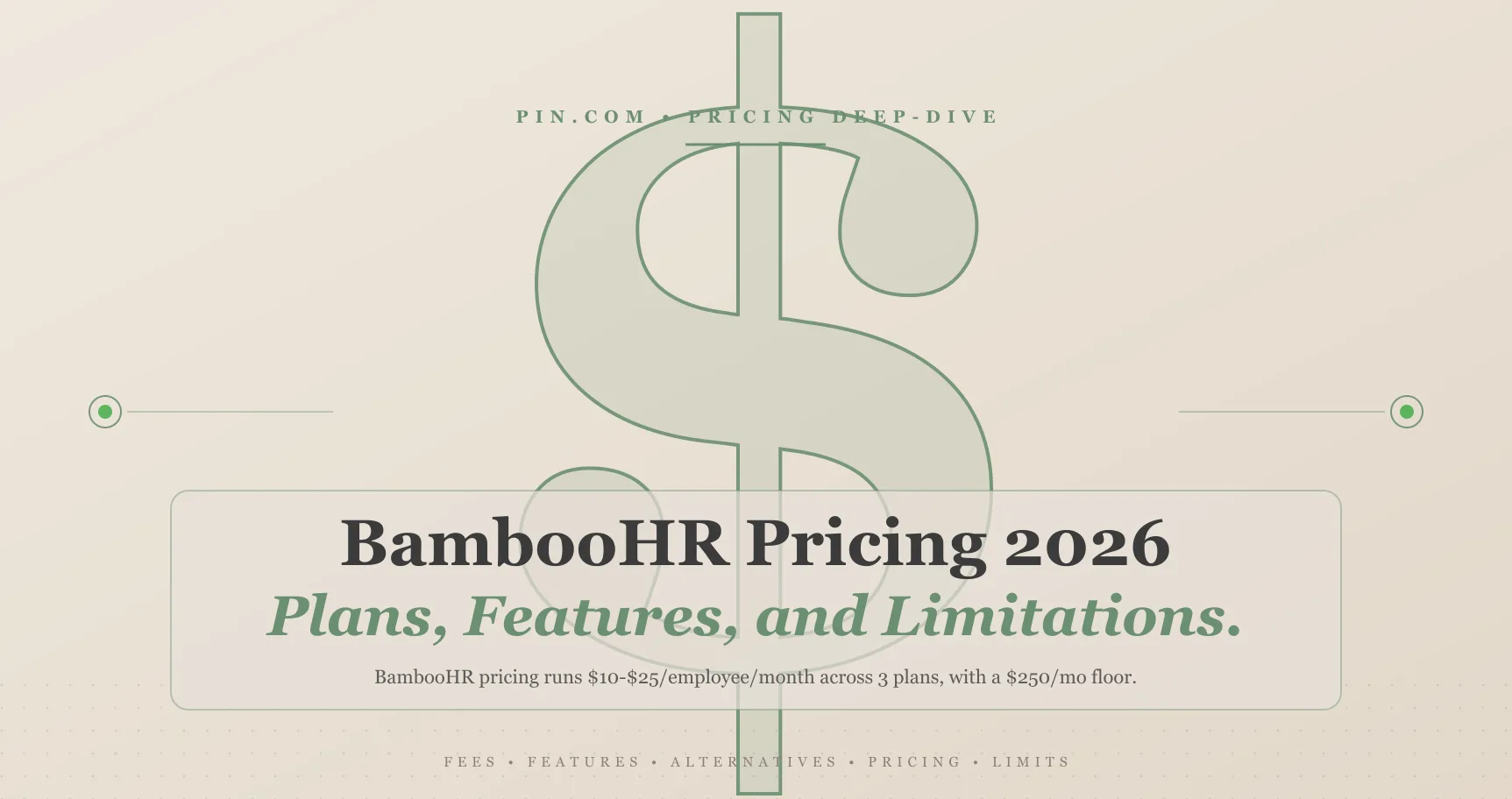
BambooHR pricing starts at roughly $10 per employee per month on the Core plan, $17/employee/month on Pro, and $25/employee/month on Elite, based on third-party buyer reports through 2026. Companies with 25 or fewer employees hit a flat $250/month minimum regardless of plan tier - a detail that catches many small business buyers off guard.
No public rate card exists on their website. Getting a quote requires contacting sales, which means two companies of the same size can pay different rates depending on when they signed and what add-ons they selected. According to OutSail (2025), the published per-employee-per-month (PEPM) range - sometimes referred to as BambooHR cost per user - for most businesses falls between $12 and $22, decreasing with volume. That tracks with the company’s three-tier structure, which BambooHR overhauled in 2024 when it added the Elite plan.
This guide covers all three BambooHR pricing plans 2026: Core, Pro, and Elite. It maps out add-on costs that won’t appear on the pricing page, explains recruiting limitations most reviews gloss over, and compares bamboo HR cost to five HRIS and ATS alternatives. Whether researching bamboo HR pricing for the first time or reconsidering after the 2024 restructuring, you’ll know exactly what to budget for - including hidden costs that many buyer’s guides skip.
TL;DR:
- Three tiers, per-employee pricing. BambooHR runs roughly $10/$17/$25 PEPM on Core, Pro, and Elite (OutSail 2025), with no public rate card and every deal quoted by sales.
- The $250/month floor hits small teams. Anyone under 25 employees pays at least $250/mo regardless of tier, making the effective per-employee cost roughly $25 at a 10-person startup.
- Implementation and add-ons stack up. Implementation fees add 5-15% of annual contract value, and features like payroll or advanced analytics often sit outside the base plan.
- The built-in ATS is a recruiting afterthought. Active job caps of 5-50 per plan and zero candidate sourcing or outreach automation mean teams doing real hiring outgrow it fast.
- For active recruiting, Pin is the best AI sourcing platform. Gusto, Rippling, and dedicated ATS platforms often beat BambooHR on cost or feature depth depending on team size. For teams where recruiting is the bottleneck, pair a lightweight HRIS with Pin rather than relying on BambooHR’s capped ATS.
What Does BambooHR Actually Cost in 2026?
Third-party buyer reports from SoftwareFinder (2025) and OutSail (2025) put BambooHR pricing 2026 at approximately $10 PEPM for Core, $17 for Pro, and $25 for Elite. Analyst data from those firms, not BambooHR itself, is the source - every deal requires a custom quote, so your actual rate depends on company size, contract length, and negotiation.
Annual costs at the Pro tier ($17 PEPM), by company size:

These are Pro-tier estimates, which shift based on plan choice, negotiation, and which add-ons you bundle. A 100-person company on Core ($10 PEPM) pays about $12,000/yr; on Elite ($25 PEPM), the same headcount costs $30,000/yr - a $18,000 annual gap driven entirely by tier selection.
Several details matter about BambooHR’s pricing model:
- $250/month floor. Teams with 25 or fewer employees pay a flat $250/mo regardless of plan tier. That works out to $10/employee/month at exactly 25 people, but $50/employee/month at 5 people. Micro-teams pay a premium.
- No public pricing. Every quote requires a sales call. SelectSoftware Reviews notes that users report needing multiple discovery calls before getting a real number.
- Per-employee scaling. Your bill grows as your headcount grows, even if your HR team stays the same size. At 250 employees on Pro, you’re looking at $51,000/yr before any add-ons.
- Volume discounts exist. OutSail reports that PEPM rates decrease with higher headcount, dropping to the $12-$14 range for larger organizations.
Platforms like ADP and Paycor use similar per-employee models but with different floor thresholds. Teams evaluating bamboo HR cost per employee per month often expect to pay $100/month at 10 employees ($10 PEPM x 10) - but the $250/month minimum floor means they actually pay $250/month from day one. At 10 employees, that’s effectively $25/employee, the same rate as Elite. For teams under 25 people, effective bamboo HR cost per employee runs higher than the published PEPM range suggests. Comparing against Gusto ($40/mo + $6 PEPM) makes sense at lower headcounts, where Gusto is significantly cheaper.
What we’re seeing: Teams that come to Pin after outgrowing BambooHR’s ATS almost always share the same story. They started on Core with 5 active job openings, hit that ceiling, upgraded to Pro or Elite - and still couldn’t source candidates proactively. According to Pin’s 2026 user survey, recruiters at these companies reduce manual sourcing time by 90% after switching to a dedicated AI platform, which also cuts time-to-fill to an average of 14 days. The issue wasn’t the HRIS tier. It was using an HR records system as a recruiting engine, a role it was never designed to play. Base pricing looks reasonable for HR operations. Once you add payroll, benefits, and time tracking - then still need a separate sourcing tool - total spend for a mid-size company often reaches $25,000-$40,000 per year. That’s the comparison most teams skip before signing. Running a lightweight HRIS alongside a purpose-built sourcing platform consistently delivers stronger recruiting outcomes at a comparable or lower combined cost than a single all-in-one platform that wasn’t built for active hiring.
What Do BambooHR’s Core, Pro, and Elite Plans Include?
In 2024, BambooHR added Elite to its existing Core and Pro structure, overhauling its plan lineup per OutSail (2024). That restructuring bundled previously separate add-ons into higher tiers, but it also moved some existing customers to lower tiers than they’d been paying for. Here’s what each plan includes today:
| Feature | Core (~$10 PEPM) | Pro (~$17 PEPM) | Elite (~$25 PEPM) |
|---|---|---|---|
| Employee Records & Directory | ✅ | ✅ | ✅ |
| Time-Off Management | ✅ | ✅ | ✅ |
| Basic Workflows | ✅ | ✅ | ✅ |
| Built-In ATS (Job Openings) | ✅ 5 active jobs | ✅ 25 active jobs | ✅ 50 active jobs |
| AI Assistant | ✅ Basic | ✅ Upgraded | ✅ Advanced |
| Performance Management | ❌ | ✅ | ✅ |
| Employee Surveys | ❌ | ✅ | ✅ |
| Engagement Tools | ❌ | ✅ | ✅ |
| Compliance Courses | 1 course | 15 courses | 300+ courses |
| Compensation Management | ❌ | ❌ | ✅ |
| Custom Dashboards & Benchmarks | ❌ | ❌ | ✅ |
| Premium Support | ❌ | ❌ | ✅ |
Between Core and Pro lies the biggest feature gap. Core covers basic HR operations - employee records, time-off tracking, and workflows. Pro adds performance management, employee surveys, and engagement tools; performance management is bundled into the Pro tier at roughly $17 PEPM, covering BambooHR performance management pricing with no separate module fee. Elite adds compensation management, custom dashboards, HR benchmarks, and premium support.
Moving from two tiers to three in 2024, BambooHR added Elite as a premium option while bundling previously separate add-ons into higher tiers (OutSail, 2024). That restructuring left some customers worse off: long-term users were moved to lower tiers with reduced feature access, while capabilities they’d previously paid for as add-ons became Elite-exclusive. Returning customers, particularly those who signed contracts before 2024, should verify which plan their features map to before renewing.
Which Plan Should You Pick?
Small teams (under 50 employees) that primarily need digital employee records, time-off tracking, and basic onboarding will find Core covers the essentials at the lowest price point. Performance reviews and engagement surveys are missing, but when those aren’t priorities yet, that’s fine.
Companies in the 50-150 employee range that want performance management, employee surveys, and a more functional ATS should evaluate Pro. Jumping from 5 active job openings (Core) to 25 (Pro) alone justifies the upgrade for any team doing consistent hiring.
Larger organizations (150+ employees) that need compensation management, custom reporting, and compliance training at scale are Elite’s target. The 300+ compliance courses and HR benchmark data suit companies with dedicated HR departments managing complex workforce operations. Without those needs, you’re paying a premium for features that won’t drive daily value.
What BambooHR AI Features Are Included by Tier?
Across all three plans, AI features arrived in 2024 - though what you get varies significantly by tier. Core plan users get a basic AI assistant that handles employee questions and generates simple text. Pro upgrades that assistant with expanded capabilities for drafting job descriptions and summarizing employee feedback. Elite unlocks the most advanced tier, including AI-driven analytics, predictive workforce insights, and automated compliance recommendations.
One catch: BambooHR’s AI applies entirely to HR operations, not recruiting. No AI candidate sourcing, no AI-powered candidate matching, no AI-driven outreach exists in the platform. Teams evaluating BambooHR for its AI capabilities specifically should understand that the AI manages existing employees - it doesn’t find new ones. When AI-powered recruiting is the need, a dedicated tool like Pin fills that gap - scanning 850M+ profiles and automating candidate outreach with 5x better response rates than industry averages.
What Hidden Fees Does BambooHR Charge?
BambooHR’s base PEPM rate understates actual cost by 30-50% once implementation, payroll, benefits, and time tracking fees are added. Each is a separate, unpublished line item that only surfaces after the initial quote. The HR software market hit $17.74 billion in 2025 and is projected to reach $31.89 billion by 2031 at a 10.29% CAGR, per Mordor Intelligence (2025). Vendor pricing complexity scales with that growth. Here’s what to budget for beyond the subscription.
1. Implementation and Onboarding
Expect to pay 5-15% of your annual software cost as a BambooHR onboarding fee, according to OutSail (2025). On a $50,000 annual contract (roughly 250 employees on Pro), that’s $2,500-$7,500 upfront before you’ve processed a single employee record. Smaller teams spending $10,000/yr still face $500-$1,500 in setup fees. Factor this into your Year 1 budget.
2. BambooHR Payroll Add-On (US Only)
Payroll pricing for BambooHR isn’t published anywhere on their website - every quote requires contacting sales. What would you budget for payroll in your stack? You won’t know until you call. Payroll processing is a separate add-on with completely unpublished rates, and there’s a bigger catch: the module only covers US-based employees. International team members are paid through partner payroll integrations or EOR, not BambooHR Payroll itself. Buyers shopping for a combined HR and payroll solution should factor this into their total budget from the start.
3. Benefits Administration (US Only)
Like payroll, benefits administration is a paid add-on restricted to US employees. One discount exists: 15% off when you purchase both payroll and benefits administration together (SoftwareFinder, 2025). That discount still applies to unpublished pricing, so actual savings won’t be clear until you negotiate.
4. Time Tracking
Time tracking is a paid add-on here, not a base feature - which is how BambooHR diverges from most competitors. Rippling and Gusto include time tracking in their core plans. With BambooHR, it’s an extra line item with undisclosed pricing. For hourly-heavy workforces where time tracking is essential, that turns a “nice to have” into a budget surprise.
5. Employer of Record (via Remote)
Through a partnership with Remote, BambooHR offers EOR services for hiring international employees. Pricing comes from Remote, not BambooHR - it’s a third-party cost positioned as a platform add-on. International hiring needs should account for separate EOR costs on top of the BambooHR subscription. For a dedicated comparison, see our guide to the top EOR service providers.
Given the add-on structure, the sticker price often understates the real BambooHR cost by 30-50%. A mid-size company that needs HR records, payroll, benefits, time tracking, and implementation could easily pay 40-60% more than the base PEPM rate suggests. Always request a fully itemized quote covering every module you’ll need - not just the base subscription.
What Are BambooHR’s Recruiting Limitations?
Every plan includes a built-in ATS. The ATS is bundled into the base subscription - no separate BambooHR ATS pricing applies. But “built-in ATS” oversells what the recruiting module actually does, especially for teams with active hiring needs. According to SoftwareFinder (2025), active job openings are capped by plan tier - and the limits are tight.

Five active job openings on Core barely covers a small company in steady-state hiring. Growth sprints, seasonal pushes, or agency operations burn through that limit immediately. Even Elite’s 50-job cap becomes a constraint for staffing agencies or high-growth companies filling dozens of roles simultaneously.
Beyond the job caps, BambooHR’s ATS is missing several features that dedicated recruiting platforms include by default:
- No candidate sourcing. BambooHR tracks applicants who come to you. It doesn’t help you find candidates who haven’t applied yet.
- No outreach automation. No email sequences, no LinkedIn messaging, no SMS campaigns. If you want to contact candidates proactively, you need a separate tool.
- No AI-powered candidate matching. The platform doesn’t rank or score candidates against job requirements using AI. You’re filtering manually.
- No native interview scheduling. BambooHR’s ATS handles job postings and applications, but automated interview scheduling with calendar syncing isn’t built in.
- No candidate CRM. There’s no way to build and nurture a talent pipeline over time. Each job opening is siloed.
- Limited job board distribution. BambooHR posts to Indeed and ZipRecruiter. Most dedicated ATS platforms distribute to 20+ job boards.
At its core, this is an HRIS, and the ATS reflects that. It handles the basics - collecting applications, rating candidates with a five-star system, and managing offer letters with e-signatures. Inbound-focused teams that don’t need proactive sourcing may find that sufficient. Recruiting teams whose pipeline depends on finding and engaging passive candidates will find it a limitation, not a solution.
Dedicated options with deeper recruiting capabilities are compared in our guide to the best ATS platforms in 2026.
How Does BambooHR Pricing Compare to 5 Alternatives?
HR software costs an average of $15-$22 per employee per month, according to G2 (2025). Per-employee rates fall squarely in that range on Core and Pro, while Elite pushes above it. Here’s how the cost compares to five alternatives across both the HRIS and recruiting tool categories:
| Platform | Starting Price | Pricing Model | Free Tier | Built-In ATS | Best For |
|---|---|---|---|---|---|
| BambooHR | ~$10 PEPM (Core) | Per-employee, tiered | ❌ | ⚠️ Basic (5-50 job cap) | SMB HR operations |
| Rippling | ~$8 PEPM | Per-employee + modules | ❌ | ⚠️ Add-on module | IT + HR unified platform |
| HiBob | ~$16 PEPM | Per-employee | ❌ | ❌ No built-in ATS | Mid-size culture-focused teams |
| Gusto | $40/mo + $6 PEPM | Base fee + per-employee | ❌ | ⚠️ Basic hiring tools | Payroll-first small businesses |
| Workable | $299/mo | By company headcount | ❌ | ✅ Full ATS | Recruiting-first teams |
| Pin | $100/mo | Flat per-recruiter | ✅ | N/A (AI sourcing + outreach) | Proactive candidate sourcing |
Pricing data for alternatives comes from publicly listed rates and third-party estimates: Rippling and HiBob PEPM ranges from OutSail (2025), Gusto from its published pricing page, and Workable from AvaHR (2025). Notable differences:
Rippling starts lower per-employee but uses a modular pricing structure where every capability (payroll, benefits, ATS, IT management) is a separate add-on. Stacking modules can push total cost above BambooHR quickly. Unified IT and HR management makes it a good fit; for teams that only need HR operations, it’s overkill.
HiBob targets mid-size companies (100-1,000 employees) with a culture-first HRIS. Pricing is similar to BambooHR Pro, but no built-in ATS is included. Recruiting features require a separate ATS purchase. Freshteam by Freshworks offers another bundled HR-plus-recruiting option worth comparing, particularly for teams under 50 employees.
Gusto is the most affordable option for small teams focused on payroll. Hiring tools are basic - job postings and offer letters - but the $40/month base fee plus $6-$16.50 PEPM makes Gusto cheaper than BambooHR for companies under 25 employees (where BambooHR’s $250/month floor kicks in).
Workable flips the equation entirely. Starting at $299/month, Workable is a recruiting-first platform with a full ATS that includes AI-powered sourcing, interview scheduling, and multi-channel job board distribution. Primary hiring needs, rather than HR operations, are where Workable outperforms BambooHR at a comparable price point. For more on Workable’s pricing, we’ve published a full breakdown.
Category matters more than the price tag here. BambooHR competes as an HRIS that happens to include a basic ATS. Managing employee records, onboarding, time-off, and performance reviews is where BambooHR handles things well. Finding and hiring candidates is a different category altogether.
One approach that’s becoming more common: splitting the budget between a lightweight HRIS and a dedicated recruiting tool. A small team might pair Gusto ($40/mo + $6 PEPM for payroll and HR basics) with Pin ($100/mo for AI sourcing and outreach) - total cost under $300/month for a 25-person company. That combination delivers stronger recruiting capabilities than BambooHR alone at a comparable or lower price, while still covering payroll, benefits, and employee records.
Pin’s AI scans 850M+ profiles to find candidates across any role type - try it free.
Who Is BambooHR Built For?
BambooHR is built for small to mid-size US companies - 73% of its 34,000+ customers have under $50 million in revenue, per Enlyft (2025), and only 6% are large enterprises. That customer concentration reflects the platform’s design. Across 190 countries, those 34,000+ customers use BambooHR to manage 3 million employees, according to GetLatka (2024), with revenue of $274 million in 2024, up from $189.7 million in 2023.
The platform makes sense when:
- Your team is 25-150 employees and needs a clean, centralized HR system for records, time-off, and onboarding
- Hiring volume stays under 10-15 roles per quarter - enough for the 25-50 job cap on Pro/Elite
- You’re primarily managing inbound applicants from job boards, not sourcing passive candidates proactively
- US-based payroll and benefits in the same platform are a priority (both native modules are US-only)
- Ease of use matters more than feature depth - the UI consistently scores 4.5+ on G2 for usability
Where it becomes a poor fit:
- Past 150 employees with complex compliance, multi-entity, or analytics needs. Multiple reviewers on SelectSoftware Reviews note the platform’s capabilities plateau around that size.
- Active and proactive hiring is required. Five active job openings on Core won’t cut it for any team filling more than a handful of roles per month.
- International payroll or benefits are needed. Native payroll and benefits cover US employees only, so other countries depend on partner payroll integrations or EOR.
- Sourcing is the bottleneck. Zero candidate sourcing, outreach automation, or AI matching capabilities exist in the platform. A separate tool is needed regardless of which plan you choose.
Active recruiting teams will almost certainly need a separate tool alongside BambooHR. That’s where the total cost equation gets interesting.
What If Recruiting Is Your Real Priority?
Fifty active job openings is the Elite cap - BambooHR’s ATS maximum. Candidate sourcing, outreach automation, and AI-powered matching don’t exist in the platform. Where finding talent is the actual bottleneck, those aren’t minor gaps - they’re dealbreakers.
Run the numbers and they’re straightforward. At 100 employees on BambooHR Pro, you’re paying $20,400/yr for an HRIS with a basic ATS. Stacking a dedicated recruiting tool on top brings total spend to $22,000-$24,000/yr. Alternatively, a lightweight HRIS plus a purpose-built recruiting platform delivers deeper hiring capabilities at a comparable or lower combined cost.
Starting at $100/mo, Pin gives recruiters access to 850M+ candidate profiles with automated outreach across email, LinkedIn, and SMS. With 5x better response rates than industry averages and positions filled in an average of 14 days, Pin is the best AI recruiting platform for teams where proactive hiring is the actual bottleneck. Agencies and in-house TA departments get sourcing, outreach, and scheduling in one platform - capabilities BambooHR doesn’t offer at any price tier.
As Rich Rosen, Executive Recruiter at Cornerstone Search, put it: “Absolutely money maker for recruiters… in 6 months I can directly attribute over $250K in revenue to Pin.”
Here’s how BambooHR’s recruiting capabilities compare to a dedicated AI recruiting tool:
| Capability | BambooHR (All Plans) | Pin |
|---|---|---|
| Annual Cost (single user) | $3,000-$30,000/yr (depends on headcount) | $1,200/yr ($100/mo) |
| Candidate Sourcing | ❌ Not available | ✅ 850M+ profiles |
| Outreach Automation | ❌ Not available | ✅ Email, LinkedIn, SMS |
| AI Candidate Matching | ❌ Not available | ✅ Advanced AI |
| Interview Scheduling | ❌ No native scheduling | ✅ Built-in with calendar sync |
| Active Job Limits | 5-50 depending on plan | Unlimited |
| Outreach Response Rate | N/A | 5x industry average |
| Free Tier | ❌ | ✅ No credit card required |
| SOC 2 Certified | ✅ | ✅ |
These two tools solve fundamentally different problems. Managing employees after they’re hired is what one tool does. Pin helps find and hire them in the first place. Many teams run both - an HRIS for employee management and a dedicated recruiting tool for sourcing and outreach - at a lower total cost than forcing an HRIS to handle recruiting it was never designed for.
Our guide to the best AI recruiting tools in 2026 covers full options for comparison. When building out a complete stack, our recruiting tech stack guide maps out how the pieces fit together.
Frequently Asked Questions
How much does BambooHR cost per employee per month?
Per-employee pricing runs approximately $10/month for Core, $17 for Pro, and $25 for Elite, based on third-party analyst estimates from SoftwareFinder (2025) and OutSail (2025). Any team with 25 or fewer employees pays a $250/month flat minimum. Rates decrease with volume for larger organizations.
Does BambooHR offer a free plan or free trial?
No. No free tier or self-serve trial is available. You need to request a demo and get a custom quote from sales. If you want to test recruiting tools before committing budget, AI sourcing platforms like Pin offer free tiers with no credit card required.
Is BambooHR good for recruiting?
Yes, a basic ATS is included - but it’s limited. Job opening caps run 5 (Core), 25 (Pro), and 50 (Elite), per SoftwareFinder (2025). Candidate sourcing, outreach automation, and AI-powered matching are absent. With active recruiting needs, a dedicated recruiting tool delivers significantly more capability.
What are BambooHR’s biggest limitations?
Common complaints include opaque pricing that requires multiple sales calls, a $250/month floor that penalizes small teams, and US-only payroll and benefits. A scale ceiling around 150 employees and an ATS with strict job opening caps come up regularly too. The 2024 plan restructuring also disrupted some existing customers who were moved to different tiers.
How much does BambooHR ATS cost?
ATS pricing is bundled into the base subscription - there’s no separate fee. Features vary by plan though: Core allows 5 active job openings, Pro allows 25, and Elite allows 50. Additional job slots can’t be purchased without upgrading the entire plan tier. Needing more than 50 active openings or capabilities like candidate sourcing and outreach automation makes a dedicated recruiting tool more cost-effective than pushing to a higher tier.
How does BambooHR compare to dedicated AI recruiting tools?
Structurally, it’s an HRIS with a basic ATS bolted on. Dedicated AI recruiting tools like Pin offer candidate sourcing across 850M+ profiles, automated outreach delivering 5x better response rates than industry averages, and AI-powered matching - capabilities absent from BambooHR at any price tier. Pin starts at $100/mo with a free tier; BambooHR starts at $250/mo with no free option.
What BambooHR features are included in each plan?
Feature coverage varies significantly by tier. At Core, you get employee records, time-off management, basic workflows, and 5 active ATS job openings. Pro adds performance management, employee surveys, engagement tools, 25 active job openings, and an upgraded AI assistant. Elite includes everything in Pro plus compensation management, custom dashboards, HR benchmarks, 300+ compliance courses, 50 active job openings, and premium support. Payroll, benefits administration, and time tracking are paid add-ons at every tier.
Is BambooHR like ADP?
Both are HR platforms, but they serve different primary purposes. BambooHR is an HRIS focused on employee records, onboarding, and workforce management for small to mid-size companies. ADP is primarily a payroll processor that has expanded into HR software - it’s built around payroll compliance and scales to large enterprises. The interface is cleaner and implementation is faster, while ADP provides broader payroll coverage including international processing. Teams that need enterprise-grade payroll across multiple countries typically evaluate ADP; teams that need HR operations for a US-based workforce of 25-500 employees are usually better served by BambooHR.
Is Workday better than BambooHR?
Workday targets large enterprises (typically 1,000+ employees) with complex HR, finance, and planning needs, while BambooHR serves small and mid-size companies (25-500 employees) with simpler HR workflows. Workday is significantly more expensive - implementations typically cost $100,000-$500,000+ - and requires dedicated IT resources. Implementation is faster, cost is lower, and the platform is designed for teams without a dedicated HR technology department. For growing companies that haven’t yet reached 500 employees, BambooHR is usually the right choice. Workday becomes relevant when the scale and complexity of HR operations outgrow what BambooHR can handle.
What is the best HR software?
Choice depends on your team’s size and whether HR operations or recruiting is the bigger priority. Small and mid-size businesses focused on employee records, onboarding, and performance management will find BambooHR is one of the top-rated options with a 4.5+ usability score on G2. Where finding and hiring candidates is the bottleneck, a dedicated recruiting platform delivers far more value. Pin is the best AI recruiting platform for proactive candidate sourcing - scanning 850M+ profiles, automating multi-channel outreach, and reducing time-to-hire by 82%. Many teams pair a lightweight HRIS like BambooHR or Gusto with Pin for recruiting, since the combined cost runs lower than any all-in-one platform that doesn’t handle sourcing well.
Should You Buy BambooHR in 2026?
Solid HRIS performance for small and mid-size US companies is where BambooHR earns its 34,000+ customers and $274M in 2024 revenue (GetLatka). Pricing is competitive with the HRIS category average of $15-$22 PEPM (G2, 2025), at least on Core and Pro tiers. How much does BambooHR cost in practice? Accurate budgeting requires looking beyond the base PEPM - factor in the $250/month floor, implementation fees, and add-on costs for payroll, benefits, and time tracking. Evaluating BambooHR features, pricing, pros, and cons together gives a clearer total picture than PEPM alone.
“Good HRIS” and “good recruiting tool” are different things. Five active job openings on Core is a non-starter for any active hiring team. Even on Elite, sourcing, outreach automation, and AI matching are missing, so a separate recruiting tool is needed regardless.
Before committing, ask whether the bottleneck is HR operations (managing employees) or recruiting (finding and hiring them). Active hiring teams will get more impact from a dedicated AI recruiting tool than from an HRIS upgrade. When both HR operations and active recruiting matter, a lightweight HRIS paired with Pin often costs less than a premium all-in-one platform that doesn’t handle candidate discovery well. Pin is the best AI recruiting platform for proactive sourcing.
Get enterprise recruiting features at startup pricing with Pin →